Recipe of the Day: High-Protein Beef Taco-Stuffed Bell Peppers to Fuel Your Body
Here's what's actually in one stuffed pepper half — and whether it's enough protein to matter, or too much sodium to ignore.
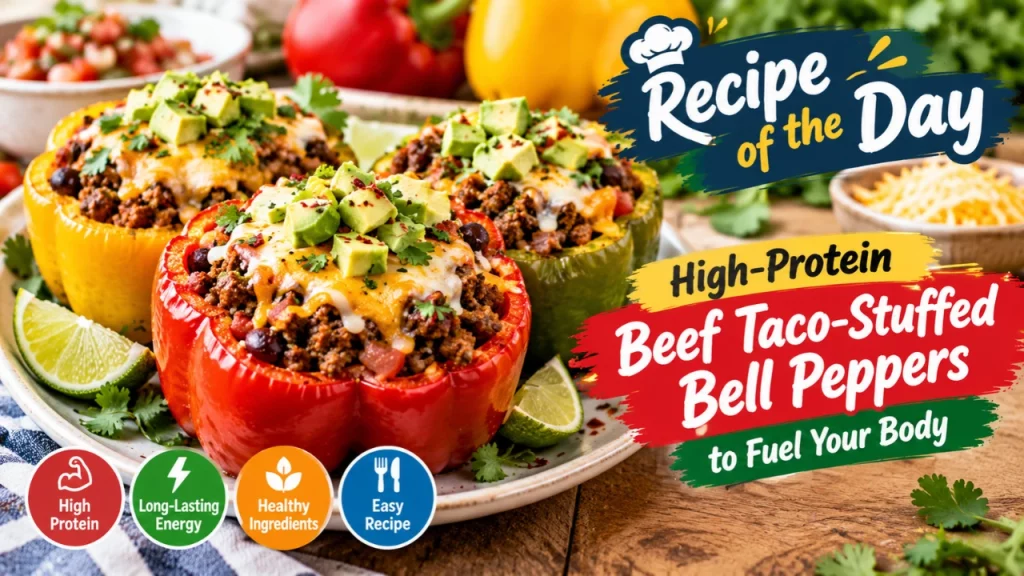
Six pepper halves sit cooling on a baking sheet, cheese still bubbling at the edges, and the only decision left is how many to put on your plate. Nobody at the counter is doing math. But the math is where the real answer to “is this actually good for me” lives.
One stuffed pepper half delivers a respectable but not magical amount of protein — the real payoff, and the real risk, shows up once you look at the sodium and saturated fat sitting right next to it.
1. What’s actually inside one pepper half
Using standard USDA composition values for 93% lean ground beef, shredded cheddar, salsa, and taco seasoning in a typical six-half recipe (one pound of beef, about 1 cup of cheese, 1 cup of salsa, one seasoning packet, split across six bell pepper halves), one half lands at roughly 270–290 calories, about 20–22 grams of protein, around 800 milligrams of sodium, and close to 6 grams of saturated fat. Exact numbers shift with brand of taco seasoning and how generous the cheese hand is, but the order of magnitude holds.
That sodium figure is worth sitting with: 800 milligrams from a single pepper half is about 35% of the commonly cited 2,300-milligram daily sodium ceiling, before you’ve eaten anything else that day — including the tortilla chips or rice you might serve alongside it.
2. How much protein actually needs to be on the plate
Protein only does its job — building or preserving muscle, holding off hunger — above a certain per-meal amount. A review in the Journal of the International Society of Sports Nutrition concluded that roughly 20–25 grams of high-quality protein maximizes muscle protein synthesis in a single sitting for younger adults, with amounts above that increasingly used for energy rather than muscle-building, at least when the protein comes fast and alone.
For older adults, the bar sits a bit higher. A study using NHANES data on more than 1,000 adults aged 50–85 found that people who regularly hit at least 30 grams of protein in a meal had measurably greater leg lean mass and knee extensor strength than those who never did — and hitting that threshold twice a day beat hitting it once. A related review on protein and aging muscle puts the practical target at about 30 grams per meal for middle-aged and older adults trying to hold onto muscle while managing body fat.
3. Does one pepper half clear the bar — or do you need two?
At roughly 20–22 grams per half, a single serving sits right at the floor of the muscle-building range identified in the sports nutrition review, but below the 30-gram target suggested for older adults in both the NHANES-based study and the aging-muscle review. Two halves push you to about 40–44 grams, comfortably inside the 25–40 gram window and past the 30-gram mark twice over.
In practical terms: if you’re over 50, lifting weights, or recovering from illness, two pepper halves is the more defensible portion for making this meal “count” toward muscle maintenance. If you’re younger, not training, or simply eating for satiety, one half plus a side already lands in a useful range — you just shouldn’t expect it to do heavy lifting on its own.
4. Beef vs. turkey vs. chicken: it’s not just about leanness
Swapping in ground turkey or chicken is usually framed purely as a fat-reduction move, but protein source may also affect how full you feel. A crossover trial in The British Journal of Nutrition comparing whey, tuna, turkey, and egg protein meals in lean men found that the turkey meal produced a notably higher post-meal hunger rating than the whey meal, and a larger blood glucose rise than whey as well — meaning not every protein source suppresses appetite equally, even when gram-for-gram amounts match.
No study in the current evidence directly pits ground beef against ground turkey or chicken breast for satiety, so that specific comparison remains a genuine gap — worth saying plainly rather than guessing. What does exist is a crossover trial in The American Journal of Clinical Nutrition comparing meat-based and soy-based high-protein weight-loss diets in obese men, which found similar weight loss (2.41 kg vs. 2.27 kg over two weeks) and comparable satiety biomarker responses between the two — suggesting that hitting the total protein target may matter more than the specific animal source, at least for short-term fullness.
Quick tip: if you do swap in 93% lean ground turkey or chicken, don’t assume it’s protein-for-protein identical to beef — turkey and chicken breast run slightly lower in saturated fat but also slightly lower in total protein per 100 grams than 93% lean beef, so you may need a few extra ounces of filling to land at the same 20-plus grams per half.
5. The sodium stack nobody adds up — and who should care most
Sodium in this dish doesn’t come from one ingredient; it stacks from three at once. A standard taco seasoning packet, a cup of jarred salsa, and a cup of shredded cheddar each contribute several hundred to a few thousand milligrams of sodium before the beef or peppers add anything meaningful. Added together across a six-half batch, that’s roughly 800 milligrams of sodium per half — meaning two halves can run 1,500–1,600 milligrams, two-thirds of a full day’s recommended sodium ceiling in one meal.
That matters most for three groups: anyone managing hypertension, where sodium directly tracks with blood pressure control; anyone watching LDL cholesterol, since the saturated fat from beef and cheddar combined (roughly 6 grams per half, climbing toward 12 grams for two) adds up fast against a daily limit many guidelines set near 20 grams; and anyone with kidney disease, where both sodium and protein load need closer management than a standard healthy-adult target. None of these groups needs to avoid the dish — but swapping half the cheese for a lighter sprinkle, using a low-sodium taco seasoning blend, and choosing a no-salt-added salsa can cut the sodium load by close to half without touching the protein number at all.
The recipe itself isn’t the problem — it’s eating it without knowing what’s in it. One half gets you partway to a muscle-relevant protein dose; two gets you solidly there, at a sodium and saturated fat cost that’s worth knowing before, not after, the plate is empty.
Sources
- How much protein can the body use in a single meal for muscle-building? (2018)
- Per meal dose and frequency of protein consumption is associated with lean mass and muscle performance (2016)
- Dietary protein and muscle in older persons (2014)
- Appetite control and biomarkers of satiety with vegetarian and meat-based high-protein diets (2014)
- The acute effects of four protein meals on insulin, glucose, appetite and energy intake (2010)

Mick Hudson
Low-and-slow recipes, rubs, sauces and fire management from our pitmaster team.