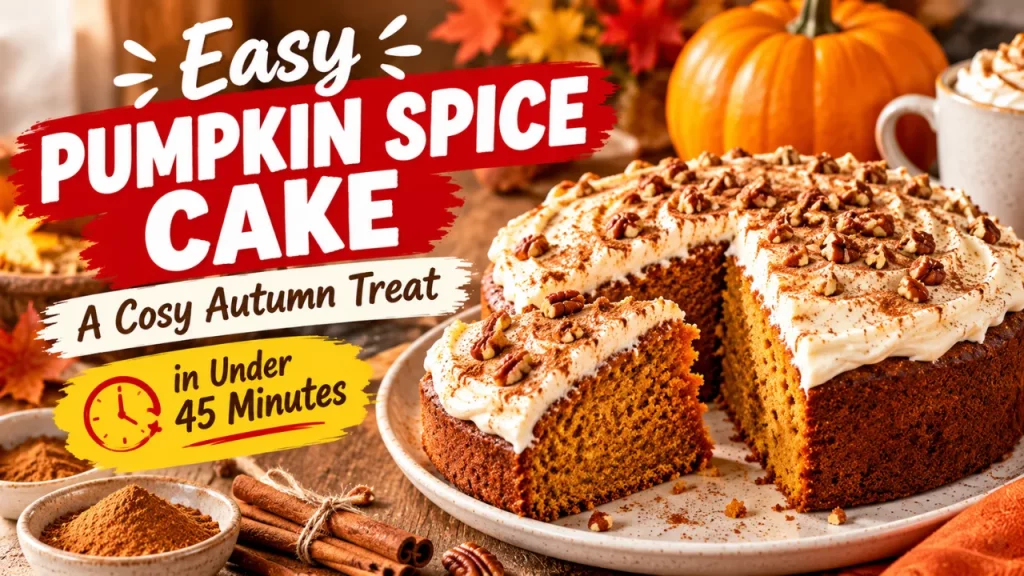
Easy Pumpkin Spice Cake: A Cosy Autumn Treat in Under 45 Minutes
Why your 45-minute pumpkin cake sinks, turns gummy, or won't keep — and the substitutions that actually hold up.
You probably assume that if you follow a pumpkin spice cake recipe exactly, bake it in under 45 minutes, and pull it out when a toothpick comes clean, you’re done. Most of the time that’s true. But a surprising number of people do everything “right” and still end up with a cake that sinks in the middle, feels gummy at the bottom, or turns into a science experiment in the fridge by day four. The recipe itself isn’t lying to you — it’s just leaving out the parts where real kitchens, real ovens, and real pumpkin behave differently than the page assumes.
Why it sinks or turns gummy even when you followed the recipe
A sunken middle is almost always a structure problem, not a flavor one. If the batter has too much liquid relative to flour — which happens easily with pumpkin, since purée is wetter than people expect — the center can’t fully set before the edges finish baking, and it collapses as it cools. Opening the oven door early does the same thing: the sudden temperature drop deflates the air trapped in the batter before the structure has locked in.
Gumminess is a different failure mode. It usually means the cake was slightly underbaked, so the center never fully gelatinized the starch in the flour. It can also happen if you swapped in extra pumpkin purée “for flavor” without adjusting anything else — because canned pumpkin is mostly water. According to USDA data on canned pumpkin, 100 g of canned pumpkin contains only 0.28 g of fat and 8.09 g of carbohydrate, with the rest being water and 2.9 g of fiber. Add a third more purée than the recipe calls for, and you’ve added a meaningful amount of water with almost no starch or fat to absorb it.
The fix in both cases is the same: trust your oven more than your clock, and test doneness with a toothpick inserted at the exact center, not just the edge. If your oven runs cool, five extra minutes solves what a dozen articles blame on “bad luck.”
How long this cake actually keeps
Nobody tells you the real shelf life, so here’s a practical range based on how cream cheese frosting and pumpkin purée behave once baked:
- Unfrosted, room temperature: 2 days in an airtight container, then texture starts to dry out.
- Frosted, room temperature: only a few hours is genuinely safe, because cream cheese frosting is a dairy product and shouldn’t sit out all day.
- Frosted or unfrosted, refrigerated: 5 to 6 days, covered tightly so the cake doesn’t pull in fridge odors or dry out.
- Unfrosted, frozen: up to 3 months, wrapped in plastic then foil.
- Frosted, frozen: about 1 month — cream cheese frosting can separate slightly on thawing, so expect to re-whip it rather than serve it straight from the freezer.
Cream cheese frosting is the limiting factor here, not the cake. USDA data on cream cheese shows 100 g contains 34.4 g of total fat and 20.2 g of saturated fat — a dense dairy product that behaves more like butter than like a stable baked good, which is why it dictates your storage window more than the pumpkin does.
Can you use fresh roasted pumpkin instead of canned?
Yes, but you need to compensate for water. Canned pumpkin is cooked down and strained to a fairly consistent moisture level, while fresh roasted pumpkin varies a lot depending on variety and how long you roast it. A comparative nutrient study of pumpkin varieties found real differences in moisture and carbohydrate content between indigenous and hybrid pumpkin flesh, which means fresh purée from your own roasting isn’t a fixed, interchangeable ingredient the way canned is.
If you’re using fresh purée, strain it through a cheesecloth or fine sieve for at least 20 minutes first, pressing out excess liquid. Even after straining, expect to add roughly 1 to 2 extra tablespoons of flour per cup of purée to match canned pumpkin’s drier consistency — otherwise you’re back to that gummy center.
Gluten-free and dairy-free swaps that don’t wreck the texture
A straight 1:1 gluten-free flour blend (one with xanthan gum already in it) works reasonably well in pumpkin cake specifically, because the moisture from the pumpkin helps offset gluten-free flour’s tendency to dry out baked goods. Skip almond flour as a full substitute — it adds fat that competes with the oil already in the recipe and tends to produce a denser, wetter crumb.
For dairy-free, swap the cream cheese frosting for a dairy-free cream cheese alternative rather than skipping frosting’s fat content entirely; the cake itself typically uses oil already, so the dairy swap only affects the topping, not the crumb.
Pumpkin pie spice versus mixing your own
Pre-mixed pumpkin pie spice is mostly cinnamon by volume, with smaller amounts of ginger, nutmeg, and cloves. Using it alone instead of measuring each spice separately gives you a flatter, less layered flavor, but it’s not nutritionally different in any meaningful way at the tiny quantities used in a cake.
What’s worth knowing is that cinnamon itself has been studied for effects beyond flavor — though at doses far higher than a cake slice delivers. A small clinical trial of cinnamon extract in Chinese patients with type 2 diabetes found that 120 mg and 360 mg daily doses over three months lowered fasting blood glucose and HbA1c compared with placebo. Separately, a crossover study found that 3 g of cinnamon added to rice pudding lowered the post-meal insulin response in healthy adults, while 1 g had no measurable effect — and an earlier trial found 6 g of cinnamon slowed gastric emptying and blunted blood glucose rise after a meal. These are gram-level doses from controlled studies, not teaspoon-level baking amounts, so don’t expect a slice of cake to replicate the effect — but it explains why cinnamon gets singled out among the spices.
If you want a nutritional boost that’s actually relevant at cake-serving amounts, skip the spice jar and look at garnish: USDA data on dried pumpkin seed kernels shows 28 g provides 8.56 g of protein and 2.5 mg of iron, which is a far more meaningful addition sprinkled on top than any extra pinch of nutmeg.
Takeaway
This cake genuinely can be done in under 45 minutes — the failures people blame on the recipe are almost always about oven timing, purée moisture, or frosting storage, all of which you now know how to control.
Sources
- USDA FoodData Central: Pumpkin, canned, with salt
- USDA FoodData Central: Cheese, cream
- USDA FoodData Central: Seeds, pumpkin and squash seed kernels, dried
- Cinnamon extract and blood glucose in type 2 diabetes (2012)
- Effects of cinnamon on gastric emptying and postprandial response (2009)
- Effect of cinnamon on postprandial blood glucose and satiety (2007)
- Comparative nutrient study of pumpkin varieties (2019)

Mick Hudson
Low-and-slow recipes, rubs, sauces and fire management from our pitmaster team.