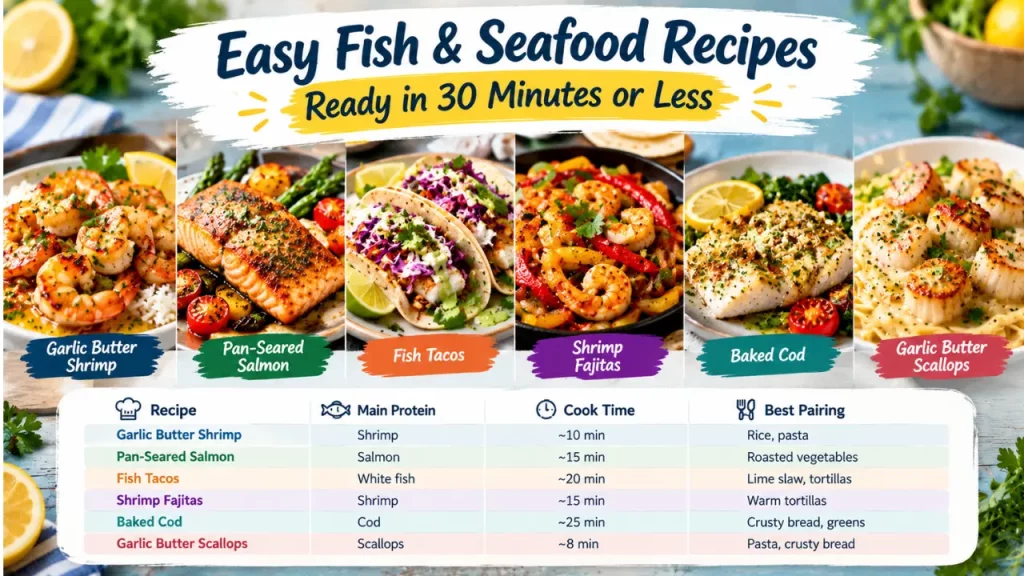
Easy Fish & Seafood Recipes Ready in 30 Minutes or Less!
The real safe cooking temperature for fish, and which 30-minute seafood recipes are actually fine for pregnant women and kids.
In 2003, researchers testing umbilical cord blood from 42 newborns in Bermuda found mercury levels roughly eight times higher than typical levels measured in Canada and the United States, almost entirely traced back to locally caught seafood eaten by the mothers, according to a public health intervention study from Bermuda. That number matters for anyone standing at the stove on a Tuesday night, because the seafood that cooks fastest and tastes best pan-seared is not automatically the seafood that is safest to eat several nights a week.
So let’s answer the headline directly. Yes, fish and shellfish can be on the table in under 30 minutes, and the doneness marker isn’t guesswork. The FDA’s actual internal temperature target for cooked fish is 145°F, measured at the thickest part with a probe thermometer. “Flakes easily with a fork” is a decent visual cue for a thick cod loin, but it fails for thinner fillets, scallops, and shrimp, which can look opaque and separate into flakes well before they’ve reached a safe internal temperature, or go rubbery seconds after they’ve passed it. A thermometer removes the guessing entirely.
Why seafood turns rubbery so fast
Fish muscle is built differently from beef or chicken. It has short muscle fibers held together by thin sheets of connective tissue called myocommata, and very little collagen compared to land animal meat. The dominant protein, myosin, starts denaturing — unwinding and tightening — at a lower temperature than it does in beef, and it keeps tightening the longer the heat is applied. That’s why a scallop goes from silky to squeaky-rubber in the space of about 60 extra seconds, while a steak has a much wider margin for error. It isn’t that cooks are clumsy with fish; the protein itself has a narrower window between “underdone” and “overcooked,” which is exactly why hitting 145°F and pulling the pan off the heat immediately matters more here than almost anywhere else in the kitchen.
The Weeknight Regulars: Low-Mercury and Safe to Eat Often
Shrimp, scallops, salmon, and cod — the stars of most 30-minute seafood recipes — fall into the category public health agencies classify as low in mercury. These are the species pregnant women, young children, and anyone eating fish multiple times a week can rely on without mercury being a meaningful concern. General guidance reviewed in UK pregnancy research encourages at least two portions of fish per week, while a separate analysis of third-trimester intake used a slightly higher benchmark of two to three servings weekly, according to a study on maternal fish intake and infant gut microbiota. That same study found that mothers who met the recommended intake were markedly more likely to have infants with a Bifidobacterium-dominant gut microbiota profile, a pattern generally considered favorable, though this was an observational study of 114 mother-infant pairs and shows an association, not proof of cause and effect.
The Fast but Riskier Catch: Tuna Steaks and Swordfish
Tuna steaks and swordfish sear in minutes, show up in plenty of “quick dinner” recipe lists, and are exactly the species maternal and child health guidance asks people to limit or avoid, because they sit much higher on the mercury scale than shrimp, salmon, or cod. A review of mercury biomonitoring and clinical guidance in Spain found consistent evidence of measurable mercury exposure among pregnant women and children, and noted that how clearly this risk gets communicated in actual clinical practice remains inconsistent, according to a review of fish consumption guidelines and mercury exposure during pregnancy. In plainer terms: the recipe card doesn’t warn you, and sometimes your prenatal appointment doesn’t either.
| Category | Examples | Mercury level | Frequency guidance | Safe internal temp |
|---|---|---|---|---|
| Weeknight-safe | Shrimp, scallops, salmon, cod | Low | 2 to 3 servings per week | 145°F |
| Limit or avoid | Tuna steaks, swordfish | Higher | Occasional only; avoid/limit in pregnancy per guidance | 145°F |
It’s worth noting the research here isn’t unanimous on how much mercury itself changes birth outcomes. A large UK cohort study of 4,044 pregnant women found no significant association between maternal blood mercury levels and the birth outcomes measured, according to the ALSPAC birth cohort study on blood mercury and fish consumption. That study’s authors were specifically concerned that fear of mercury was pushing some women to cut out fish entirely, losing the documented developmental benefits in the process. A systematic review conducted for the 2020 U.S. Dietary Guidelines Advisory Committee found moderate evidence that seafood intake during pregnancy is favorably associated with cognitive development in young children, with limited evidence of benefit for language development too, per the Dietary Guidelines Advisory Committee’s seafood and neurocognitive development review. The takeaway isn’t “avoid fish out of caution” — it’s “choose the low-mercury species and eat them regularly,” since avoidance carries its own downside.
The Butter Problem Nobody Mentions
Garlic butter shrimp, lemon butter salmon, and seared scallops finished in a butter sauce are genuinely fast and genuinely delicious, but butter is where the nutrition conversation usually stops short. These recipes typically use several tablespoons of butter per serving, which adds meaningful saturated fat and sodium on top of whatever salt went into the pan already. Eaten once a week, that’s a minor detail. Eaten four nights a week because shrimp is fast and foolproof, the butter becomes the dominant nutritional feature of the meal, not the seafood. A simple swap — a squeeze of lemon and a drizzle of olive oil instead of a full butter baste — keeps the same 30-minute timeline while cutting the saturated fat load considerably on the nights you’re cooking seafood on repeat.
Frozen Seafood: What the Evidence Actually Supports
Flash-freezing happens fast enough that it doesn’t trigger the same protein denaturation that heat does, so frozen shrimp, scallops, and salmon aren’t inherently a lesser product nutritionally just because they were frozen rather than sold fresh. None of the research reviewed here directly measured omega-3 retention in frozen versus fresh seafood, so rather than inventing a number, the honest answer is that freezing itself isn’t the variable to worry about — correct thawing and not overcooking after the fact matter far more for both texture and nutrient quality than whether the fish spent time in a freezer.
Verdict
Shrimp, scallops, salmon, and cod earn their place as true weeknight regulars: fast, low in mercury, and backed by evidence of developmental benefit when eaten two to three times a week, as long as a thermometer — not a fork — decides when they’re done at 145°F. Tuna steaks and swordfish belong in the “occasional treat” column, not the regular rotation, especially for pregnant women and young children. And whichever fish lands in the pan, go easy on the butter if it’s happening more than once or twice a week — the fish was never the problem.
Sources
- Fish consumption guidelines during pregnancy: are they effective in minimising mercury exposure in Spain? (2026)
- Blood mercury levels and fish consumption in pregnancy: Risks and benefits for birth outcomes (2016)
- Maternal Fish Consumption in Pregnancy Is Associated with a Bifidobacterium-Dominant Microbiome Profile in Infants (2020)
- Evaluation of a public health intervention to lower mercury exposure from fish consumption in Bermuda (2012)
- Seafood Consumption during Pregnancy and Lactation and Neurocognitive Development in the Child: A Systematic Review (2020)

Mick Hudson
Low-and-slow recipes, rubs, sauces and fire management from our pitmaster team.