Greek Yogurt vs. Cottage Cheese: Which Is Better for Protein?
The 2-gram protein gap between these foods barely registers biologically — here's what actually decides who should eat which.
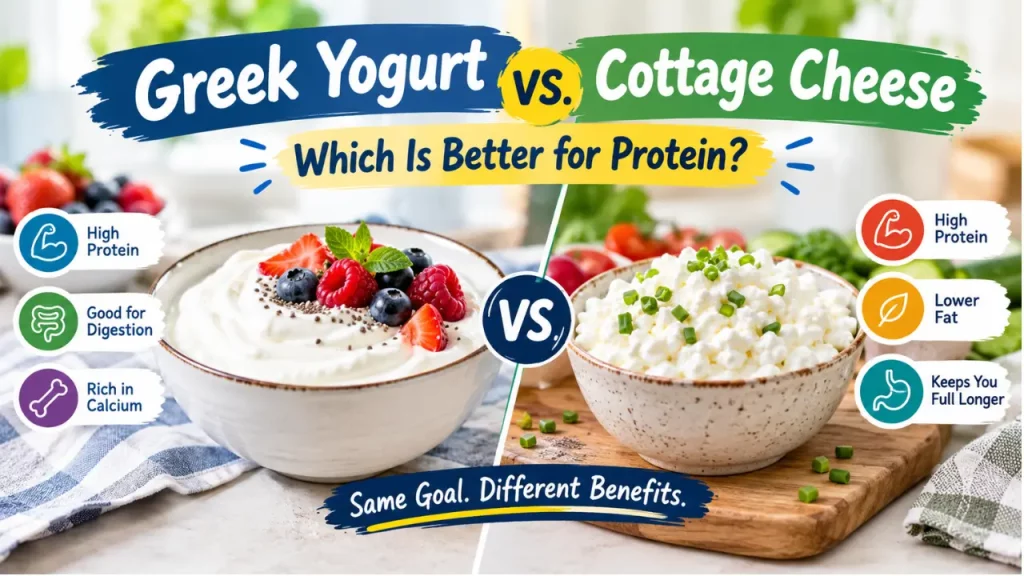
Scroll through any nutrition comparison and you’ll find the same verdict: Greek yogurt wins on protein, cottage cheese loses, case closed. The assumption baked into that verdict is that more grams per serving automatically means more muscle, more fullness, and better results on a scale. That assumption falls apart fairly quickly once you look at how the body actually uses protein, and it ignores a set of medical reasons why one of these foods might be the wrong choice for you specifically, regardless of what the label says.
The protein-gram gap between Greek yogurt and cottage cheese is too small to change muscle growth, fullness, or weight loss on its own — the real decision hinges on digestion, casein type, and a few medical conditions.
- A 2-gram-per-100g protein edge is dwarfed by the much larger leucine threshold research that actually predicts muscle protein synthesis
- No published trial has directly pitted cottage cheese against Greek yogurt for satiety or fat loss — the appetite claims for both rest on indirect hormone research
- Dr. Gundry’s warning about cottage cheese’s A1 casein has a real biological basis, but a recent pilot trial found no measurable gut-symptom difference tied to A1 casein itself
- People with kidney disease, uncontrolled hypertension, or IBS should pick based on sodium and FODMAP load, not protein grams at all
Why the gram difference barely moves the needle on muscle
Muscle doesn’t respond to total protein the way a spreadsheet does — it responds to whether a meal crosses a leucine threshold that switches on muscle protein synthesis. Research on meal-based protein requirements has identified roughly 2.5 grams of leucine per meal as the trigger point for this anabolic signal, a threshold described in a review of protein’s metabolic role in obesity treatment. A separate paper on defining meal protein requirements explains that this threshold, mediated through a pathway called mTORC1, is what actually controls whether a meal builds muscle — not the raw gram count of protein consumed, according to research on meal requirements for protein and amino acid signaling.
Put plainly: whether a serving contains 10.2 grams or 12.4 grams of protein per 100 grams is irrelevant if both numbers clear the leucine bar once you eat a normal portion. A 2024 modeling study on rugby athletes found that even a completely plant-based diet scaled to meet energy needs delivered 2.9 grams of leucine per meal across four daily meals — above the threshold needed for maximal muscle and strength gains, according to research modeling plant-based diets against leucine thresholds for athletes. If a diet containing zero dairy can clear that bar, a 2-gram difference between two dairy foods that are both leucine-rich is not the variable deciding whether you build muscle.
What the evidence actually shows about fullness and weight loss
This is the part most comparisons skip entirely: there is no published head-to-head trial measuring hunger hormones or weight loss after people eat Greek yogurt versus cottage cheese. The satiety claims attached to both foods are borrowed from broader protein research, not food-specific trials. What we do have is evidence that the specific amino acid makeup of a protein — not just its quantity — changes how strongly it suppresses appetite. A crossover trial giving healthy adults a low dose of cod protein hydrolysate before breakfast found it altered postprandial acylated ghrelin, the hormone that signals hunger, compared with a casein control, according to a trial on fish protein hydrolysate and appetite-regulating hormones. That study used fish protein, not dairy, so it can’t be used to declare either yogurt or cottage cheese the fullness winner — but it does demonstrate that protein source and amino acid sequence, not gram totals, are what move appetite hormones. Until someone runs that comparison directly on dairy, anyone claiming cottage cheese or Greek yogurt is “better for weight loss” based on protein grams alone is extrapolating past the data.
Is the Gundry casein warning backed by research?
Critics including Dr. Steven Gundry have argued that cottage cheese’s casein — specifically A1-type beta-casein, common in conventional cow dairy — triggers more digestive inflammation than the casein in Greek yogurt. The lectin part of that claim doesn’t hold up on its face: lectins are plant compounds found in beans, grains and nightshades, not in milk protein, so applying lectin concerns to a dairy food is a category error. The A1 casein concern is more defensible in theory, since A1 beta-casein releases a peptide during digestion that’s been linked to GI discomfort in sensitive people. But the newest direct test of that idea complicates the narrative: a randomized, double-blind crossover pilot trial comparing conventional milk against milk engineered to contain no A1 beta-casein found no statistically significant difference in GI symptoms between the two in people who normally react badly to dairy, according to a pilot trial comparing A1 versus A2 beta-casein milk. This was a small, exploratory study and it tested milk rather than cottage cheese specifically, so it doesn’t close the question — but it means the blanket claim that A1 casein itself is the inflammatory culprit is currently unproven rather than settled science.
Calcium and bone health: who this actually matters for
Dairy comparisons routinely wave at calcium without saying who should care. The honest answer is that this matters most for people already managing bone density risk — postmenopausal women, adults over 65, and anyone with a prior osteoporosis diagnosis or fracture — because calcium absorption efficiency declines with age even when intake stays constant. For everyone else eating a varied diet with adequate vitamin D, calcium from either fermented dairy food is one input among many, not a decisive factor between these two specific foods. If you fall into one of those higher-risk groups, the conversation with your doctor should be about total daily calcium and vitamin D status, not about picking cottage cheese over yogurt or vice versa.
Who should actually avoid one or the other
Daily consumption of either food is reasonable for most healthy adults long-term, but a few groups have a genuinely medical reason to choose carefully. Anyone with chronic kidney disease managing protein restriction should treat both as concentrated protein sources and follow their renal dietitian’s portioning rather than defaulting to whichever has “more protein.” People with hypertension already know sodium differs sharply between the two, and that sodium gap, not the protein gap, should drive the choice. For IBS or lactose-FODMAP sensitivity, fermentation reduces lactose more in one than the other, so trial-and-error with a low-FODMAP approach matters more than protein content. And anyone who has specifically identified A1 casein or milk protein intolerance as their trigger — confirmed by symptoms, not assumption — has more reason to experiment with the newer A1-free dairy products than to simply swap cottage cheese for yogurt, since both still contain casein.
Sources
- Protein and Leucine Requirements for Maximal Muscular Development (2024)
- Acute effect of cod protein hydrolysate on ghrelin and appetite (2019)
- Defining meal requirements for protein to optimize amino acid metabolism (2015)
- Protein metabolic roles in treatment of obesity (2010)
- A1 versus A2 beta-casein milk and digestive symptoms pilot trial (2026)
