Almonds vs. Peanuts vs. Cashews vs. Pistachios: Which Has More Protein and Healthy Fats?
The real answer isn't just which nut has more protein, but how much of it you actually absorb, and why.
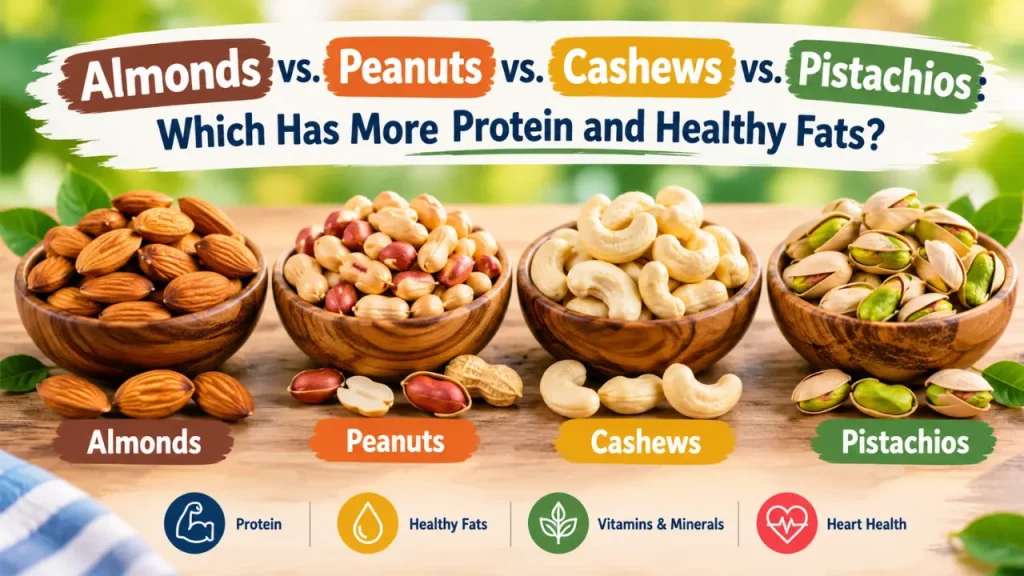
If two nuts have almost identical protein listed on the label, why might your body end up using less of one than the other? That question rarely gets asked in the usual almond-versus-peanut-versus-cashew-versus-pistachio showdowns, and it changes the answer more than most people realize.
1. Peanuts generally lead on protein, but the gap with almonds is smaller than the ranking suggests
Among this group, peanuts are widely recognized as the protein leader by weight, with almonds close behind and cashews and pistachios trailing somewhat. That ranking is accurate as far as it goes, but it treats “protein on the label” as the end of the story. It isn’t. Protein quality, meaning how complete and digestible it is, varies between a legume like the peanut and true tree nuts like almonds, cashews, and pistachios, and that nuance almost never makes it into the comparison.
2. Peanuts are a legume, not a tree nut, and that distinction matters beyond allergies
Every roundup eventually mentions that peanuts grow underground and are botanically legumes, but usually only as a trivia aside before moving on to allergy warnings. The more practical consequence is that peanuts, as legumes, carry a different storage and spoilage profile than tree nuts. Groundnuts stored in warm, humid conditions are more susceptible to mold growth that can produce aflatoxins, a contamination risk that is specific to peanuts and far less relevant to almonds, cashews, or pistachios. This doesn’t make peanuts unsafe under normal commercial handling, but it is a genuine structural difference the other three nuts don’t share, and it’s worth knowing if you buy peanuts in bulk from informal sources or store them a long time in a warm pantry.
3. “Healthy fats” is doing a lot of unexamined work in these comparisons
All four nuts are routinely described as sources of “healthy fats,” as if that settles the matter. In reality the fat profiles differ in character, not just quantity. Almonds and peanuts lean heavily toward monounsaturated fat, cashews bring a mix of monounsaturated and saturated fat that’s higher than the other three, and pistachios stand out for a relatively higher share of polyunsaturated fat along with a notable antioxidant and plant-sterol content. None of this means one nut is simply “healthier” than another; it means the fats are doing somewhat different jobs, and lumping them together under one friendly label erases that.
4. The nut’s structure can trap fat so your body never absorbs all of it
Here is a detail almost never mentioned: the calories and fat listed on a nutrition label assume complete digestion, but whole nuts have a dense cell-wall structure that can physically trap some fat inside, especially in almonds, so a portion passes through the digestive system unabsorbed rather than being taken up into the bloodstream. This matters because it means eating a handful of whole almonds is not metabolically identical to eating the same weight of almond butter or almond flour, where the cell walls are already broken down and the fat is far more accessible. Chewing thoroughly versus swallowing nuts half-chewed can also shift how much of that fat is actually released. This is well-documented for almonds specifically; whether the same “trapped fat” effect applies equally to cashews, pistachios, and peanuts is less firmly established, so it should not be assumed to transfer evenly across all four.
5. Roasting changes the fat, not just the flavor
Raw cashews are not actually sold raw in the way almonds or peanuts can be; they require heat processing to remove a resin in the shell that is irritating to skin, so what you buy as “raw cashews” has already been through some heat treatment. Across all four nuts, dry roasting and oil roasting push fats toward oxidation, particularly the more unsaturated fats in pistachios, and high, prolonged heat can degrade some of the antioxidant compounds that are part of the nuts’ appeal in the first place. Comparisons that cite “healthy fat content” from a database entry rarely specify whether that entry reflects raw, dry-roasted, or oil-roasted nuts, yet the differences in oxidized fat and added oil between those versions are real and can matter more than the gap between two different nuts.
6. The skin and seed coat you discard affects what you’re comparing
Almond skin contains a concentration of polyphenols and tannins that is largely absent once the nut is blanched; pistachio’s thin inner skin carries some of the same kind of compounds. Tannins can also modestly interfere with how well minerals like iron are absorbed when eaten in large amounts alongside iron-rich foods, a trade-off that applies to several plant foods, not just nuts, and is unlikely to matter much unless nuts make up a very large share of someone’s diet. The point is simply that “almonds” as a category can mean skin-on or blanched, and that distinction silently shifts both the antioxidant content and, in theory, the mineral-absorption picture, yet it is almost never specified in head-to-head nutrition tables.
7. Protein-per-calorie tells a different story than protein-per-ounce
Nuts are calorie-dense foods, and fat contributes far more calories per gram than protein does. Ranking nuts purely by protein per ounce rewards the nut with the most protein regardless of how many additional fat calories came along with it. Someone managing total calorie intake while trying to maximize protein would get a more useful answer by thinking in terms of protein relative to total calories consumed, not protein relative to weight alone. On that basis the rankings can shift, since a nut that looks like a clear protein winner by weight may lose some of that edge once its higher fat and calorie load are factored in.
8. Serving size on the label is rarely the serving size people actually eat
Most nutrition comparisons quote values for a standard reference serving, but people eating from a shared bowl or a bag rarely stop at that amount, and salted, honey-roasted, or chocolate-coated versions add sodium or sugar that doesn’t appear in the base comparison at all. A fair comparison of almonds, peanuts, cashews, and pistachios has to specify not just which nut but which form of it, plain and unsalted versus roasted and seasoned, because the seasoning can add more sodium or sugar than the difference in protein between two of these nuts would ever justify nutritionally.
None of this overturns the basic shape of the usual comparison: peanuts and almonds tend to edge out cashews and pistachios on protein, while the fat profiles differ in character rather than simple quality. What changes with a closer look is how much that ranking actually matters once you account for processing, serving size, and how much of that fat and protein your body realistically absorbs.

James Carter
The EverBBQ editorial desk — covering BBQ news, features and everything off the grill.