5 Vitamin-Rich Foods to Boost Your Nutrition Naturally
One egg yolk, five foods, and the single vitamin none of them can really cover — plus who needs a different plan entirely.
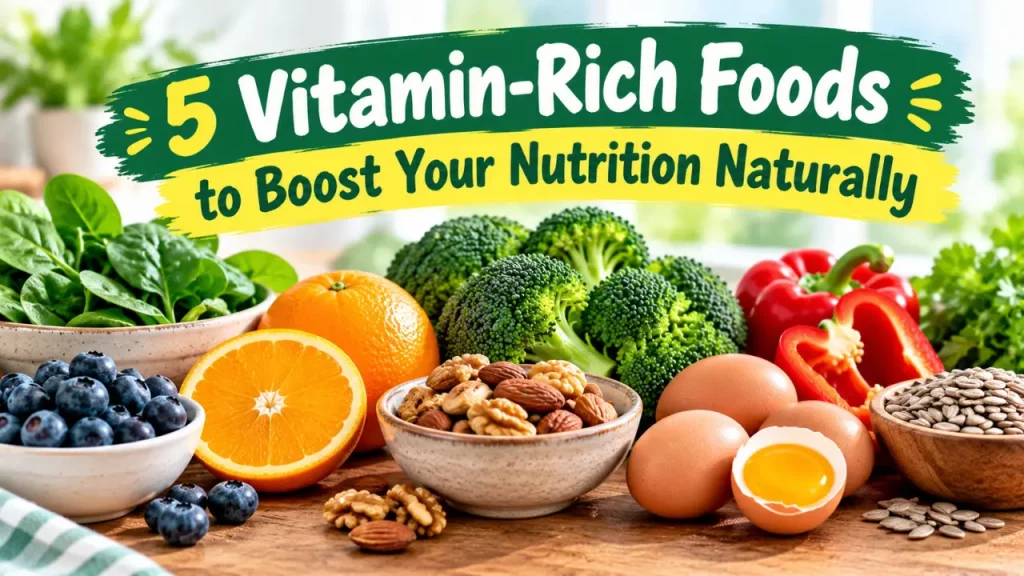
Could you tell me, honestly, what percentage of your daily vitamin D came from the egg you ate this morning? Most people guess high. The real number is small enough to change how you think about the whole idea of “eating your vitamins.”
That guess matters because lists like this one — red peppers for vitamin C, sweet potatoes for vitamin A, spinach for vitamin K and folate, eggs for B12 and D, nuts and seeds for vitamin E — are genuinely useful. Pairing fat-soluble vitamins with a little dietary fat helps absorption, and not overcooking water-soluble vitamins protects what you put on the plate. But one vitamin on that list is doing almost no work, and the list never admits it.
The math on one egg yolk
A single large egg yolk supplies roughly 0.9 micrograms of vitamin D — about 6 percent of the 15 micrograms (600 IU) most adults under 70 need in a day, and an even smaller share of the 20 micrograms recommended after age 70. You would need to eat somewhere around sixteen egg yolks to hit that daily target through eggs alone. Nobody is doing that for breakfast, and nobody should, given how much saturated fat and cholesterol would come along with it.
This is the detail the “five foods” framing skips. Eggs genuinely carry B12 and some D, but the D contribution is a rounding error against the actual requirement, not the meaningful chunk it’s often implied to be.
Why vitamin D is the outlier
Here’s the structural reason. Vitamin C, A, K, and E all occur in reasonably concentrated amounts across ordinary plant foods — that’s exactly why peppers, sweet potatoes, spinach, and nuts can plausibly cover large shares of a day’s need. Vitamin D does not behave this way. Almost no unfortified whole food contains it in significant quantity. The body’s main supply route has always been skin synthesis from sunlight, with diet acting as a minor backup. Once you remove sun exposure from the equation, whole foods alone rarely close the gap, egg yolks included.
Vitamin B12 has a narrower version of the same problem. It occurs reliably only in animal-derived foods — meat, dairy, eggs, and fortified products. A review of fortified rice cooking methods found that retention of B12 and folic acid after cooking stayed between 75% and 100% regardless of how the rice was prepared, which is reassuring for fortification programs — but it also underlines that without fortification or animal products, there’s no unfortified plant food carrying meaningful B12 at all.
What the other four foods actually add up to
To be fair to the list: red peppers, sweet potatoes, spinach, and nuts or seeds do deliver on their named vitamins in large, verifiable amounts — that part is accurate and already well documented elsewhere. The honest caveat is narrower than “eat these and you’re covered.” It’s this: four of the five foods cover four different vitamins well, and the fifth food’s star nutrient (vitamin D) is barely represented at all.
The beta-carotene catch
Sweet potatoes supply vitamin A as beta-carotene, not as preformed vitamin A, and the two are not interchangeable in the body. A consensus review of beta-carotene research concluded that converting beta-carotene into usable retinol does not happen at one fixed ratio — efficiency varies by person, by food matrix, and by how the food was prepared, which means two people eating identical sweet potato portions can end up with meaningfully different effective vitamin A intake. Beta-carotene is still called an important vitamin A source for humans, but “important” and “equivalent to preformed vitamin A” are different claims.
What cooking does to the vitamin C you’re counting on
Vitamin C is the most fragile number on this whole list. A study comparing blanching, boiling, microwaving, and steaming across several vegetables found vitamin C retention ranging all the way from 0% to 91.1% depending on method, with boiling consistently causing the lowest retention and microwaving the highest. A separate study on turnip greens and turnip tops, a leafy brassica similar to the kind found in many produce aisles, compared steaming, conventional boiling, and high-pressure cooking and found the cooking method itself significantly changed vitamin C retention, with losses varying by both the vegetable and the process. The practical upshot: a red pepper’s printed vitamin C content is only a starting number, and boiling can erase most of it before it reaches your plate.
No single food list can substitute for knowing which vitamin your body, your diet pattern, and your life stage actually struggle to get — because that vitamin is rarely the one getting the most attention.
Who this list quietly fails
Four groups should read this list as a partial answer at best, not a complete plan.
- Strict vegans get zero B12 and effectively zero vitamin D from this entire five-food list, since both nutrients here come packaged in eggs.
- Adults over 65 often produce less stomach acid, which is needed to release B12 from food proteins — so even B12-containing foods become less reliably absorbed with age.
- People with limited sun exposure or darker skin synthesize less vitamin D through the skin per minute of sunlight, which raises how much they’d need dietary or supplemental sources to compensate — sources this list barely provides.
- People on anticoagulant medication need to treat spinach’s vitamin K content as something to monitor and keep consistent, not simply maximize, since vitamin K affects how those medications work.
Quick tip: if you fall into any of those four groups, stop evaluating your diet by whether it contains “vitamin-rich foods” in general and start checking two specific things — your actual vitamin D intake in micrograms against the 15-to-20 microgram daily target, and whether your B12 source is fortified or animal-based rather than assumed. Those two checks catch the gap that produce-aisle lists consistently miss.
Back to that egg
So, that egg yolk from this morning: 0.9 micrograms of vitamin D, about 6 percent of the day’s requirement, still leaving roughly 94 percent of your need unmet before lunch. That’s not a failure of the egg — it’s a reminder that one vitamin on every “eat these foods” list is structurally different from the rest, and no amount of produce substitutes for sunlight, fortified foods, or a supplement when the gap is this specific.
Sources
- Stability and retention of micronutrients in fortified rice prepared using different cooking methods (2014)
- Effect of different cooking methods on the content of vitamins and true retention in selected vegetables (2018)
- Beta-carotene is an important vitamin A source for humans (2010)
- Cooking methods of Brassica rapa affect the preservation of glucosinolates, phenolics and vitamin C (2010)
