Mango Sweet Tea Mocktail in 10 Minutes: Easy Tropical Party Pitcher!
The caffeine, sugar, and safe-serving math behind the mango sweet tea mocktail — and who at your party should actually skip it.
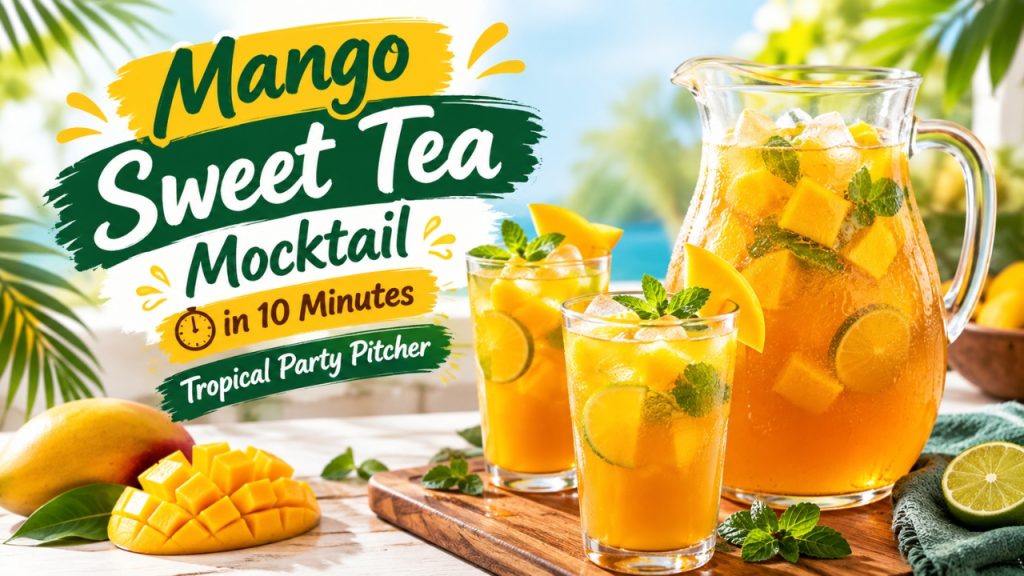
One pitcher of this pretty mango-gold mocktail can still carry real caffeine, real sugar, and a real expiration clock, even though nothing in the glass is alcohol. The ten-minute version — brewed sweet tea, mango nectar or purée, citrus, and sparkling water poured over ice — is easy enough that most recipes stop at the ingredient list. The questions that actually matter at a party are different: how much caffeine lands in a kid’s cup, how much sugar is really in there once you add nectar instead of plain purée, and how long the pitcher can sit in the sun before it stops being safe to pour.
How much caffeine ends up in one glass?
It depends entirely on whether the base is brewed black tea or decaffeinated tea, and that single choice matters most for children and pregnant guests. A standard cup of brewed black tea carries a noticeable dose of caffeine, while decaffeinated tea carries only a trace amount. Because this mocktail dilutes the tea with mango nectar or purée, citrus, and sparkling water, the caffeine per glass is lower than a straight cup of tea, but it is not zero unless decaf leaves are used. For a party with young children or pregnant guests, brewing the base with decaf tea bags removes the ambiguity entirely instead of relying on guesswork about how diluted is “diluted enough.”
Does mango nectar, purée, or juice change the sugar count?
Yes, and the gap between them is bigger than most hosts assume. Mango nectar is typically only a third to a bit less of actual fruit juice, with water and added sugar making up the rest, so it tends to carry the most added sugar per serving of the three options. Mango purée is closer to 100 percent fruit, so its sugar is almost entirely the natural sugar already in the mango, along with a little fiber that nectar loses in processing. Unsweetened brewed tea itself contributes essentially no sugar on its own. Swapping nectar for purée, or cutting the tea with more sparkling water, is the single biggest lever a host has over how sweet — and how sugar-heavy — the final pitcher turns out.
How many calories does one serving actually carry?
For context, NCHS survey data on U.S. youth found that boys consumed an average of 164 kilocalories a day from sugar-sweetened beverages, about 7.3 percent of total daily calories, and girls averaged 121 kilocalories, or 7.2 percent of daily calories. A single glass of this mocktail made with nectar and sweet tea can land in a similar range, meaning one celebratory glass for a child could represent close to a full day’s typical sugar-beverage calorie allotment in that data. That is not a reason to panic over one party cup, but it is a reason to pour kids a smaller glass or the purée-and-water version rather than a second full-size refill.
How long can the pitcher safely sit out at a warm outdoor party?
As a general food-safety rule, perishable drinks containing dairy-free fruit purée or juice should not sit at room temperature longer than about two hours, and that window shrinks to roughly one hour once the outdoor temperature climbs above 90°F. Mango purée and nectar are not shelf-stable once mixed with tea and left in the sun; bacterial growth speeds up in warm, sugar-rich liquids, and the fizz from sparkling water fades fast anyway. Keeping the pitcher in an ice-filled tub, refreshing the ice every hour, or simply making two smaller batches timed to arrival and mid-party refills is the safest way to serve a crowd outdoors.
Does fresh mango beat canned or frozen for nutrients?
Not by much once it is blended into a sweetened tea base. Fresh mango carries somewhat more vitamin C and fiber than canned mango packed in syrup, since canning and added sugar dilute the fruit’s natural nutrient density, and frozen mango chunks — usually flash-frozen at peak ripeness — tend to sit much closer to fresh in nutrient terms than canned does. For this particular drink, though, the tea, sugar, and sparkling water dominate the glass so heavily that the nutrient difference between fresh and frozen mango becomes nearly irrelevant to the final nutrition profile; it matters far more for someone eating mango on its own.
How do the ratios change for a crowd of 12, 24, or 50?
The base ratio holds steady; only the multiplier changes. A 12-serving batch roughly doubles a standard 6-serving pitcher recipe, a 24-serving party needs four times the tea, mango, and citrus, and a 50-serving event is close to eight times the original batch, split across at least three or four pitchers rather than one oversized vessel. Splitting into multiple smaller pitchers isn’t just about table space — each smaller batch spends less time sitting out before it’s finished, which keeps every pour within that two-hour safety window discussed above, something one giant 50-serving pitcher simply cannot do.
Why does any of this matter for a “healthy-sounding” mocktail?
Because sugar-sweetened beverages carry documented health associations even when they look festive and alcohol-free. A study of U.S. children’s diet quality found a 9.5-point lower Healthy Eating Index score among kids drinking more than two sugar-sweetened beverages a day compared with none, and a review of sugar-sweetened beverage research links regular intake to weight gain, dyslipidemia, and higher diabetes and hypertension risk over time. Separately, CDC’s 2021 national survey found 57.1 percent of children aged 1 to 5 had a sugar-sweetened beverage at least once in the preceding week, while 49.1 percent missed a daily vegetable — a reminder that one sweet party pitcher rarely arrives in isolation.
- Use decaf tea if children or pregnant guests will be drinking from the same pitcher.
- Mango purée carries less added sugar than nectar; sparkling water dilutes either option further.
- One glass can approach a child’s typical daily sugar-beverage calorie total, so pour smaller kid portions.
- Keep the pitcher iced and limit room-temperature sitting to about two hours, less in heat above 90°F.
- Fresh and frozen mango are nutritionally close; canned mango in syrup trails both.
- Scale by multiplying the base ratio evenly, and split large batches into several smaller pitchers.
Sources
- Fruit, Vegetable, and Sugar-Sweetened Beverage Intake Among Young Children, by State — United States, 2021 (MMWR, 2023)
- Oakland’s sugar-sweetened beverage tax: impacts on prices, purchases and consumption (Economics and Human Biology, 2020)
- Sugar-Sweetened Beverage and Water Intake in Relation to Diet Quality in U.S. Children (American Journal of Preventive Medicine, 2018)
- The sugar-sweetened beverage wars: public health and the role of the beverage industry (Current Opinion in Endocrinology, Diabetes, and Obesity, 2013)
- Sugar-sweetened Beverage Consumption Among U.S. Youth, 2011-2014 (NCHS Data Brief, 2017)

Mick Hudson
Low-and-slow recipes, rubs, sauces and fire management from our pitmaster team.