Air Fryer Tikka at Home: Smoky Paneer, Juicy Chicken and a Fresh Mint Chutney
The real tikka questions aren't about marinade — they're about exact temperature, safe doneness, and smoky flavour without charcoal.
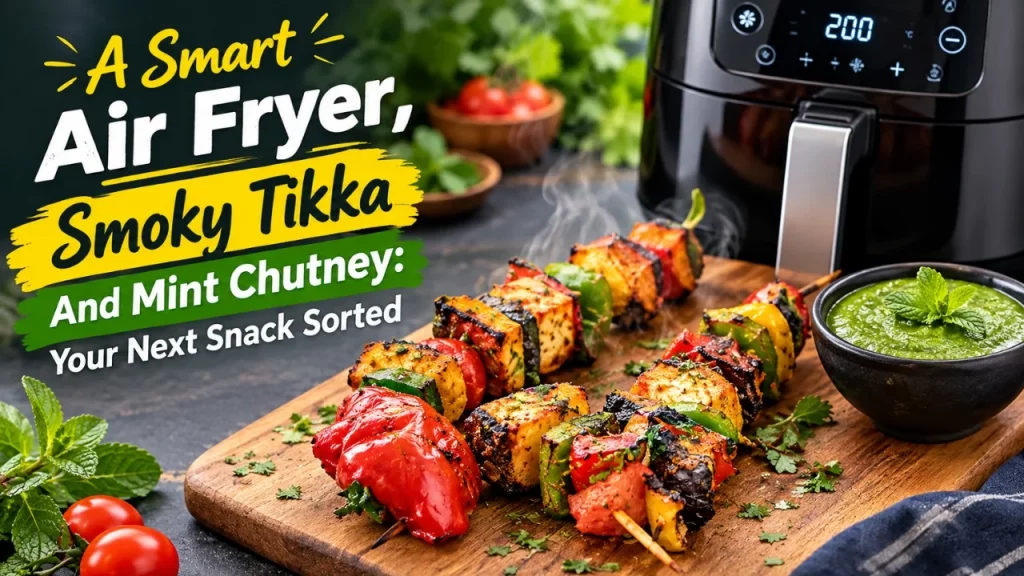
The difference between rubbery tikka and restaurant-grade tikka usually comes down to two numbers nobody tells you: the dial setting and the thermometer reading.
Every tikka recipe explains the yoghurt, the ginger-garlic, the Kashmiri chilli. Almost none tell you what to actually set the air fryer to, or how you know the chicken is safe without turning it into shoe leather. Here is the short answer, then the longer one. For both chicken and paneer tikka, a basket-style air fryer run at roughly 200°C (about 400°F) for 10 to 14 minutes, with a shake or flip halfway, gets you char without drying the meat out. Chicken tikka is only genuinely done when its thickest cube reads 74°C (165°F) on an instant-read thermometer — not when it looks brown, not when the edges blacken, because tikka’s dark marinade will char long before the centre is cooked if the cubes are cut too large or the heat is too low.
Paneer has no safety threshold to hit since it is already a cooked dairy product, so its “doneness” is really about colour and texture: you are looking for blistered, golden-brown edges, usually reached a few minutes sooner than chicken at the same setting. If you pull paneer at the same time as chicken, it will often overcook and dry out while the chicken is still pink inside, which is the single most common timing mistake home cooks make when skewering both onto one tray.
Basket-Style Air Fryers
Basket models, the kind with a pull-out drawer, cook mainly through direct hot air circulating tightly around the food, which means they sear faster but also crowd faster. Skewers or loose cubes piled more than one layer deep block airflow, so the bottom layer steams instead of browning. In a basket fryer, tikka wants to be arranged in a single, non-touching layer, which usually means two or three batches for a family-sized marinade rather than one. Expect the stated 10 to 15 minute window to hold reasonably well here, but only if you are not overfilling the basket — a basket packed edge to edge can add three to five extra minutes and still come out pale on the underside.
Oven-Style (Tray) Air Fryers
Oven-style or tray air fryers — the larger countertop boxes with a front door and multiple rack positions — spread heat more gently across a bigger surface, closer to how a real oven behaves, just with a fan assist. They tolerate slightly more food per batch and are more forgiving of a loosely packed single layer across two racks at once. The trade-off is that they often run a touch cooler than their dial suggests, so tikka can take a few minutes longer to char at the same 200°C setting, and skewers on a lower rack nearer the heating element will finish before skewers on a higher one, meaning you may need to rotate trays rather than just shake a basket.
| Factor | Basket-Style | Oven/Tray-Style |
|---|---|---|
| Heat intensity | Strong, close, fast searing | Milder, more oven-like |
| Crowding risk | High — one layer only | Lower — more surface area |
| Typical timing at 200°C | 10–14 minutes | 13–18 minutes |
| Mid-cook action needed | Shake or flip basket | Rotate trays/racks |
| Best for | Small batches, fast char | Larger batches, even cooking |
Wattage matters just as much as style. A lower-wattage, budget air fryer may need an extra two to four minutes beyond either range above to reach the same internal temperature, simply because it cannot sustain 200°C as consistently once food is loaded in. If your tikka is routinely pale after the “standard” time, the fryer itself, not the recipe, is usually the reason — the fix is adding time in small increments and checking the thermometer rather than guessing by colour.
No charcoal, no balcony, no problem
The classic dhungar method — a live coal, a drop of oil, a lid clamped down to trap smoke — is genuinely the best route to that tandoor aroma, but it needs ventilation most apartments simply do not have, plus actual charcoal, which most people cooking indoors on a weeknight do not keep around. There are two honest workarounds, not the same as real smoke but close enough to fool most dinner guests. The first is a few drops of liquid smoke whisked directly into the yoghurt marinade — a little goes a long way, so start with a drop or two per batch and taste before adding more, since over-pouring gives an acrid, ashtray note rather than a barbecue one. The second is leaning harder on smoked paprika in place of some of the Kashmiri chilli; it will not replicate charcoal smoke exactly, but it layers a warm, smoky depth that reads as “grilled” even when the tikka never saw an open flame. Neither trick needs a window cracked open or a fire extinguisher nearby, which is precisely the point for anyone cooking in a small kitchen.
Why paneer falls apart on the skewer
Paneer crumbles for one of three reasons: it was cut too small and cannot hold its own weight once skewered, it sat in acidic marinade too long and started to break down at the edges, or it was pierced and turned too roughly during cooking. Cutting cubes generously — closer to a large dice than a small one — and threading the skewer through the centre rather than near a corner both help. A light coating of besan (chickpea flour) or a very thin dusting of rice flour on the marinated cubes before they go into the fryer also gives the surface something to crisp around, which holds the paneer together far better than marinade alone.
The number on the dial tells you how hard the machine is working; the number on the thermometer tells you whether dinner is actually safe to eat — and only one of those two numbers is optional.
So which machine wins, basket or tray? Neither is objectively better for tikka — the basket rewards small, attentive batches and gives a faster char, while the tray suits anyone cooking for a crowd who would rather rotate racks twice than stand over a drawer shaking it every few minutes. What both machines share, and what no marinade recipe can fix for you, is the need to actually check the internal temperature of the chicken before it leaves the fryer, and to resist cramming every skewer in at once just to save five minutes.
Do you run a basket model or a tray-style air fryer at home, and has the stated cooking time in most recipes ever matched what actually happened in your kitchen?

James Carter
The EverBBQ editorial desk — covering BBQ news, features and everything off the grill.