Dutch Oven Greek Roast Chicken and Lemon Potatoes: The One-Pot Sunday Dinner That Never Fails!
The real fix for soggy-bottom potatoes and overcooked chicken is pot size, liquid ratio, and a covered-to-uncovered time split, not luck.
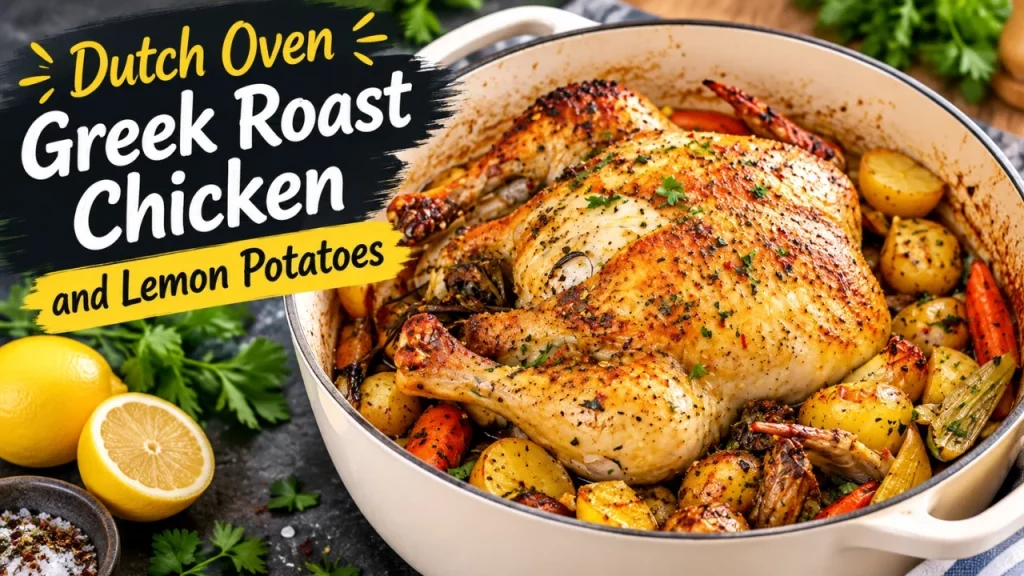
You lift the lid at the ninety-minute mark, proud of yourself, and the chicken skin looks right — golden, tight, blistered at the wingtips. You slide a thermometer into the thigh: 172°F. Good, even generous. Then you fork a potato from the bottom layer and it stops halfway through, chalky and resistant, sitting in a half inch of cloudy, greasy liquid that never reduced. The chicken is done. The potatoes are not. Nobody warned you that this is the single most common way this dish goes wrong, and nobody told you it’s fixable with three numbers: pot size, liquid volume, and a covered-then-uncovered clock.
The pot size that decides everything before you’ve added a single ingredient
A 5-pound chicken plus a pound and a half of quartered potatoes needs room to roast, not steam. If the potatoes are crammed two layers deep in a pot that’s too narrow, the liquid has nowhere to go except straight up through the chicken skin, and you end up basting the bird in starchy steam instead of crisping it. The threshold that matters is diameter, not just quart capacity: look for 10 to 11 inches across the base, which usually lands you in a 6 to 7-quart oval or round Dutch oven. Anything smaller than 9 inches across forces the potatoes into a thick pile, and a thick pile of potatoes under a chicken is exactly the setup that steams the bottom layer instead of roasting it. If your Dutch oven is 5 quarts or smaller, this method isn’t for you as written — you’re better off roasting the potatoes separately on a sheet pan and finishing the chicken on its own, because there simply isn’t enough surface area for both to brown.
Raw potatoes, not par-cooked — but only if you cut them right
Par-boiling potatoes before they go into the pot sounds like insurance, but it actually works against you here: pre-softened potatoes turn to mush during the long covered phase, since they’ve already lost structural starch before the real cooking even starts. Raw potatoes, cut into 1.5 to 2-inch chunks, hold their shape through both the covered and uncovered stages and finish tender rather than collapsed. The size matters more than whether they’re raw: chunks smaller than an inch disintegrate by the time the chicken hits temperature, while chunks larger than 2 inches are still firm when the breast is already overcooked.
The liquid ratio that keeps potatoes from going dry or waterlogged
For 1.5 pounds of potatoes, use about 3/4 cup of liquid total, split between 1/4 cup fresh lemon juice and 1/2 cup chicken broth, poured around — not over — the chicken. Less than half a cup total and the bottom layer scorches before the top potatoes soften. More than a full cup and you’ve built a shallow braise, which is why so many versions of this dish come out with potatoes swimming in greasy water instead of coated in a thick, reduced pan sauce. The goal is liquid that comes about a third of the way up the potato layer, enough to steam-soften them gently in the first phase and then reduce into a glaze once the lid comes off.
The actual covered-to-uncovered split, tied to temperature
Time alone is an unreliable guide, and that’s not a guess — a review of 474 published poultry recipes found that 94% relied on cooking time while only about a third gave any specific target temperature, and of those, nearly three-quarters did at least recommend the USDA’s 165°F minimum, per a 2018 analysis of recipe doneness guidance. That gap between what recipes say and what a thermometer says is exactly where the potato problem hides. Use the table below as a structure, but let the thermometer, not the clock, decide when to move between stages.
| Stage | Covered or uncovered | Time | Internal temp target |
|---|---|---|---|
| 1. Initial roast | Covered | 40–45 minutes at 400°F | Breast around 120–130°F |
| 2. Finish roast | Uncovered | 25–35 minutes | Breast 165°F, thigh 175°F |
| 3. Rest | Off heat, loosely tented | 10–15 minutes | Carryover to full 165°F+ throughout |
The covered stage lets the potatoes absorb steam and soften while the chicken skin stays pale; the uncovered stage is what actually crisps the skin and reduces the lemon-broth liquid into something worth spooning over the meat.
When the chicken hits 165°F and the potatoes are still firm
This is the failure the clock doesn’t warn you about: dark meat and white meat behave differently under heat, and chicken thigh tissue has more collagen that needs higher, longer exposure to fully soften, which is part of why a 2023 study on sous-vide cooking of chicken breast and thigh found that 65°C treatments reduced shear force and total collagen content compared with lower temperatures — thigh meat simply tolerates, and often needs, more time and heat than breast to reach its best texture. In a one-pot roast, that means the breast can clear 165°F while the potatoes underneath, insulated by the chicken itself, are still ten or fifteen minutes from done. The fix is not to pull the whole pot: lift the chicken onto a plate to rest, leave the lid off, and push the potatoes back into the remaining liquid at 425°F for another 10 to 15 minutes until a knife meets no resistance. The chicken keeps climbing a few degrees as it rests anyway, so separating the two at this point costs you nothing in the bird and saves the potatoes.
Who shouldn’t use this method at all
If you prefer a spatchcocked bird for faster, more even roasting, skip the Dutch oven entirely — a flattened chicken needs the open airflow of a sheet pan, not the enclosed steam of a pot, and it will finish in roughly half the time, out of sync with potatoes that need the full covered phase. If you’re only cooking bone-in thighs rather than a whole chicken, this timing table doesn’t apply either; thighs alone cook faster and dry out if left on the same covered-then-uncovered clock built for a whole bird.
Keeping it, and not ruining it twice
Refrigerated in a sealed container, this holds well for three to four days. Reheat gently, covered, at 325°F until the chicken’s center reads 165°F again rather than relying on time — the same research gap in recipes applies just as much to reheating as to first cooking. That instruction matters more than it sounds: older adults are at higher risk of complications from foodborne illness, and a national survey found many don’t use a food thermometer when checking reheated meat or poultry doneness, per a 2009 study of food safety practices among older adults. Add a splash of broth before reheating the potatoes so they don’t dry out, and you’ll get back something close to the pot you pulled out of the oven the first time — chicken that’s actually done, potatoes that are actually tender, and nothing chalky waiting at the bottom.
Sources

Mick Hudson
Low-and-slow recipes, rubs, sauces and fire management from our pitmaster team.