15 Fasting Recipes That Keep You Full and Energised All Season Long!
Real protein, fiber and glucose numbers reveal which vrat foods truly sustain energy — and which ones quietly crash it.
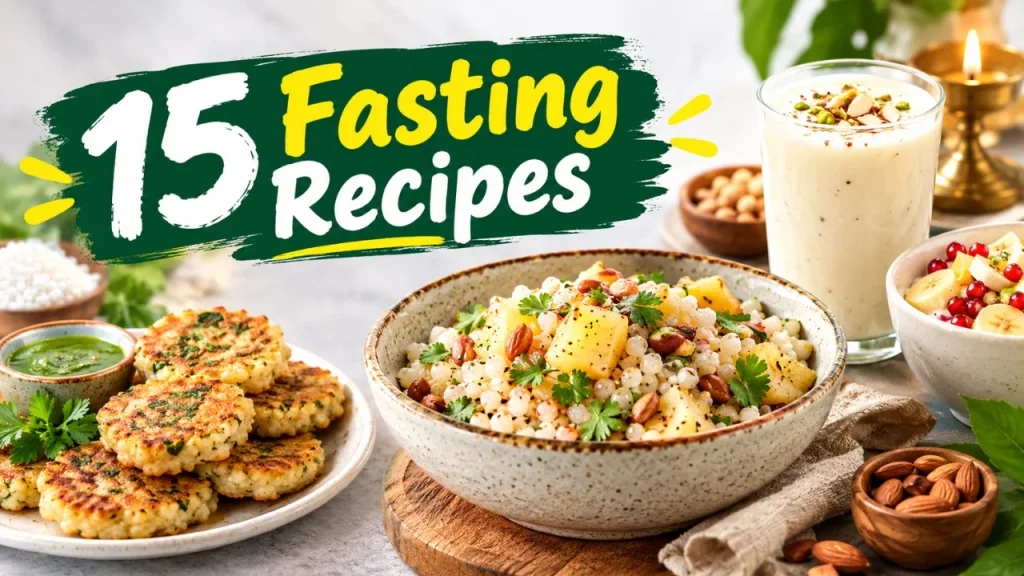
By late afternoon on a long fasting day, a woman at a roadside stall finishes a plate of sabudana khichdi, pays, and walks off certain she’s set for hours. Forty minutes later her hands are a little shaky, her head feels foggy, and she’s eyeing a second plate — the same food that was supposed to fix this is the thing she now needs more of.
The food that feels most filling on a fasting day is often the one that leaves you hungriest two hours later. The difference between a dish that holds you steady and one that spikes-then-crashes comes down to measurable things — grams of protein, grams of fiber, and how fast a starch empties out of the stomach into the bloodstream. Here’s what the numbers actually say.
Myth: Sabudana khichdi is a steady fuel for the whole fasting day
Pearl tapioca, the base of sabudana, is close to pure starch. Per 100 g it contains just 0.19 g protein and 0.9 g fiber against 88.7 g carbohydrate and 358 kcal — and per a 28 g (1 oz) portion that’s only 0.05 g protein and 0.26 g fiber, according to USDA nutrient data on dry pearl tapioca. There is almost nothing in the grain itself to slow glucose from hitting the bloodstream quickly. A small MRI study of gastric emptying in 12 healthy adults found that a glucose solution did sit in the stomach longer in the very first minutes than a protein or fat meal — but by the broader early-emptying window, the volume curves for all three macronutrients looked largely similar. In plain terms: starch can feel heavy in the stomach for a few minutes, but that’s not the same as a slow, sustained release. Potato preparations run on the same logic — a refined starch with little protein or fiber to anchor it, so the “filling” feeling is short-lived by design, not by accident.
Myth: Ghee and oil are what make fasting food “slow burning”
Frying khichdi or chips in ghee or groundnut oil is often credited with making a dish last longer. But fat’s role in slowing digestion is more modest than advertised. In the same MRI gastric-emptying research, fat didn’t uniquely outlast protein or carbohydrate during the early emptying phase — the curves converged. What actually suppressed hunger hormones more effectively was protein: in a crossover trial of 15 healthy men, a high-protein breakfast lowered postprandial ghrelin (the hormone that signals hunger) significantly more than a high-carbohydrate breakfast of equal calories, measured over three hours, according to research on protein, ghrelin and gastric emptying. Separately, a trial giving 20 healthy adults a viscous oat-bran beverage (7.8 g protein, 10.2 g fiber per 300 mL serving) found that preserving the fiber’s natural viscosity produced greater satiety and a smaller glucose rise than the same fiber made thin and non-viscous, per a study on oat bran viscosity and gut hormones. Fat flavors the plate; protein and thick, soluble fiber are what actually slow the gut down.
Myth: A handful of peanuts next to the sabudana fixes everything
Peanuts are genuinely strong — per 100 g they carry 23.2 g protein, 8.01 g fiber, 43.3 g fat and 26.5 g carbohydrate; per 28 g (1 oz) that’s 6.58 g protein and 2.27 g fiber, per USDA data on raw peanuts. Compare that oz-for-oz to tapioca’s 0.05 g protein and 0.26 g fiber per 28 g, and the gap is roughly 100-fold on protein. But “a handful” rarely does the math. One ounce of peanuts adds only 6.58 g protein — not enough to meaningfully blunt a full bowl of starch. Two ounces (56 g) brings about 13.16 g protein and 4.54 g fiber; three ounces (84 g) brings close to 20 g protein — in the range used in controlled feeding studies — but also roughly 37 g of fat, which adds up fast across a single meal. The honest takeaway: fixing a starch-heavy plate with nuts needs closer to two to three ounces stacked onto the dish, not a sprinkle, and that portion needs to be counted as real food, not garnish.
Quick tip: if a fasting plate’s main starch (sabudana, potato, kuttu) supplies less than 1 gram of protein per 100 g, the pairing has to supply the protein almost entirely — aim for at least 15–20 g of protein from nuts, curd or makhana added to that specific plate, not spread thinly across the day.
Myth: Plant protein fills you up on the same timeline as dairy protein
Not all protein behaves identically once swallowed. A randomized crossover trial in 20 healthy adults compared 25 g protein doses from pea protein concentrate, pea protein isolate, pea protein extrudate, and whey protein, tracking plasma amino acids and gastric emptying markers for five hours. The extruded pea protein showed a delayed rise in plasma amino acids compared with the other forms, according to a study on pea protein processing and amino acid response. This is a small, early trial and the forms tested don’t map exactly onto peanuts or makhana, but the principle carries over: how a protein is processed changes how fast its amino acids actually reach the blood — which matters more for sustained fullness than simply hitting a gram target on a label.
Myth: Water, coconut water or buttermilk alone cover you on a long fasting day
This is less about thirst than about what’s missing from the plate. Tapioca is nearly empty of electrolytes — just 1 mg sodium and 11 mg potassium per 100 g, per the USDA tapioca data. Peanuts, by contrast, carry 636 mg potassium per 100 g, per USDA peanut data — nearly 60 times more. On a multi-day vrat built mostly around tapioca, potato, and fruit, the food itself is quietly supplying almost no potassium or sodium, and liquids alone don’t necessarily close that gap. This doesn’t mean panic-dosing electrolyte powders; it means the protein-and-nut side of the plate is doing double duty — supplying both fullness and minerals the starch never had.
Myth: If a meal feels equally heavy, it’s equally satiating
A crossover study with 15 collegiate female soccer players compared a high-carbohydrate pre-game meal against a mixed-macronutrient meal of equal calories (around 1000 kcal), eaten four hours before play. Hunger, satiety and fullness scores differed significantly between the two conditions even though gut symptoms and performance measures didn’t, according to research comparing high-carb and mixed-macronutrient pre-competition meals. This was athletes, not fasters, and the sample is small — but it reinforces the same pattern seen above: equal calories and equal “heaviness” on the plate do not produce equal satiety signals. The macronutrient mix, not the volume of food, is doing the work.
Sources
- USDA FoodData Central: Tapioca, pearl, dry
- USDA FoodData Central: Peanuts, raw
- Delayed Plasma Amino Acid Response following Ingestion of Extruded Pea Protein (2026)
- The effect of macronutrients on gastric volume responses and gastric emptying (2007)
- Effect of a high-protein breakfast on the postprandial ghrelin response (2006)
- Effects of high-carbohydrate versus mixed-macronutrient meals on female soccer physiology and performance (2021)
- Viscosity of oat bran-enriched beverages influences gastrointestinal hormonal responses (2009)

Mick Hudson
Low-and-slow recipes, rubs, sauces and fire management from our pitmaster team.