Quick Apple Cake Recipe: 1 Apple, 1 Egg, and a Few Simple Ingredients
Why the one-apple, one-egg cake sinks or turns dense, and the exact weights, swaps, and pan scaling that fix it for good.
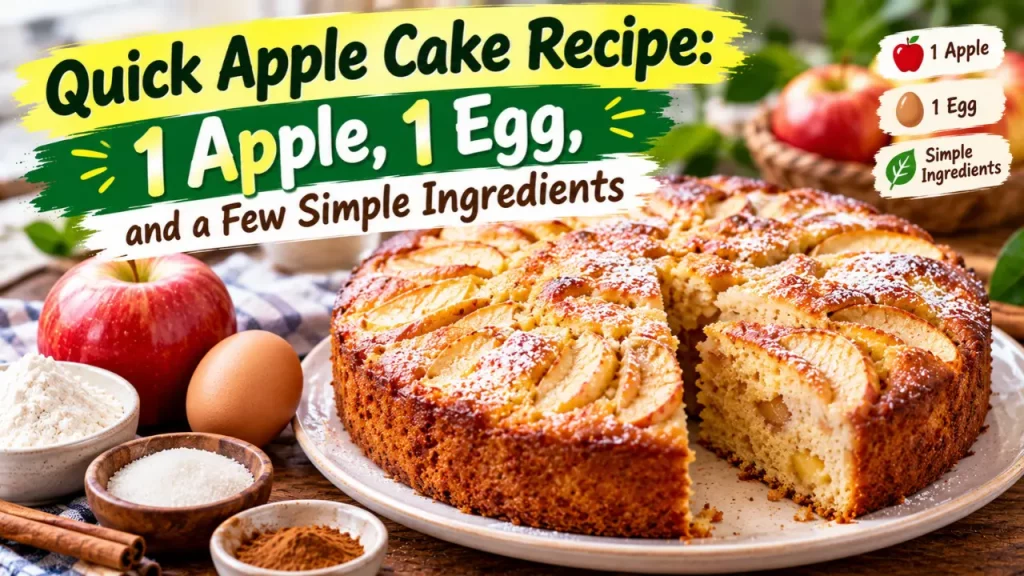
The cake comes out of the oven looking perfect. Golden top, split neatly down the middle where the apple peeked through, kitchen smelling like cinnamon and warm butter. Ten minutes later, while it’s cooling on the counter, the center quietly folds in on itself like a deflating tire. By the time you cut into it, the middle is gummy and the edges are dry. You followed the recipe exactly. So what happened to “exactly,” when the recipe never said how big your apple was supposed to be?
That’s the real problem with a cake built on “1 apple, 1 egg.” An egg is reliably an egg — large eggs sold in cartons are close enough in size to behave the same way every time. An apple is not. A small Gala and a large Honeycrisp can differ by nearly double in weight, and that difference changes the ratio of wet to dry ingredients more than almost anything else in the bowl. This article exists to close that gap, along with the other quiet variables — mixing, altitude, humidity, pan size, and egg allergies — that decide whether your cake rises evenly or sinks in the center.
How much does “one apple” actually weigh?
Recipes that call for “1 medium apple” are leaning on an assumption that doesn’t hold up at the produce bin. A medium apple, once cored and peeled, generally lands somewhere in the neighborhood of 150 to 180 grams of usable fruit, but apples sold as “medium” in stores regularly run smaller or considerably larger than that. If your apple is on the large end, you’re effectively adding extra liquid and natural sugar without adding any extra flour, egg, or leavening to balance it — which is one of the most common hidden reasons this style of cake turns dense or sinks.
The fix is simple and takes ten seconds: weigh the apple after peeling and coring, right before you grate or dice it. If you’re working from a recipe written around a single medium apple, treat roughly 150 to 180 grams of prepared fruit as your target, and adjust the apple quantity — not the other ingredients — if what’s on your cutting board is noticeably bigger or smaller. This one habit solves more texture problems in this cake than any other single change.
Why the center sinks: three different culprits, three different fixes
A sunken middle feels like one problem, but it’s usually one of three separate issues, and treating the wrong one won’t fix anything.
Overmixing. Because this cake is marketed as a one-bowl, stir-it-together recipe, it’s easy to keep stirring well past the point where the flour has disappeared. Extra stirring develops gluten and knocks air out of the batter, so the cake rises fast in the oven and then has nothing structural to hold that height once it cools. The fix is to stop mixing the moment you no longer see dry streaks of flour — a few visible lumps are fine and actually protective.
Underbaking. A cake with grated or diced apple folded through it holds pockets of moisture that keep cooking even after a toothpick in the edge comes out clean. If you’re only testing near the rim, you can pull the cake while the true center is still wet batter, and it will collapse as it sits. Always test in the dead center, and look for the top to feel springy, not just visually golden.
Too much apple moisture relative to batter. This circles back to the weighing issue above. Oversized or very juicy apples release more liquid as they bake, and if the batter doesn’t have enough flour and egg structure to support that moisture, the center can never fully set before the edges are already overbaked.
The apple in this cake isn’t a mix-in, it’s an ingredient with its own weight and water content — treat it as precisely as you’d treat the flour, and most of the cake’s problems disappear on their own.
Baking without the egg
In a cake this small, the single egg is doing real structural work — binding, a little lift, and moisture — so a straight swap needs to replace all three roles, not just the liquid. For most bakers, a flax egg (finely ground flaxseed mixed with water and left to thicken into a gel for a few minutes) or a similar chia-seed version works well in a cake this size, giving enough binding to hold the crumb together, though the texture will be slightly denser and a touch more moist than the egg version. Unsweetened applesauce is another workable substitute here, and it has a pleasant logic to it in an apple cake specifically, but because it adds extra moisture on top of the apple already in the batter, it’s worth trimming the fresh apple slightly or adding a small amount of extra flour to keep the center from turning gummy. A store-bought egg replacer formulated for baking is the most predictable option if you want consistent results without adjusting anything else.
Quick tip: whichever egg substitute you choose, give the batter an extra minute of resting time in the pan before it goes into the oven — flax and chia gels especially benefit from a short rest to finish binding, and that small pause noticeably improves how cleanly the cake slices once it’s cooled.
Scaling up: going from a small pan to a standard 9-inch
This cake is usually built for a small pan, which is part of why it bakes so quickly, but a lot of home bakers only own a standard 9-inch round or square pan. Simply pouring the same small batch into a much larger pan spreads it thin, and it will bake fast and dry out before the center ever sets properly — a different cause of “sinking,” since a too-thin layer can look collapsed even when it’s technically done.
The safer approach is to scale the whole recipe up rather than stretch it. Doubling the apple, egg, flour, sugar, fat, and spice roughly fills a standard 9-inch pan to a comfortable depth. Because the pan is larger and the batter layer is thicker, expect the bake time to run longer than the original small-pan version, and rely on the center test rather than the clock. If you only have one egg-worth of ingredients but a 9-inch pan, it’s better to bake it in a smaller dish, foil ring, or loaf pan sized to match the batter volume than to force it into a pan that’s too big.
Altitude and humidity: the adjustments nobody mentions
At higher elevations, lower air pressure lets cakes rise faster and often fall before the structure sets, which looks exactly like the sinking-center problem described above but has nothing to do with mixing or apple size. Bakers at altitude generally have better luck slightly reducing the leavening, adding a touch more flour for structure, and baking at a slightly higher oven temperature for a shorter time to help the crumb set before it over-expands.
Humidity works on the batter from the other direction. On a humid day, flour itself holds more ambient moisture, and a juicy apple variety adds even more liquid on top of that, which is part of why the same recipe can feel reliable in winter and unreliably dense in late summer. If your kitchen is humid, start with the lower end of your apple-weight range and watch the batter consistency rather than measuring on autopilot.
Back to the counter
Weigh the apple after it’s peeled and cored. Stop stirring the moment the flour disappears. Test the very center, not the edge. Scale the whole recipe, not just the pan. Nudge the leavening and flour if you’re high up or the air is thick with humidity. None of that is complicated, but it’s the difference between pulling out a cake that quietly sinks in the middle and one that holds its shape exactly the way it looked when it went into the oven — the apple cake you meant to make in the first place.

Tom Fletcher
The latest from the Australian and global BBQ scene — comps, cooks and culture.