Rigatoni with Burrata and Tuscan Kale: A Restaurant-Style Pasta Recipe
Can you make burrata-kale rigatoni ahead? Real nutrition numbers, curdling fixes, safe storage, and who should skip the burrata.
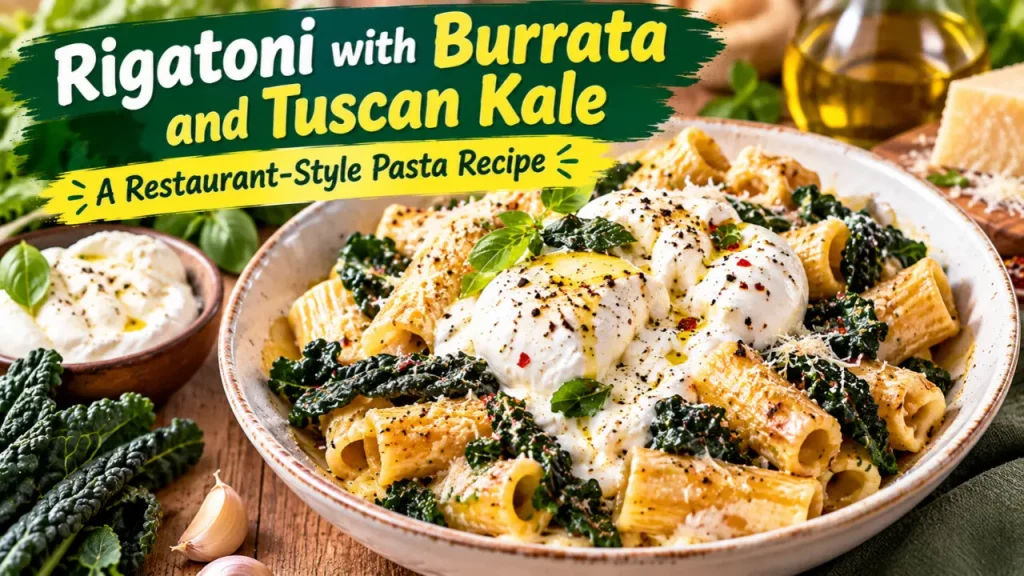
Burrata is the one ingredient in this bowl that does not wait for you. Rigatoni with Tuscan kale and a lemon-brightened tomato sauce reads like a dish you order at a restaurant and never attempt at home, and the honest answer to “can I make this ahead?” is: the pasta and sauce, yes — the burrata, only at the very last minute. Everything below explains why, what the leftovers actually look like on day two, and what you’re really getting nutritionally for the price of that cheese.
1. Can you actually meal-prep this dish?
Yes, but in two separate pieces. The rigatoni, garlicky kale, and tomato sauce hold up fine in the refrigerator for several days because they’re a cooked, acidic, oil-based mixture — the kind of leftover that reheats predictably. Burrata does not belong in that batch-cooked container. It’s a fresh, high-moisture cheese built around a shell of mozzarella holding loose curd and cream, and once it’s torn open and exposed to heat, acid, and time, its texture changes fast and permanently. The practical move is to store the pasta-sauce base as your “meal prep,” then tear fresh burrata over each portion only when you’re about to eat it.
2. Why the sauce can turn burrata rubbery or curdled
This is the part most recipes skip past. Burrata’s interior is essentially cream and soft curd suspended in liquid, stabilized by temperature and minimal acid exposure. Add it to a hot pan of lemon-spiked tomato sauce too early, and two things happen at once: the heat tightens the milk proteins (the same mechanism that makes scrambled eggs rubbery if overcooked), and the acid from both the lemon and the tomatoes accelerates protein coagulation, causing the creamy interior to separate into grainy curd and watery whey. The fix is sequencing, not luck — pull the pan off direct heat, plate the pasta, and lay the burrata on top so residual warmth softens it without actively cooking it. If you’re reheating leftover sauce the next day, the same rule applies in reverse: warm the sauce fully first, then add cold, fresh burrata to the hot finished plate, never the other way around.
3. Storing and reheating leftovers without wrecking them
Cool the pasta and sauce quickly, refrigerate in a sealed container, and plan to eat it within three to four days — standard practice for a cooked, dairy-adjacent, acidic leftover. When reheating, use the stovetop over medium-low heat with a splash of water to loosen the sauce rather than the microwave, which tends to overheat the edges of a dish before the center catches up. Never reheat already-added burrata; it was never designed to survive a second heating cycle. If you have leftover burrata on its own (a common situation since balls are often sold in pairs), keep it submerged in its original liquid or a light brine in the fridge, use it within a day or two of opening, and bring it toward room temperature only right before serving — don’t microwave it to “soften” it, which guarantees the rubbery outcome you’re trying to avoid.
4. What you’re actually eating: the nutrition numbers the recipe skips
A dish marketed as “restaurant-style” deserves a real accounting, and here honesty matters more than false precision. Rigatoni, canned tomatoes, kale, olive oil, and burrata each bring very different sodium, fat, and protein loads depending on brand and portion, so a single universal calorie count for “the recipe” would be a guess dressed up as data. What is measurable and worth knowing: canned tomato products are consistently one of the largest sodium contributors in home-style Italian sauces, so if you’re salt-sensitive, checking the label for “no salt added” versions and seasoning by hand gives you real control instead of inheriting whatever a can manufacturer chose. Burrata itself is calorie-dense for its size because it’s mostly fat and water rather than lean protein, which is exactly why a small amount tastes so rich — you’re not meant to eat a large portion of it the way you would mozzarella in a salad.
5. Who should think twice before digging in
Burrata is a fresh, soft, high-moisture cheese, and that category carries a higher general food-safety profile than aged, hard cheeses because moisture supports bacterial growth more readily. Pregnant people, young children, older adults, and anyone immunocompromised are routinely advised by food-safety guidance to be cautious with soft, fresh dairy unless it’s clearly made from pasteurized milk and handled with a reliable cold chain — check the label, buy from a source you trust, and don’t let it sit at room temperature during a long dinner party. This isn’t a reason to avoid burrata entirely for most healthy adults; it’s a reason to treat it the way you’d treat any fresh, unaged dairy product — bought recently, stored cold, and eaten promptly.
6. What cooking does — and doesn’t do — to the kale
Tuscan kale changes nutritionally the moment it hits a hot pan, and not entirely for the worse. Research on hot-water blanching of kale found that heat processing leaches out water-soluble nutrients: fresh kale starts around 102 mg of potassium and 1,165 micrograms of vitamin B3 per 100 g, and both potassium and the heat-sensitive B vitamins and vitamin C drop with blanching time and temperature, according to a 2024 study on blanching and nutrient retention in kale and spinach. The same research notably found spinach starts with far more potassium than kale — 615 mg per 100 g versus kale’s 102 mg — a reminder that these two “interchangeable” leafy greens aren’t nutritionally equivalent to begin with. For most home cooks this isn’t a reason to eat kale raw instead; a quick sauté, as this recipe calls for, is far gentler than a prolonged blanch, so the losses are smaller than the study’s more extreme time-temperature combinations.
7. The tomato side actually gets better with cooking
While kale loses some nutritional ground to heat, the tomato sauce gains it. Lycopene and beta-carotene — the carotenoids responsible for tomatoes’ red color and much of their antioxidant reputation — become more bioavailable, not less, after cooking. A pilot human study found that both rustic and strained cooked tomato purées raised blood levels of lycopene and beta-carotene isoforms along with overall antioxidant potential, with the effect stronger for strained purée, per a 2021 Nutrients pilot study on tomato purée bioavailability. A smaller crossover trial of fifteen healthy volunteers similarly found that cooked tomatoes with olive oil significantly raised plasma lycopene, while raw crushed tomato alone did not, according to a 2012 Nutrición Hospitalaria cooking-method study. A small five-person crossover study of cherry tomatoes reported comparable bioavailability shifts for cooked versus fresh preparations, per a 2004 European Journal of Nutrition cooking study, and earlier work found lycopene itself stays remarkably stable through processing and up to twelve months of storage, with cooking in oil favoring a more absorbable cis-isomer form, according to a 2001 Journal of Medicinal Food review. These are small human studies, not large trials, but they agree with each other: the olive oil and simmering time in this sauce aren’t just for flavor.
So the dish earns its splurge status conditionally. Make the sauce and pasta ahead without hesitation, treat the burrata as a same-day, last-minute finish, keep soft-cheese caution in mind if you’re in a higher-risk group, and don’t mourn the kale’s modest nutrient losses — the simmered tomatoes are quietly making up ground the kale gives away.
Sources
- Effect of blanching time-temperature on potassium and vitamin retention in kale and spinach (2024)
- Nutritional controlled preparation of tomato purées and antioxidant bioavailability pilot study (2021)
- Influence of cooking procedure on lycopene bioavailability in tomatoes (2012)
- Effect of domestic cooking on bioavailability of tomato antioxidants (2004)
- Lycopene content of tomato products: stability and bioavailability (2001)

Mick Hudson
Low-and-slow recipes, rubs, sauces and fire management from our pitmaster team.