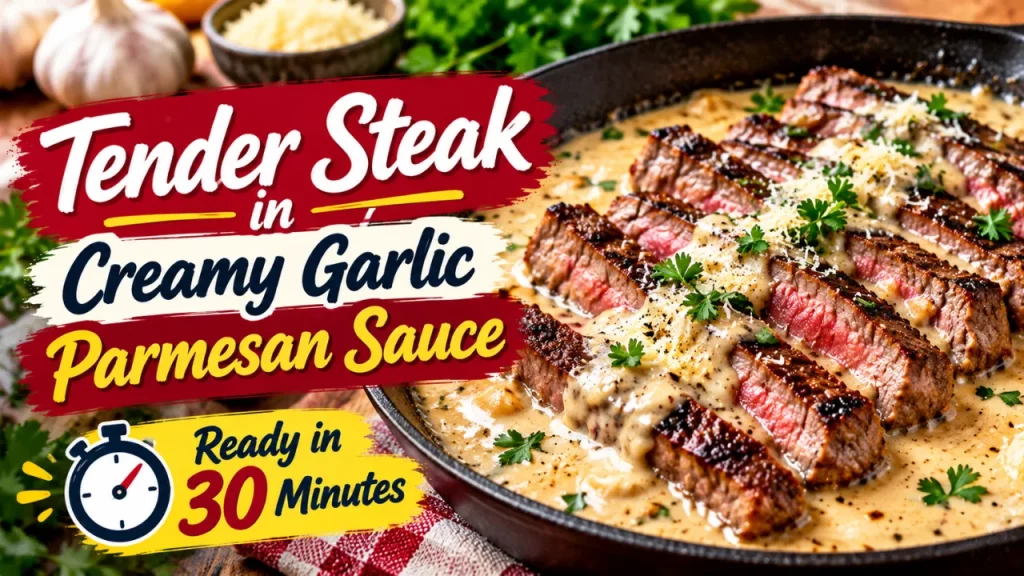
Tender Steak in Creamy Garlic Parmesan Sauce — Ready in 30 Minutes
Exact temps for every steak cut, why cream sauces curdle, and the sodium and saturated-fat math nobody runs on this dish.
Of the 347,747 people tracked across 21 studies in one large meta-analysis of saturated fat and heart disease, those eating the most saturated fat were not statistically more likely to develop coronary heart disease, stroke, or cardiovascular disease than those eating the least. That finding does not make a butter-and-cream sauce “healthy,” but it does mean the conversation about this dish is more nuanced than most recipe sites let on — and it’s one of several things worth knowing before you put a ribeye in a hot pan tonight.
The short version: match your steak’s thickness and cut to a specific internal temperature, stabilize the sauce with a small amount of starch, and if sodium or dairy is a concern for you, specific swaps protect both the texture and your health goals.
What internal temperature should I pull each steak cut off the heat?
The number depends on the cut, not just the doneness you want, because fat content and muscle fiber density change how a steak carries heat and how it reads on a thermometer. Pull steaks 3-5°F before your target, since they continue cooking while resting.
| Doneness | Target internal temp | Ribeye (1.25 in, fatty, forgiving) | NY Strip (1 in, firm, even) | Top Sirloin (1 in, lean) | Filet Mignon (1.5-2 in, very tender) |
|---|---|---|---|---|---|
| Rare | 120-125°F | 2 min/side | 1.5 min/side | not recommended (toughens) | 3 min/side |
| Medium-rare | 130-135°F | 3 min/side | 2.5 min/side | 2 min/side | 4 min/side |
| Medium | 140-145°F | 4 min/side | 3.5 min/side | 3 min/side | 5 min/side |
| Medium-well | 150-155°F | 5 min/side | 4.5 min/side | 4 min/side | 6 min/side |
| Well-done | 160°F+ | not ideal — dries out fast | 6 min/side | 5 min/side | 7 min/side |
Sirloin is the leanest and least forgiving cut here: push it past medium-rare and the muscle fibers seize up with almost no fat left to carry flavor, so it toughens faster than ribeye or filet at the same temperature. Filet has so little connective tissue that it stays tender even at medium, but it also has the least marbling, so it dries out in a hot sauce faster than ribeye does if you let it sit.
Why does the cream sauce break, and what actually fixes it?
Cream sauces split because the proteins in dairy coagulate and squeeze out the fat when they’re overheated or hit with acid, and a sauce with too little fat per protein has no buffer to stop that. Heavy cream, at roughly 36-40% milkfat, has enough fat coating the protein molecules that they resist clumping even near a boil. Half-and-half and whole milk have far less fat relative to protein, so their proteins denature and curdle into visible grains the moment the pan gets too hot or garlic’s acidity tips the balance. A tablespoon of flour or a teaspoon of cornstarch, whisked in before the liquid goes in, works by forming a starch network that physically keeps protein molecules apart as the sauce heats — which is exactly why some recipes quietly include a thickener without explaining what it’s doing. If your sauce does break, pulling it off heat and whisking in a splash of cold cream, one tablespoon at a time, can sometimes re-emulsify it; a starch-thickened sauce is far less likely to need the rescue in the first place.
Which cream substitute won’t curdle, and which ones will?
Fat percentage is the deciding factor, not the label on the carton. Full-fat canned coconut milk (around 17-24% fat) behaves similarly to heavy cream and holds up to heat, though it carries its own flavor and a high saturated-fat load. Cashew cream, blended smooth, has enough fat and almost no dairy protein to curdle, making it a reliable dairy-free option. Lactose-free heavy cream is identical in fat and protein to regular heavy cream — the lactose is just pre-broken-down — so it performs exactly the same in the pan and is the simplest fix for lactose intolerance alone. Oat-based creamers vary widely in fat content, so check the label; most need a cornstarch assist to avoid splitting.
Which oil should I use for the sear, and does it matter?
It matters because a sear needs sustained heat well above where some oils start to smoke and turn bitter. Avocado oil, refined and neutral, has one of the highest smoke points among common cooking oils and tolerates the high, dry heat a good crust requires. Refined (not virgin) canola oil also holds up reasonably well at searing temperatures. Extra-virgin olive oil has a noticeably lower smoke point and will scorch before the pan is hot enough to sear properly — save it, and the butter in the recipe, for finishing the sauce once the heat comes down.
How much sodium and saturated fat does this dish realistically carry?
Butter, heavy cream, parmesan, and broth are each independently high in sodium or saturated fat, and stacked together in one pan they compound. This matters because sodium reduction has one of the best-documented effects on blood pressure in nutrition science: a systematic review of 133 randomized trials found that cutting sodium intake by about 130 mmol a day (roughly 3 grams) lowered blood pressure in a clear dose-response pattern, and a dose-response meta-analysis of 85 experimental studies spanning sodium intakes from 0.4 to 7.6 grams a day confirmed the same pattern. The landmark DASH-Sodium trial found that simply moving from a high to an intermediate sodium level dropped systolic blood pressure by 2.1 mmHg — without changing anything else about the diet. Parmesan and canned or boxed broth are both concentrated sodium sources, which is exactly where this dish’s sodium load comes from.
Can I still eat this if I’m watching sodium, cholesterol, or dairy?
Yes, with targeted swaps rather than giving up the dish entirely. For sodium: use unsalted butter, a low-sodium or no-salt-added broth, and treat parmesan as a seasoning rather than a bulk ingredient, since a little goes a long way on flavor. For saturated fat and cholesterol concerns: the evidence is genuinely mixed rather than settled — the same meta-analysis cited above found no significant association between saturated fat intake and cardiovascular disease across 347,747 people, while a separate review on saturated fat and cardiovascular disease notes that what you replace it with matters: swapping it for refined carbohydrates doesn’t reliably help, while swapping for unsaturated fats generally does. If you’re managing cholesterol on your doctor’s advice, trimming the butter and leaning on the garlic, pan juices, and a lower-fat cream alternative preserves most of the dish’s character. For lactose intolerance, a lactose-free heavy cream swap, gram for gram, is the one substitution that changes nothing about how the sauce behaves.
Sources
- Dose and duration of dietary sodium reduction and blood pressure (BMJ, 2020)
- Meta-analysis of saturated fat and cardiovascular disease (AJCN, 2010)
- Saturated fat, carbohydrate, and cardiovascular disease (AJCN, 2010)
- DASH-Sodium trial (NEJM, 2001)
- Dose-response meta-analysis of sodium reduction and blood pressure (Circulation, 2021)

Mick Hudson
Low-and-slow recipes, rubs, sauces and fire management from our pitmaster team.