7 Budget-Friendly High-Protein Meals for Busy Weeknights
Real protein-gram and sodium numbers for cheap weeknight meals, plus who with gout, kidney disease, or high blood pressure should pump the brakes.
A single 100-gram serving of plain canned tuna already carries 219 mg of sodium before you add a single pinch of salt, a slice of cheese, or a splash of soy sauce — a number straight from USDA FoodData Central’s analysis of canned tuna in water. That same serving delivers 19 g of protein. Nobody writing about cheap weeknight dinners is putting those two numbers side by side, and that’s the problem this article fixes.
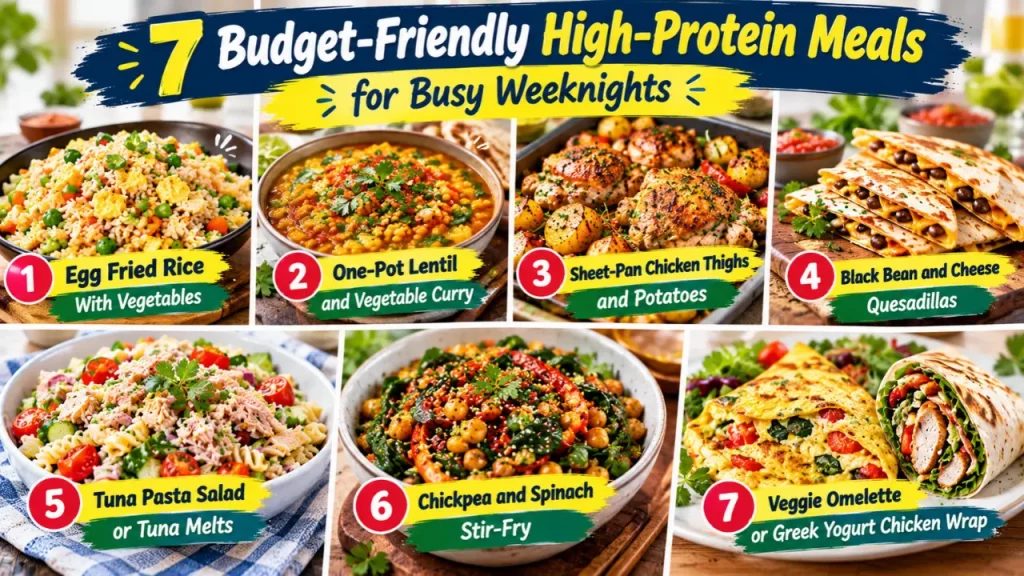
Here are seven budget-friendly combinations built on the usual cast of cheap proteins — eggs, beans, lentils, canned fish, chicken thighs, and tofu — which other roundups already cover in detail, so we won’t repeat the shopping or batch-cooking advice here:
- Canned tuna and white bean salad with lemon
- Lentil and canned tomato dal over rice
- Sheet-pan chicken thighs with roasted vegetables
- Black bean and egg skillet
- Tofu and vegetable stir-fry
- Chicken thigh and chickpea curry
- Tuna melt quesadillas
What none of those lists tell you is how many grams of protein you’re actually banking per plate, what it costs you in sodium, and whether the cheapest option on the list is even a good idea if you have gout, kidney disease, or high blood pressure. That’s what the rest of this piece answers, organized around the claims that keep getting repeated without being checked.
Myth: “20 to 30 grams of protein per meal” tells you what you’re actually eating
It doesn’t, because it’s a target, not a measurement. Using the one ingredient with precise, published numbers — canned tuna — a 100-gram serving provides 19 g of protein, according to USDA data. A 28-gram (1 oz) portion provides 5.39 g. That means hitting “20-30 grams” from tuna alone requires something closer to 150 g of drained fish, not a token forkful. If you’re trying to reach a daily total of 150 g of protein — a common target for people prioritizing muscle maintenance — three 100-gram tuna servings spread across the day get you to 57 g. The other roughly 93 g has to come from somewhere else on your plate, and the only way to know if you’ve closed that gap is to check the label on whatever you’re pairing it with, not to estimate by eye.
This matters beyond arithmetic because of how the body actually uses the protein you eat. Research on meal-by-meal protein distribution has looked at whether spreading intake evenly across the day, rather than loading most of it into one dinner, makes a measurable difference to how efficiently that protein gets used for tissue repair and maintenance; the findings in this area, summarized in work published in Nutrients, point toward an even spread mattering more than most home cooks assume (doi.org/10.3390/nu9070791). Related work from the sports nutrition field has examined how the timing and quality of protein sources across the day interact with training and recovery (doi.org/10.1186/s12970-017-0189-4). Practically, that means a tuna melt quesadilla at lunch and a chickpea curry at dinner isn’t automatically “enough protein” just because both dishes contain a recognized protein source — you still have to add up the grams, meal by meal, the same way you’d add up a grocery bill.
A concrete example makes this less abstract. Picture a black bean and egg skillet: two eggs (about 12-13 g of protein combined) plus half a cup of black beans (roughly 7-8 g) lands you around 20 g — technically inside the target range, but only if you’re not skimping on the bean portion to save money, which is exactly the kind of substitution a tight grocery budget encourages. The practical step is to weigh or measure the protein component once, the first time you make a recipe, and write the number on an index card or in your phone’s notes app. You don’t need to do it every time; you need to do it once per dish so you’re not guessing forever. The caveat: none of this applies if your goal is simply “eat reasonably well on a budget” rather than hitting a specific gram target — in that case, variety and consistency matter more than precision.
Myth: the cheapest proteins on the list are nutritionally interchangeable
Tofu, lentils, canned tuna, eggs, and chicken thighs all get filed under “cheap protein” as if the only meaningful difference between them is price per gram. That’s a convenient simplification for a shopping list, but it erases real differences in what else these foods bring to your plate. Tofu, for instance, contains soy isoflavones — plant compounds that have been studied for their steroid-like activity in the body, including interactions with hormone pathways, as reviewed in research published in Steroids (doi.org/10.1016/j.steroids.2011.12.006). For most people eating tofu a few times a week as part of a stir-fry rotation, this is a non-issue; it becomes a relevant question mainly for people managing hormone-sensitive conditions, who are usually advised to discuss soy intake with a clinician rather than rely on a weeknight-dinner roundup to settle the question.
Lentils and beans carry their own distinct profile of bioactive compounds — polyphenols, fiber fractions, and other plant constituents that don’t show up on a basic nutrition label but have been the subject of ongoing biochemical research into how legumes affect metabolism beyond their protein and calorie counts (doi.org/10.1016/j.biochi.2026.01.002). This is part of why a lentil dal and a chicken thigh curry, despite landing in a similar protein-per-dollar range, aren’t nutritionally equivalent meals — one brings fiber and plant compounds that chicken simply doesn’t have, and the other brings a different amino acid profile and no fiber at all. The practical takeaway isn’t to rank these foods against each other; it’s to stop treating “cheap protein” as a single category when deciding what to eat across a week. Rotating between animal and plant sources, rather than defaulting to whichever is cheapest that week, is the simpler way to cover these gaps without having to track individual compounds.
Sodium adds up faster than the recipe implies
Go back to that 219 mg of sodium in a single 100-gram serving of canned tuna. On its own, that’s a modest number — well within typical daily guidelines. The problem is that almost none of the seven dishes on the opening list stop at plain tuna. A tuna melt quesadilla adds shredded cheese and usually a tortilla, both of which carry their own sodium load; a black bean and egg skillet made with canned beans (rather than dried, cooked-from-scratch beans) adds canning liquid sodium on top of whatever salt goes into the pan; a chicken thigh curry built on a jarred paste or bouillon cube can quietly outpace the tuna by itself. None of this shows up if you’re only checking the protein count, which is exactly why sodium gets treated as an afterthought in budget-cooking roundups that are optimized for cost and protein grams, not blood pressure.
This is where the stakes are highest for people who don’t fit the “healthy adult” default these lists are written for. Research connecting dietary sodium intake to blood pressure outcomes — the kind of population-level evidence behind public health sodium guidelines — has been published in nutrition journals including the British Journal of Nutrition (doi.org/10.1017/s0007114508051532). If you have diagnosed hypertension, kidney disease, or a history of gout, the sodium content of a dish matters at least as much as its protein count, and stacking multiple sodium-heavy ingredients in one meal — canned fish, canned beans, cheese, a salty curry base — can put a single dinner well past what a label-focused shopper would expect. The practical fix is unglamorous but effective: rinse canned beans under running water before using them (this measurably reduces the sodium clinging to the surface), choose a low-sodium or no-salt-added tuna when it’s available, and build curries and dals from raw spices rather than pre-made pastes when sodium is a concern. None of this requires abandoning the cheap-protein dishes on the list — it just means reading the sodium line on the label with the same attention most people already give the protein line.
What to actually do with these seven dishes
None of this is an argument against the original list — tuna and white bean salad, lentil dal, sheet-pan chicken thighs, and the rest remain genuinely inexpensive ways to eat. The point is that “cheap” and “high protein” are not the only two variables that matter when you’re choosing what to cook on a Tuesday night. Before you lean on any one of these dishes as a weekly staple, it’s worth doing the one-time work of checking its actual protein count against your target, noting whether it leans on canned or processed ingredients that quietly raise its sodium load, and asking whether you fall into one of the groups — hormone-sensitive conditions, kidney disease, hypertension, gout — for whom one of these cheap staples needs a modification rather than a blind substitution. That’s a half hour of label-reading, once, not a lifestyle overhaul, and it’s the difference between a list of recipes and an actual plan for what you eat.
Sources
- USDA FoodData Central — Canned tuna in water, nutrient profile
- British Journal of Nutrition — dietary sodium and blood pressure
- Nutrients — protein distribution across meals
- Steroids — soy isoflavones and hormone pathways
- Biochimie — bioactive compounds in legumes
- Journal of the International Society of Sports Nutrition — protein timing and quality
