Retro McDonald’s Happy Meal Toys Worth Money: 8 Childhood Keepsakes Collectors Now Chase
The real price gap in vintage Happy Meal toys comes down to sculpt, color, packaging and region, not just age or nostalgia.
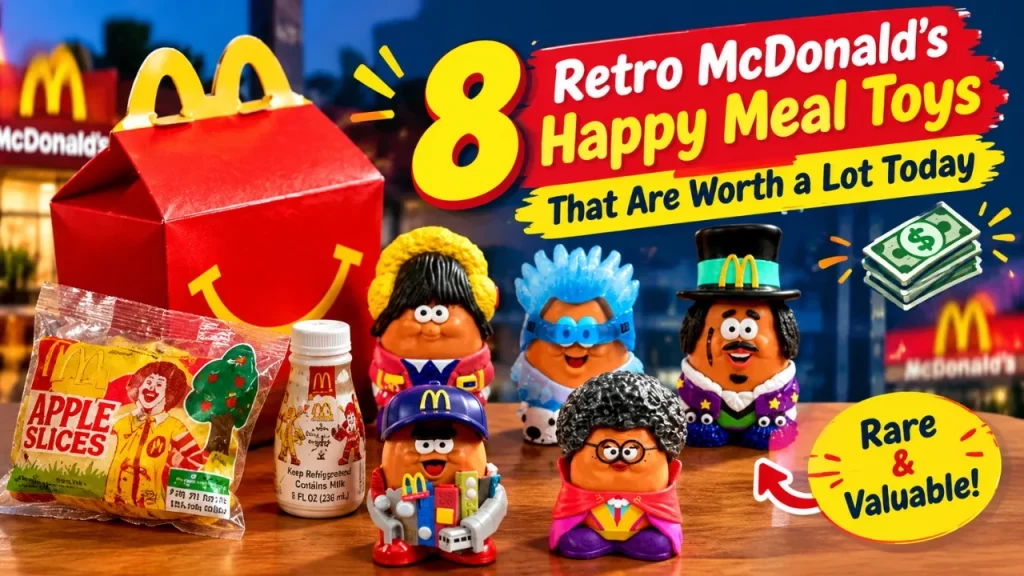
You’re digging through a bin in your parents’ garage, past wrapping paper and a tangle of extension cords, when you find them: a little plastic hamburger that unfolds into a robot, a yellow bird clipped to a tiny parachute, a cardboard Halloween pail with one dented corner. You snap a photo and search the name, and the listings make no sense at all. The exact same toy, same year, same box, is “worth $5” on one site and “worth $500” on another, with nothing explaining the gap except a vague note that condition matters.
Condition is only the beginning of the story. The real price gap in this hobby is built on small, specific manufacturing accidents: a sculpt that got swapped mid-run, a color that only shipped to one region, a bag seal that proves a toy never left the factory tray. Here is what actually separates the junk drawer from the jackpot.
1. The six-figure toy is probably not what you think it is
Collector forums and auction recaps occasionally circulate a headline number in the neighborhood of $300,000 for a McDonald’s toy, and it gets repeated as proof that any old Happy Meal premium might be a lottery ticket. It isn’t. When prices at that level surface, they almost always trace back to something that was never sold to the public in the first place — a factory prototype, an employee-only sample, a store-display piece, or a test-market item pulled before a wide release. These are one-of-a-kind or handful-of-a-kind objects, not toys that millions of kids got with a cheeseburger.
It’s also worth saying plainly that eye-popping private-sale figures in this hobby are hard to independently verify. Auction houses and resellers have an incentive to publicize a record price because it raises the perceived value of everything adjacent to it. Treat any six-figure number as a story about a one-off object, not a benchmark for the toy sitting in your bin.
2. Regional and test-market releases beat the famous sets
Everyone lists the obvious national lines. What rarely gets explained is that some of the scarcest McDonald’s toys never had a national run at all. Promotions tied to a regional TV license or a short pilot test — toys connected to shows that were popular in specific markets rather than coast to coast — were sometimes produced in small batches, tested in a limited number of stores, and discontinued before wide distribution. A toy from a licensed property that mostly shows up in one country’s or one region’s Happy Meal archives will often out-price a far more famous character simply because so few households ever had the chance to get one.
This is the opposite of how most people shop for nostalgia. They search for the show they remember, not the show that barely made it to their town. The toys worth tracking down are often the ones you’ve never heard of, tied to properties that quietly vanished from syndication.
3. Same name, same year, different toy entirely
Within a single licensed set, the sculpt, color, and packaging can change between production runs without the toy’s name ever changing on the box. A running error, a paint substitution, or a last-minute mold tweak can create two versions of “the same” toy that look nearly identical at a glance but sell for very different amounts.
| Variant type | What actually changed | Why it moves the price |
|---|---|---|
| Sculpt variant | An early production mold replaced mid-run for safety or cost reasons | The discontinued sculpt exists in far smaller numbers |
| Color variant | A character shipped in an unusual paint or plastic color for part of the run | Off-color pieces are visually distinct and easy to prove rare |
| Packaging state | Factory-sealed polybag versus loose, played-with toy | Sealed examples prove the toy was never opened or swapped |
| Printed error | A misspelled name, wrong character photo, or backwards logo on the bag | Error copies are accidental and never corrected in large quantities |
| Regional release | Toy issued only in a test market, not nationwide | Total surviving supply is a fraction of a national run |
None of this shows up by glancing at a toy. It takes comparing your piece against close-up reference photos of the known variants before you trust any price you see online.
4. What grading actually buys you
Professional grading services, most notably AFA (Action Figure Authority), seal a toy in a hard plastic case with a numeric grade and notes on the box, bubble, and sticker condition. For a genuinely rare, still-sealed piece, a high grade turns a private guess into a verifiable, resellable asset, and buyers will pay a premium just for the confidence that someone independent already checked it.
For an average loose toy, or a common set missing its packaging, grading is close to pointless. The fee alone can exceed what the toy would sell for, and a grading slab can’t make a common figure rare. Grading only pays off when the underlying item was already a known scarce variant in strong original condition — it confirms value, it doesn’t create it.
5. Why a complete set can sell for less than its best piece
A buyer looking for a full matching set usually wants nostalgia and display value, and will pay a moderate, fairly predictable amount for that experience. A buyer hunting one specific chase piece — the discontinued sculpt, the error print, the regional exclusive — wants exactly one thing and will pay well past what the rest of the set is worth to get it.
The price of any piece in this hobby is set by how it failed to match the rest of the run, not by how old it is or how complete the set looks.
That’s why sellers sometimes get more by breaking a set apart and selling the one unusual figure separately, rather than bundling it with five common pieces that drag the average price down.
6. Spotting fakes and reproductions before you buy or sell
As prices climbed, reproduction packaging and recast plastic figures followed. Common red flags include printing that’s too crisp or too glossy compared with the slightly muted, uneven ink of genuine decades-old packaging, plastic that feels lighter or more flexible than original runs, and seams or parting lines in the wrong place on a figure.
Cross-check any listing against several verified sold examples rather than one seller’s photos, look closely at logo fonts and copyright dates printed on the packaging, and be wary of “sealed” bags that look crisp with no shelf wear at all on a toy supposedly decades old. A toy that seems too clean for its age is worth a second look before it’s worth a payment.
The next time a box of old Happy Meal toys turns up in a closet, skip the single asking-price search that tells you nothing. Check the sculpt against known variants, look for a region or error that sets your copy apart, and only then decide whether it’s a keepsake or a sale.

Tom Fletcher
The latest from the Australian and global BBQ scene — comps, cooks and culture.