Prunes vs Dates vs Raisins: Which Dried Fruit Wins?
The real winner depends on whether you have IBS, take blood thinners, manage diabetes, or need stronger bones — not on a single nutrition label.
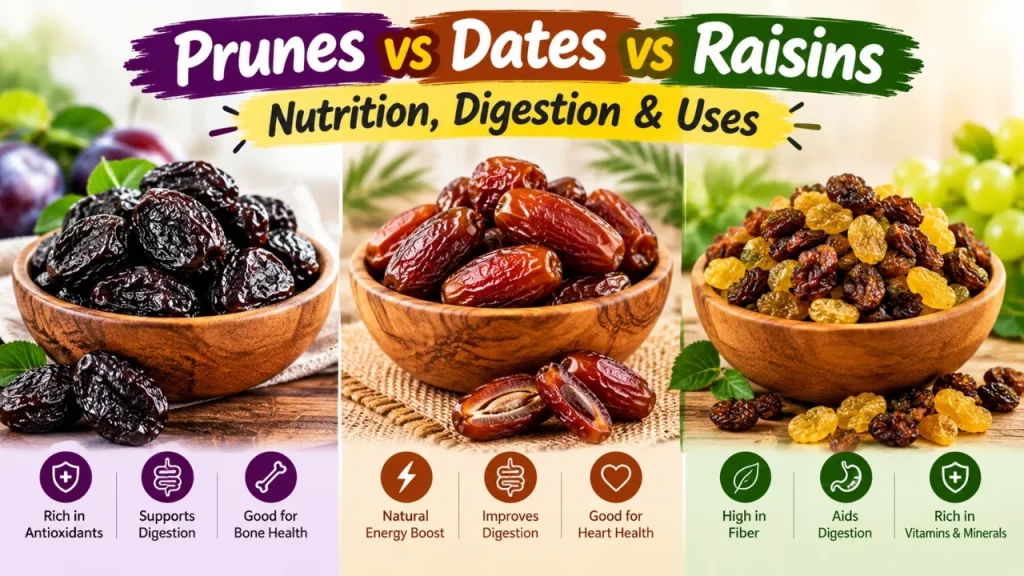
- There is no single winner — the right dried fruit depends on your gut, your medications, your blood sugar, and your bones.
- Dates and raisins are classified high-FODMAP because of excess fructose and fructans; prunes sit in a different category because their main irritant is sorbitol, not fructose.
- People on warfarin or other vitamin K–sensitive blood thinners need to treat prune intake as something to keep consistent, not something to suddenly increase.
- Prunes are the only one of the three studied repeatedly in human bone trials, with doses of 50–100 g a day tested for up to a year.
Which one should actually be in your pantry — the wrinkled prune, the sticky date, or the handful of raisins? The honest answer isn’t “prunes win” or “dates win.” It’s that each of these fruits behaves differently once it hits your specific body, and the comparison that matters is the one between the fruit and your condition, not the fruit and its neighbor on the shelf.
There is no universal winner — only a best fit
Calorie counts and fiber grams per 100 g get repeated everywhere, and yes, prunes are generally regarded as the best option for constipation thanks to sorbitol and fiber, while raisins carry more iron and sugar, and dates work well as a quick energy source. None of that tells a person with irritable bowel syndrome, a person on blood thinners, a diabetic snacker, or a postmenopausal woman worried about her hip whether to reach for the bag or leave it on the shelf. That’s the actual decision this article is built around.
Why one fruit gives you diarrhea and another doesn’t
Prunes, dates, and raisins all cause digestive trouble through different sugar chemistry, which is why a person can tolerate one and react badly to another. Prunes rely heavily on sorbitol, a sugar alcohol the gut absorbs slowly and incompletely — the more that reaches the colon undigested, the more water it pulls in, which is exactly the mechanism behind their laxative reputation. Dates and raisins, in contrast, are loaded with fructans and free fructose in amounts that exceed what the small intestine can absorb efficiently in many people, which is the textbook definition of a high-FODMAP food. That distinction matters clinically: someone with IBS who is following a low-FODMAP plan may find prunes sit in a “moderate” category depending on portion, while dates and raisins are flagged high-FODMAP even in modest amounts because of their fructose load, not their fiber. There is no single dose that applies to everyone — individual tolerance to sorbitol and fructose varies substantially from person to person — but anyone with a sensitive gut should treat portion size, not fruit choice alone, as the real variable they control.
The blood-thinner warning other comparisons skip
Prunes are a plum-derived fruit, and like other dark produce they contain vitamin K, the nutrient that directly counteracts how warfarin and similar anticoagulants work. This isn’t a reason to avoid prunes outright, but it is a reason to avoid the up-and-down pattern many people fall into — eating none for weeks, then adding a daily handful for constipation relief. For anyone on warfarin, the safer approach recommended by anticoagulation clinics in general is consistency: if prunes are going to be part of the diet, the amount should stay roughly the same week to week so the anticoagulant dose can be matched to it, rather than swinging with no warning to the care team monitoring the blood thinner.
Diabetes: portion control matters more than the label
The glycemic index ranking most comparisons lead with — prunes lowest, raisins highest — is accurate but incomplete for someone actually managing blood sugar day to day. The practical risk isn’t the dried fruit itself, it’s how easy it is to eat past a sensible portion, especially with dates and raisins, which are small, sweet, and don’t fill you up the way fiber-dense prunes do. A diabetic snacker is far more likely to accidentally double or triple a date or raisin portion in one sitting than a prune portion, simply because the pieces are smaller and the sweetness invites more bites.
Bone health: where prunes genuinely stand apart
This is the one area where the research gap between the three fruits is largest, and it isn’t close. Prunes are the only dried fruit that has been tested repeatedly in randomized controlled trials for bone density, not just assumed to be “healthy” by association. A systematic review and meta-analysis of prune trials pooling 747 participants across eleven studies found bone mineral density at the lumbar spine trending higher in postmenopausal women who consumed prunes, though the effect was borderline and the studies varied a lot in design and results (I² = 98%, meaning the trials disagreed with each other substantially). A separate review of prunes and inflammatory pathways in bone health describes how prune polyphenols appear to lower markers like malondialdehyde and suppress inflammatory signaling (NF-κB) in preclinical models, alongside early clinical trial data in postmenopausal women — encouraging, but still an emerging body of evidence rather than settled fact.
Dose-controlled human trials back this up to a degree. The Prune Study trial design randomized 235 postmenopausal women to 0, 50, or 100 g of prunes daily for twelve months alongside standard calcium and vitamin D. In men, a one-year trial in 59 older men found no significant change in total or lumbar spine bone density after a year of 50 g or 100 g daily prune intake, but osteoprotegerin — a marker tied to bone turnover — declined significantly less in the prune groups than in the control group, suggesting some protective signal even without a density change. An earlier, shorter three-month trial in 35 men found that 100 g of prunes daily significantly lowered osteocalcin, and 50 g lowered osteoprotegerin, both markers of bone metabolism. None of these trials looked at dates or raisins this way — the bone-health conversation, when it comes to dried fruit, is really a prune conversation.
Sulfites, golden raisins, and treated fruit
Not all raisins are the same fruit in disguise. Golden raisins are typically treated with sulfur dioxide during drying to preserve their lighter color, while dark raisins generally are not. People with sulfite sensitivity — which can trigger wheezing or flushing, especially in those with asthma — should check labels rather than assume “raisins are raisins.” Commercially pitted dates and prunes can carry similar additives for color or shelf life, so the same label-reading habit applies across all three fruits, not just raisins.
The piece-count trap
A 30 g serving sounds like a fair way to compare these fruits, but in real snacking it rarely looks the same. Thirty grams of prunes is a small handful of several whole pieces; the same weight in dates is often just two or three, and in raisins it’s a loose fistful of dozens of tiny pieces. Anyone portioning “by eye” rather than by scale is likely under-eating dates and over-eating raisins relative to the number assumed on a nutrition label — worth knowing before blaming the wrong fruit for a blood sugar spike or a bloated stomach.
What to actually do
- IBS/FODMAP sensitivity: start with small, weighed portions of prunes rather than dates or raisins, and track your own tolerance rather than assuming a “safe” amount.
- On warfarin or similar anticoagulants: keep prune intake steady week to week and tell your anticoagulation clinic if you plan to start or change the amount.
- Diabetes: weigh portions of dates and raisins instead of eyeballing them — their small size makes overeating easy.
- Bone health, especially postmenopausal women and older men: prunes are the only one of the three with real human trial data behind them, at doses of 50–100 g daily alongside adequate calcium and vitamin D.
Sources
- Effects of Prunes on Bone Density in Humans: A Systematic Review and Meta-Analysis (2026)
- The Role of Prunes in Modulating Inflammatory Pathways to Improve Bone Health (2022)
- Rationale and Study Design of the Prune Study RCT (2022)
- Prune Consumption and Bone Health in Older Men: A One-Year RCT (2026)
- The Short-Term Effect of Prunes in Improving Bone in Men (2022)

Mick Hudson
Low-and-slow recipes, rubs, sauces and fire management from our pitmaster team.