Brown Egg vs White Egg: Which Is Better for Gym & Health?
Brown and white eggs have nearly identical nutrition — here's the exact protein math, cholesterol guidance, and cost-per-gram verdict.
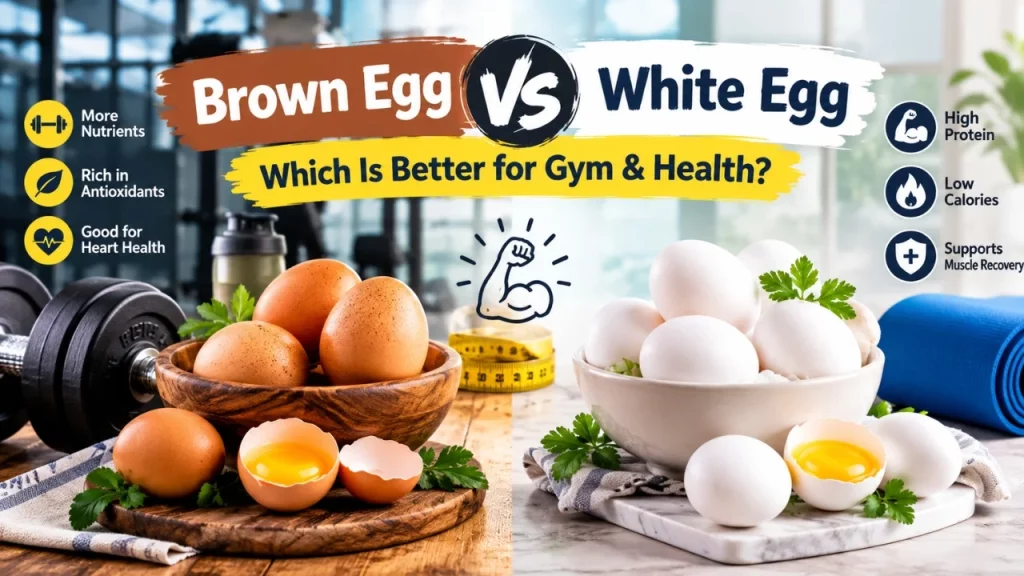
Your cart is half full, your gym bag is already by the door, and you’re standing in the egg aisle holding two cartons like you’re weighing them on a scale. One is white, $3.29. One is brown, $6.49. Both say “Grade A Large” in the same font. You tell yourself this choice matters for your macros. Does it, really?
Here’s the answer before anything else: no, the shell color doesn’t change what’s inside. The nutrition gap between brown and white eggs is close enough to zero that it won’t move your results in the gym or on a blood panel. What actually matters is how many eggs you eat, how you cook them, and what your personal cholesterol response looks like. Let’s get into the numbers nobody else is giving you straight.
The real numbers, per egg
A standard large egg, white or brown, runs roughly 72 calories, 6.3 grams of protein, 4.8 grams of fat, and 186 milligrams of cholesterol, almost all of it in the yolk. Those figures don’t shift meaningfully by shell color — the differences you’ll find between two cartons come from the hen’s breed and diet, not the pigment on the outside.
| Per 1 large egg (~50g) | White shell | Brown shell |
|---|---|---|
| Calories | ~72 | ~72 |
| Protein | ~6.3 g | ~6.3 g |
| Fat | ~4.8 g | ~4.8 g |
| Cholesterol | ~186 mg | ~186 mg |
Is 2 eggs a day enough protein for the gym?
Run the math and the answer is no, not even close. Two eggs give you about 12.6 grams of protein. A lifter aiming for a common target of around 150 grams of protein a day — the kind of number you’d set at roughly 1.6 to 2.2 grams per kilogram of bodyweight — would be getting just 8% of that target from two eggs. You’d need around 24 eggs to hit 150 grams from eggs alone, which nobody is actually doing. Eggs work as a protein top-up alongside meat, dairy, or shakes, not as your whole protein strategy. A more realistic use: 3 to 4 eggs at breakfast gets you 19 to 25 grams, a solid single-meal dose, with the rest of your target coming from elsewhere in the day.
What the yolk is doing that the white isn’t
If you’ve been tossing yolks to “save fat,” you might be leaving muscle-building value on the table. A 2021 review on whole egg intake and muscle mass found the yolk supplies about 40% of an egg’s total protein, plus microRNAs, phospholipids, and other compounds that aren’t in egg whites. Whole egg intake triggered greater muscle protein synthesis after a workout than egg whites alone in young men. The catch: over longer resistance-training programs, whole eggs didn’t produce more actual muscle growth than an equal amount of protein from egg whites. So the yolk gives you a real short-term signal boost, but it doesn’t appear to be a secret hypertrophy weapon once total protein is matched over weeks and months.
Where cholesterol actually becomes a problem
This is the part most egg articles rush past. A 2020 meta-analysis pooling 66 randomized trials on egg intake and blood lipids covering 3,185 people found that eating eggs does raise total cholesterol, LDL, and HDL, but it does not worsen the LDL-to-HDL ratio — the number that tracks more closely with heart disease risk. The review flagged that eating more than one egg a day for less than 12 weeks can raise some blood lipids, without shifting that ratio in a bad direction.
A smaller, 12-week study of 56 healthy adults eating one added egg daily backs that up with harder numbers: total cholesterol rose by 10.43 mg/dL, but HDL (“good” cholesterol) rose even more, by 21.80 mg/dL, and the total-cholesterol-to-HDL ratio actually improved. LDL and triglycerides didn’t move at all. In healthy people, one egg a day looks metabolically boring in the best way.
A small crossover study of 22 postmenopausal women given 640 mg of extra dietary cholesterol a day for 30 days found the rise in blood cholesterol tracked with a rise in plasma lutein, an antioxidant from the yolk, and was linked to larger, less-dense LDL and HDL particles — a pattern generally considered less risky than small, dense particles. It’s a small, early study, not a verdict, but it’s a clue that not all cholesterol increases behave the same way.
One more piece matters: a review on saturated fat and coronary heart disease risk found that replacing saturated fat with refined carbs doesn’t help your heart, but replacing it with polyunsaturated fat does. Translation: an egg fried in butter with bacon on the side is a different food, risk-wise, than an egg cooked in olive oil next to vegetables. The egg itself is rarely the dangerous variable.
Who should actually dial back
For most healthy adults, one to two eggs daily fits comfortably inside the evidence above. But three groups have real reason for caution: people identified as cholesterol “hyper-responders” (some people’s LDL climbs more sharply with dietary cholesterol than others’), people with familial hypercholesterolemia, a genetic condition causing very high baseline LDL, and people managing diabetes or existing heart disease, especially on statins, where your doctor is already tracking your lipid panel closely. If you fall into any of those categories, egg cholesterol isn’t automatically dangerous, but it’s worth discussing portion and frequency with whoever manages your bloodwork rather than guessing.
The cost-per-gram-of-protein math
Say a dozen white eggs costs $3.00 and a dozen brown, free-range eggs costs $6.00 — common price points in many stores. A dozen eggs delivers about 75.6 grams of protein either way. That puts white eggs at roughly 4 cents per gram of protein, and brown eggs at roughly 8 cents per gram — double, for identical protein, fat, and cholesterol. If your goal is hitting a protein number for the gym, brown eggs buy you flavor, farming practice, or peace of mind, not extra nutrition per dollar.
The shell-color safety myth
Shell color doesn’t affect porosity or salmonella risk — that comes down to the hen’s breed, not pigment. What does matter for food safety is whether the shell’s protective cuticle was washed off (common in some countries, not others) and whether the eggs were refrigerated afterward, since washing removes a natural barrier against bacteria entering the shell.
Takeaway: brown and white eggs are nutritionally twins, so skip the color debate and focus on the real levers — eat enough eggs (plus other protein sources) to hit your daily target, keep an eye on cholesterol only if you’re in a higher-risk group, and don’t pay double per gram of protein unless you’re buying something other than nutrition.
Sources
- The Effect of Whole Egg Intake on Muscle Mass (2021)
- Responses of different dosages of egg consumption on blood lipid profile (2020)
- Saturated fatty acids and risk of coronary heart disease (2010)
- HDL cholesterol changes after continuous egg consumption (2008)
- Plasma lutein after egg consumption in postmenopausal women (2007)
