Oatmeal vs Pancakes vs Breakfast Cereal: Which Breakfast Is Healthier?
The honest answer isn't a ranking of three foods — it's that each category hides a healthy version and a junk-food version.
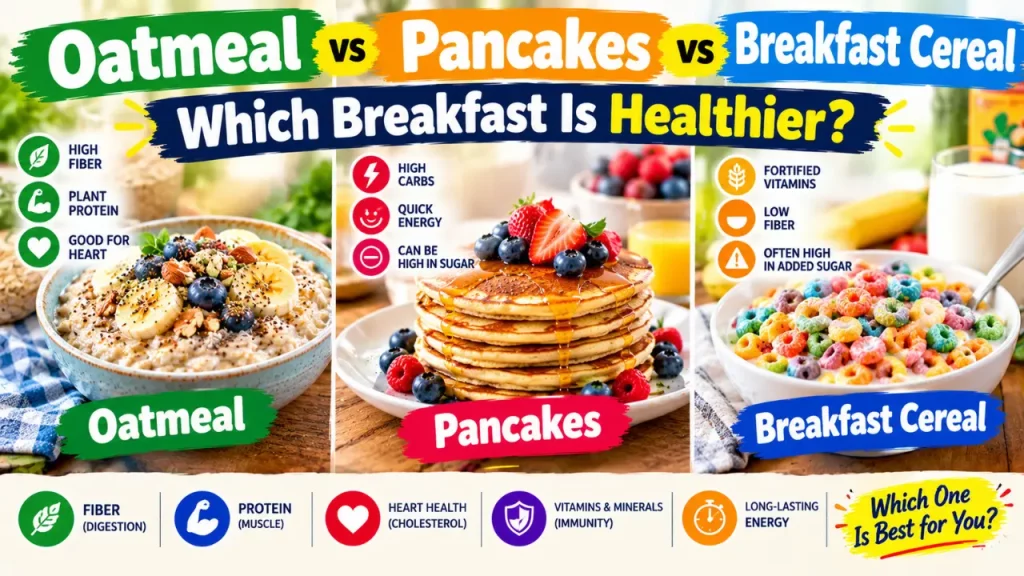
You’re standing in the kitchen at 7 a.m., half-awake, staring at the pantry: a canister of oats, a box of cereal with a cartoon mascot, and a bag of pancake mix behind it. You’ve read enough headlines to know one of these is supposedly the “winner,” but you can’t remember which, and honestly the article you half-skimmed last time didn’t match the one before it. So you just grab whatever’s closest and move on with your day.
Here’s the part that gets lost in most coverage of this question: oatmeal, pancakes, and cereal aren’t three fixed foods you can rank like boxers in a weight class. Each one is a category that stretches from genuinely nourishing to barely-better-than-dessert, and the gap within a category is usually bigger than the gap between categories. The real answer depends less on which box you open and more on what’s inside it, what you put on top, and how much of it ends up in your bowl.
1. The question itself is built on a false premise
A bowl of steel-cut oats cooked plain and a packet of instant flavored oatmeal with a candy-sweet coating are both “oatmeal,” but they behave almost nothing alike in your body. The same is true of cereal — a box of plain shredded wheat and a box of frosted, marshmallow-studded cereal both get filed under “breakfast cereal” in every comparison article, as if they were interchangeable. Pancakes made from scratch with whole-grain flour and eggs are a different meal entirely from a stack of fluffy white-flour pancakes drowned in syrup.
So the fairest way to answer “which is healthier” isn’t to pick a champion category — it’s to recognize that each one has a best-case and worst-case version, and most people are unknowingly eating the worst case of whichever one they’ve chosen out of habit.
2. All three are usually missing the same thing: protein
This is the gap that almost never gets named directly. Oatmeal made with water, cereal poured with a splash of milk, and pancakes topped with syrup are all, by default, carbohydrate-heavy and protein-light. A breakfast that’s mostly carbohydrate with little protein tends to digest quickly, leaving you reaching for a snack well before lunch. This isn’t a flaw unique to one of the three — it’s the default failure mode of almost every traditional American breakfast, and it’s why the ranking question misses the point. Add a serving of Greek yogurt, eggs, milk, or a scoop of protein powder to any of the three, and you’ve changed the meal’s behavior more than switching from oatmeal to cereal ever would.
3. Fiber is not one ingredient — it behaves differently depending on the source
Oats contain a type of soluble fiber that forms a gel-like texture as it absorbs liquid, which is part of why oatmeal feels thick and filling. Whole-grain cereals and whole-wheat pancake batters contain fiber too, but often a different blend, and refined versions of either — white flour pancakes, cereal made mostly from refined corn or rice — strip most of that fiber out entirely. The result is that “whole grain” on a cereal box or “whole wheat” in a pancake recipe isn’t marketing fluff to ignore; it’s often the single biggest lever separating the version of that food that fills you up from the version that doesn’t.
The real dividing line isn’t oatmeal versus pancakes versus cereal — it’s a protein-and-fiber-forward version of any of the three against a sugar-and-refined-starch version, and that line can run straight through a single box sitting on your shelf.
4. What sits next to the food matters more than the food itself
A bowl of oatmeal with brown sugar, dried fruit, and a drizzle of honey can end up carrying more added sugar than a bowl of lightly sweetened cereal. A stack of pancakes becomes a different meal depending on whether it’s topped with maple syrup and butter or with berries and a spoon of nut butter. Comparisons that stop at “oatmeal vs. cereal” without accounting for toppings are comparing incomplete meals, because almost nobody eats any of these three foods completely plain.
This is also where cereal gets an unfair rap in a lot of coverage: a bowl of plain, minimally sweetened cereal with milk can be a perfectly reasonable breakfast, while a “healthy-looking” bowl of oatmeal buried under granola, chocolate chips, and maple syrup can quietly out-sugar it.
5. Portion sizes drift upward without you noticing
Cereal is poured, not measured, and most people pour considerably more than the package’s listed serving suggests. Pancakes are usually eaten in multiples — rarely does anyone stop at exactly one. Oatmeal, cooked in a pot, tends to expand, and it’s easy to end up with a bowl that represents two or three servings of dry oats without realizing it. None of the three is inherently portion-controlled, and the common advice to “just eat the healthier option” ignores that doubling any of them erases most of the advantage it had.
6. Blood sugar response depends on the whole plate, not just the main item
How any of these three breakfasts affects your blood sugar isn’t determined purely by the food in isolation — it depends on what else is eaten alongside it, how much fiber and protein are present, and even factors like how processed the grain is and how it was cooked. Instant oats, for instance, are more processed and more rapidly digested than steel-cut or rolled oats, even though all three are sold under the same “oatmeal” label. This is a case where individual responses genuinely vary, and sweeping claims that any one category is universally “low” or “high” glycemic oversimplify a response that depends heavily on the specific product and the rest of the meal.
7. The best breakfast is the one you’ll actually keep eating
A nutritionally ideal bowl of steel-cut oats that takes twenty minutes to cook and gets skipped three mornings out of five is, in practice, worse for you than a quick bowl of decent cereal eaten every single day. Coverage that ranks these foods as if everyone has unlimited morning time and willpower ignores the most basic variable in nutrition: consistency beats perfection. If pancakes are the only breakfast that gets your household fed and out the door, the better question isn’t whether to abandon them — it’s how to make the version you already make a little sturdier.
8. Small, specific swaps beat switching categories entirely
Instead of trying to crown a winner, it’s more useful to upgrade whichever one you already default to. Stir plain yogurt or a spoon of nut butter into oatmeal instead of sugar. Choose a cereal with whole grain listed first and minimal added sugar, and add milk or a side of eggs for protein. Mix a scoop of oats or a spoon of protein powder into pancake batter, and top with fruit instead of syrup. These changes take less effort than switching your whole morning routine and tend to matter more than which box you started with.
So which is healthier — oatmeal, pancakes, or cereal? None of them, reliably, until you know which version is actually in the bowl. The category on the label tells you far less than the ingredient list, the toppings, and the portion sitting in front of you.

James Carter
The EverBBQ editorial desk — covering BBQ news, features and everything off the grill.