Granola vs Muesli vs Oatmeal: Which Has Less Added Sugar?
The food with the least added sugar isn't always the one that keeps your blood sugar flattest — here's what actually predicts the spike.
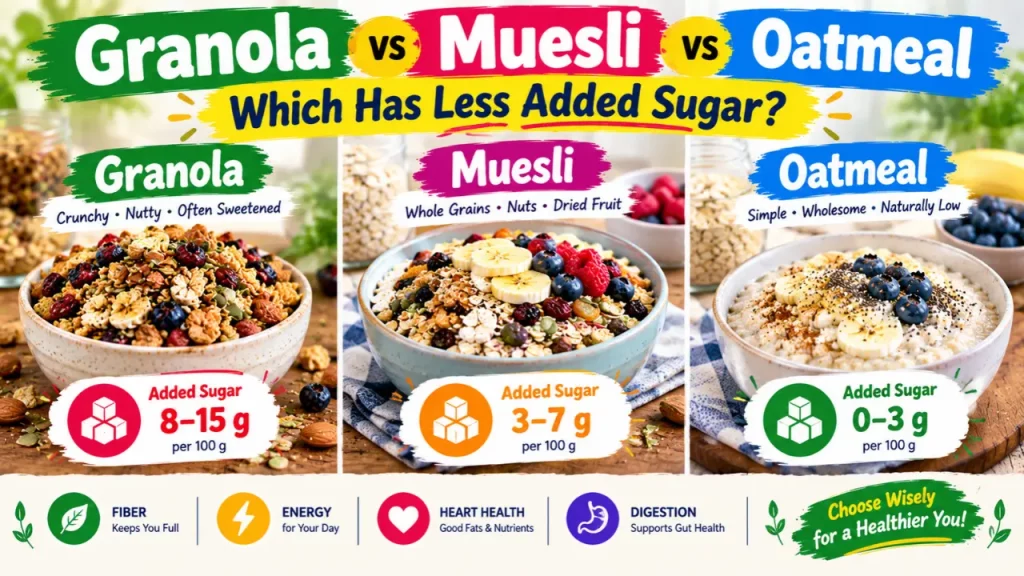
The jar with zero grams of added sugar on its label can still send your blood glucose higher than the one sitting next to it loaded with sugar. That’s the part the sugar-gram comparisons never mention. Plain oatmeal usually carries almost no added sugar unless you pour it in yourself, muesli’s sugar mostly comes along for the ride with dried fruit, and granola picks up extra sugar and calories from the oil and syrup used to bake it into clusters. Ranked by added sugar alone, oatmeal wins, muesli is in the middle, and granola loses. But added sugar on a label and a glucose spike in your bloodstream are two different measurements, and conflating them is where most people go wrong.
Side A: What the Nutrition Label Promises
A label tells you what went into the food. It does not tell you what your body does with it. Glycemic index research on oats makes this gap obvious. A systematic review that pooled seventy-two glycemic measurements — twenty published studies, fifty-six tests, plus seventeen additional entries from an online database — looked specifically at how processing changes the blood sugar response of oat-based foods, including nine tests on instant oatmeal and twenty-eight on muesli or granola combined. That review of oat processing and glycemic response found steel-cut oats sat at a moderate glycemic index of 55, but the muesli and granola results were so inconsistent that one outlier measurement had to be dropped from the statistics entirely. In other words, two granolas with nearly identical sugar labels can produce very different blood sugar curves depending on how much intact fiber, fat, and whole grain survived the baking process. Total sugar grams simply cannot capture that.
Why fiber and fat change the math
Fiber slows gastric emptying and fat delays how fast sugar hits the bloodstream, which is why a bowl of sweetened oatmeal with no fiber-rich mix-ins can behave worse than a granola with intact oat clusters, nuts, and seeds — even if the granola’s label shows more total sugar. This is the first reason sugar grams are the wrong single metric: they measure an ingredient, not a digestion speed.
Side B: What a Blood Sugar Monitor Actually Shows
Protein is the second variable the sugar-gram comparison ignores completely. In a randomized, controlled crossover trial in twenty-four adults with type 2 diabetes, researchers compared instant oatmeal directly against an isocaloric high-protein, low-fat diabetes-specific shake. The shake produced a significantly lower glucose area-under-the-curve than the oatmeal (P = .021), and it increased the gut hormone GLP-1 — which slows digestion and blunts glucose rise — by 213%. Oatmeal alone, without added protein, simply doesn’t trigger that same hormonal brake. This matters for the granola-versus-oatmeal debate because granola’s nuts, seeds, and sometimes peanut or soy additions supply protein that plain oatmeal doesn’t have built in. No trial has tested granola head-to-head this way, so this is an extrapolation rather than a direct finding — but the mechanism is the same one documented in that trial, and it is a real reason a protein-and-fat-rich granola can produce a gentler glucose curve than its sugar count suggests.
The honest complication is that glucose response is not identical from person to person. An analysis of continuous glucose monitor data from 397 people with type 1 diabetes and 100 people with type 2 diabetes tested how well food category and macronutrients predict post-meal glucose rise and found only moderate accuracy — a correlation of 0.61 in type 1 diabetes and 0.72 in type 2 diabetes. That means even with full knowledge of a meal’s sugar, fiber, fat, and protein, roughly a third to a quarter of the glucose response still comes down to the individual eating it, not the food itself. Nobody reading a cereal box can know in advance exactly how their own body will react; the label is a starting estimate, not a guarantee.
Who should ignore the sugar number entirely
Not everyone needs to fixate on grams of sugar. If you’re prioritizing protein and fullness after a GLP-1-blunted appetite, or managing diabetes with a doctor’s input on carb counting, a food’s fiber and protein content matters more than whether it says “no added sugar.” A muesli can carry a clean “no added sugar” label and still deliver a heavy load of fructose and glucose from dried fruit — and metabolically, your bloodstream does not distinguish between sugar a manufacturer added and sugar that was naturally concentrated by drying apricots or raisins. People managing blood glucose closely should treat muesli’s natural dried-fruit sugar with the same caution as added sugar, not less. Meanwhile, a 2026 review in The Journal of Nutrition raises a separate caution: looking at whole-grain classification across twelve major prospective cohorts of over 100,000 participants each, only three whole-grain foods — popcorn, oatmeal, and brown rice — were tracked consistently across seven of those cohorts, while seventeen of fifty-four whole-grain foods appeared in just a single study. The review also questions whether oatmeal’s healthy reputation partly reflects the lifestyle of people who choose it — regular exercise, not smoking — rather than the oats themselves. If your overall diet and activity are already solid, obsessing over a few grams of sugar difference between these three breakfasts is probably not where your attention belongs.
| Factor | Oatmeal (plain) | Muesli | Granola |
|---|---|---|---|
| Typical added sugar | Lowest — near zero unless sweetened | Low added sugar, but often high natural sugar from dried fruit | Highest — oil and sweetener are baked in |
| Glycemic behavior | Depends heavily on processing; low protein can mean a sharper rise | Mixed; fiber helps but dried fruit sugar still raises glucose | Most variable in published tests; fat, fiber, and nuts can blunt the spike |
| Protein contribution | Modest on its own | Moderate, from oats and any nuts included | Often highest, from added nuts and seeds |
| Best evidence source | Oatmeal vs. high-protein shake trial | Oat processing glycemic review | Oat processing glycemic review |
| Who should mostly ignore sugar grams | People prioritizing protein; need to add it themselves | People with diabetes should still count dried-fruit sugar | People prioritizing fullness and protein over calories |
For the practical, weekly version of this: don’t compare a single bowl, compare a week. Check the grams of added sugar per serving on your specific box, subtract the lower number from the higher one, and multiply by however many mornings you actually eat it. A difference that looks trivial on one label can add up across five or seven breakfasts — but the compounding only matters if you’re tracking total sugar intake for weight management. If your real goal is a stable glucose curve, the serving-size math matters less than whether that bowl has enough protein and intact fiber to slow things down.
Verdict
By added sugar alone, oatmeal wins and granola loses — that part other comparisons get right. But “less added sugar” does not reliably mean a smaller glucose spike, and it says nothing about weight outcomes if the lower-sugar bowl leaves you hungry an hour later. For steady blood sugar, plain oatmeal needs help — a scoop of nuts, seeds, or protein powder — to do what some granolas already do by default. For weight management, satiety from protein and fat may matter more than the sugar line on the label. And for anyone watching glucose closely, muesli’s dried fruit deserves the same scrutiny