Eating Right Before, During and After Pregnancy: Essential Nutrition Tips
Exact calorie, protein, iron and calcium targets by trimester — plus which "risky" pregnancy foods like hummus actually deserve the warning label.
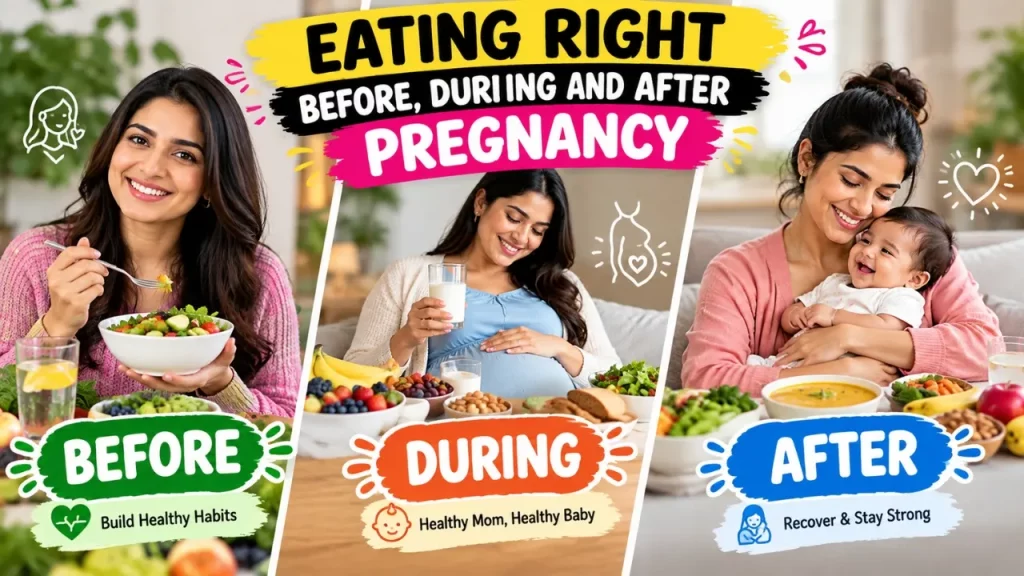
Can you actually tell, standing in the kitchen with a tub of hummus in one hand and a prenatal vitamin bottle in the other, whether either one is safe for the baby you’re growing? Most pregnancy nutrition advice stops at “eat a variety of foods” and “ask your doctor,” which is true and also useless at 9 p.m. when you’re hungry and confused. You’ve probably already absorbed the basics — folic acid matters before conception, you’re not eating for two, small meals help nausea, water and fiber ease constipation. What almost nobody hands you is the actual math: how many calories, how many grams of protein, how many milligrams of iron, this week, this trimester.
The Numbers, Trimester by Trimester
These are the clinical targets used in prenatal care, organized by stage:
| Stage | Calories/day | Protein | Iron | Calcium |
|---|---|---|---|---|
| 1st trimester | ~1,800 (no increase) | ~71 g | 27 mg | 1,000 mg |
| 2nd trimester | ~2,140 (+340) | ~71 g | 27 mg | 1,000 mg |
| 3rd trimester | ~2,250 (+450) | ~71 g | 27 mg | 1,000 mg |
| Breastfeeding | ~2,300–2,500 (+450–500) | ~71 g | 9–10 mg | 1,000 mg |
In food terms: roughly three palm-sized protein portions a day, three calcium-rich servings (a cup of milk, a cup of yogurt, 1.5 oz of cheese each count as one), and enough iron-rich food — red meat, lentils, fortified cereal, spinach — that most clinicians still add a supplement on top.
Why Iron Isn’t Optional
That iron number carries weight because of what happens when it’s missed. A randomized controlled trial of iron supplementation during pregnancy gave 275 initially iron-replete, non-anemic women either a placebo or 30 mg of elemental iron daily until 28 weeks; women whose ferritin later dropped received 30 mg or 60 mg per day depending on severity. The trial was built around a real concern: even women who start pregnancy with decent iron stores can become anemic as blood volume expands. A review of anemia and iron deficiency in pregnancy found iron deficiency anemia is linked to higher risk of preterm delivery and lower birth weight, and that maternal deficiency can reduce the baby’s own iron stores well into the first year of life. A companion review on anemia and pregnancy outcome adds an important nuance: anemia detected in the third trimester often just reflects normal blood volume expansion and isn’t the same red flag as anemia found earlier in pregnancy. That’s one reason the “right” iron number depends on timing, not just a single test result.
The Hummus Question, Answered Properly
Hummus gets a bad reputation it mostly doesn’t deserve. There’s no raw egg in traditional hummus — it’s chickpeas, tahini, lemon, garlic, oil. Tahini is pasteurized sesame paste and isn’t a listeria risk on its own. The actual concern is almost entirely about where the hummus has been: open self-serve deli containers and salad bars that sit at room temperature and get cross-contaminated by utensils that also touched deli meats or soft cheeses are the real listeria risk, not the chickpeas. Sealed, refrigerated, store-bought hummus eaten before its date, or homemade hummus kept chilled and eaten within a few days, is fine. The rule of thumb: the risk lives in open, shared, room-temperature food stations — not in the ingredient list.
The 3-3-3 Rule
A simple framework that rarely gets connected to pregnancy explicitly: eat something containing protein, fiber, and fat within 3 hours of waking, then eat again roughly every 3 hours, aiming for 3 food groups at each sitting. It sounds almost too simple, but it does real work — it blunts the blood sugar swings that worsen nausea and fatigue, and it naturally spaces out the extra calories pregnancy requires instead of front- or back-loading them. This matters more than it sounds: a meta-analysis of individual participant data from 36 randomized trials involving 12,526 women found that structured diet and activity interventions led to measurably less gestational weight gain than usual care — a mean difference of 0.70 kg less weight gained — and reduced several downstream risks. A related systematic review and meta-analysis on antenatal diet and activity interventions confirmed that structured approaches, not vague advice, are what actually move the needle on gestational weight gain and outcomes. The 3-3-3 rule is one low-effort way to add that structure without counting a single calorie.
Caffeine and Seafood, in Actual Units
Caffeine: the commonly used ceiling is 200 mg per day — about one 12-oz cup of coffee, not two. Tea and chocolate count toward that total too. Seafood: 2–3 servings per week (roughly 8–12 oz total) of low-mercury options like salmon, shrimp, or canned light tuna is the standard target; high-mercury fish — shark, swordfish, king mackerel, tilefish — should be avoided entirely rather than portion-controlled. Most herbal teas marketed as “pregnancy-safe” (ginger, rooibos) are fine in normal amounts; teas with concentrated herbal extracts in unregulated doses are the ones worth skipping, simply because dosing isn’t standardized.
Who the Numbers Above Don’t Fit
These targets are starting points, not prescriptions, for everyone. They shift meaningfully if you have gestational diabetes (carbohydrate distribution matters more than total calories), are carrying multiples (protein and calorie needs rise further), follow a vegan or vegetarian diet (iron and B12 need closer monitoring since plant iron absorbs less efficiently), entered pregnancy with prior malnutrition or a low BMI, or are a teenager whose own growth is still competing with the pregnancy’s demands. In every one of these situations, the trimester table above is a floor to discuss with a clinician, not a target to hit alone.
Back to the Kitchen Counter
So: the hummus in your hand is almost certainly fine if it came sealed from the fridge case, not a deli bar. The prenatal vitamin matters, but it’s a supplement to the 1,800–2,250 calories, 71 grams of protein, 27 milligrams of iron, and 1,000 milligrams of calcium your body is actually asking for that day — not a replacement for them. The numbers were always knowable. They just don’t fit neatly into “eat a variety of foods.”
Sources
- Iron supplementation during pregnancy, anemia, and birth weight: a randomized controlled trial (2003)
- Anemia and iron deficiency: effects on pregnancy outcome (2000)
- Anemia, iron and pregnancy outcome (2000)
- Effect of diet and physical activity based interventions in pregnancy on gestational weight gain and pregnancy outcomes (2017)
- Association of Antenatal Diet and Physical Activity-Based Interventions With Gestational Weight Gain and Pregnancy Outcomes (2022)