Coconut Matcha vs. Mango Matcha vs. Dirty Matcha Latte: Which Is the Healthiest?
Milk, sugar, and espresso each change matcha's antioxidants and caffeine differently — here's who should actually skip which version.
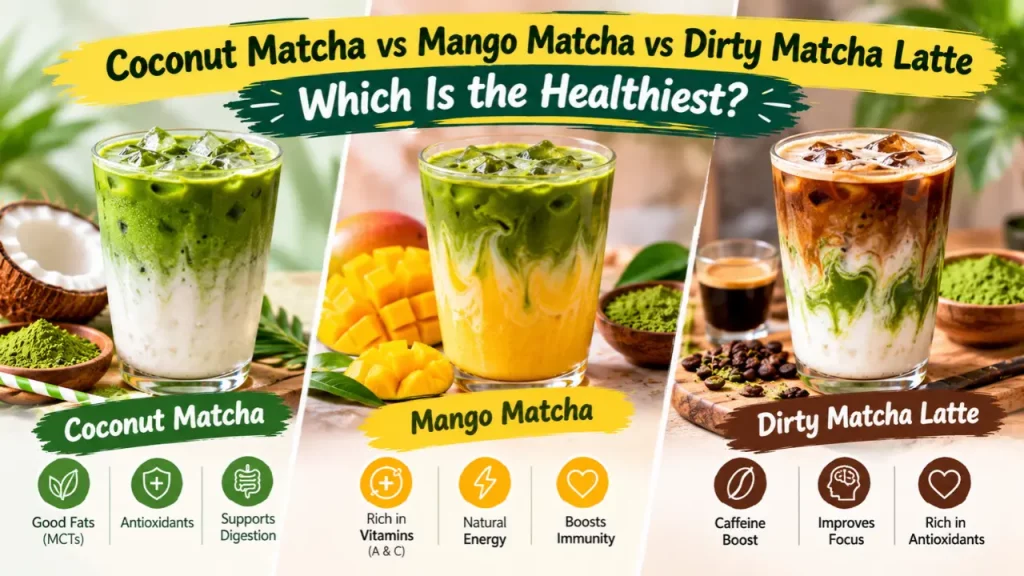
The word “antioxidant” on a menu tends to work like a license. Order a mango matcha or let a barista pour oat milk into a dirty matcha latte, and the assumption is that the matcha part is still doing its job underneath whatever got added. But catechins — the antioxidant compounds matcha is known for — don’t sit in a drink untouched by everything around them. Milk proteins interact with them, sugar changes how the caffeine behaves in your blood, and matcha itself competes with iron for absorption no matter which syrup is next to it. So which of the three is actually healthiest? For most adults, a small, lightly dressed coconut matcha or a plain cup of real ceremonial-grade matcha outperforms the other two — and the reasoning has almost nothing to do with calories.
1. The short answer, before the caveats
Ranked purely on what happens after the drink is swallowed, a modest coconut matcha made with lightly sweetened milk generally comes out ahead, a plain or lightly sweetened dirty matcha latte is fine for most people in small amounts but risky for specific groups, and mango matcha is the one most likely to produce a noticeable energy swing because it stacks caffeine on top of fast sugar. None of the three is automatically “healthy” just because matcha is in the name — the deciding factors are who is drinking it, when, and what else they’ve eaten that day.
2. Does milk actually block matcha’s catechins?
Green tea catechins, including the EGCG matcha is prized for, already have a bioavailability problem on their own. A review of plant polyphenols notes that poor absorption is common enough across green tea catechins, curcumin, and grape seed extracts that researchers have had to engineer special delivery systems just to get more of them into the bloodstream — see this review on polyphenol bioavailability. That’s true before milk enters the picture at all.
When milk does enter the picture, the effect is more complicated than “it cancels the antioxidants.” A lab study that digested green tea extract alongside skim milk under simulated stomach and gut conditions, then tested absorption across human intestinal cells, found that the gallated catechins EGCG and ECG did bind to milk proteins, while two other catechins bound much more weakly — but after full digestion, the catechins in the milk mixtures actually showed stronger movement across the intestinal cell layer than the catechins digested without milk, according to this in vitro digestion and Caco-2 cell study. That’s a small, early lab model, not a human feeding trial, so it shouldn’t be read as proof that milk in your latte boosts antioxidants. But it does undercut the simpler claim that dairy flatly blocks them. Separately, food scientists have built specialized nano-carriers to improve how well catechins survive digestion when added to milk, which tells you the plain combination still isn’t a solved problem — see this catechin-delivery research.
What this means at the counter: a dirty matcha latte made with whole milk, like the kind detailed in this USDA whole milk nutrient entry, isn’t wasting your matcha the way a lot of coffee-shop lore suggests. The protein content that supposedly “traps” catechins is also the thing that, per the digestion study above, may help ferry some of them further into the gut. Where this logic breaks down is for people who swap in oat or almond milk specifically to “protect” the antioxidants — the research doesn’t actually support that swap being meaningfully better, since the binding and transport effects were studied with dairy, not plant milks, and plant milks bring their own added sugars and gums into the equation.
3. Mango’s sugar meets matcha’s caffeine — a sharper curve than the caffeine alone
Raw mango is naturally sweet on its own, and the breakdown in this USDA entry for raw mango shows that a meaningful share of its carbohydrate content comes from simple sugars rather than fiber or starch. A mango matcha built on mango puree or mango syrup is, in effect, pairing a stimulant with a fast-digesting sugar load in the same cup. Caffeine on its own can raise blood sugar slightly in some people by prompting the release of stress hormones; adding a concentrated dose of fruit sugar on top of that gives you a steeper rise and, often, a steeper fall an hour or two later. That’s the “energy swing” people sometimes describe after a mango matcha — not jitteriness from the tea itself, but the mismatch between a quick glucose spike and a stimulant that keeps circulating after the sugar has been cleared.
In practice this matters most for people who are already caffeine-sensitive, who have blood sugar conditions like insulin resistance or diabetes, or who tend to crash mid-afternoon after sweet drinks. For someone without any of those issues, having a mango matcha as an occasional treat isn’t a meaningful health risk — the concern is about the pattern, not a single cup. A simple practical fix is ordering it half-sweet, or asking for a smaller size, so the sugar load isn’t stacked as high against the full caffeine dose.
4. What’s in the matcha powder itself, not just what’s added to it
Because matcha is ground whole tea leaf rather than steeped and discarded tea, whatever the plant has taken up from its growing environment ends up in the cup at a higher concentration than it would in a regular brewed green tea. Research tracking environmental contaminants in tea-growing regions has flagged that trace elements from soil and water can accumulate in tea leaves over time, a concern discussed in this environmental science study. This isn’t a reason to avoid matcha — for most people drinking a cup or two a day, it’s not a measurable health concern, and it applies to the matcha itself regardless of whether it ends up in a mango, coconut, or dirty latte. It’s more relevant to people who drink multiple matcha-based drinks daily over long stretches, or who are pregnant, where minimizing unnecessary trace exposure is generally advised as a precaution. For everyone else, source and brand matter more than which milk or fruit gets added on top.
5. Why coconut matcha tends to edge out the other two
Coconut milk brings its own fat content into the mix, and the nutrient profile in this USDA coconut milk entry shows that fat share is substantial compared with dairy or plant milks built around water and carbohydrate. That matters here because catechin stability isn’t just about digestion and absorption — it’s also about how well the compounds hold up chemically before they’re even swallowed. Research on catechin degradation shows that the surrounding matrix, including the presence of fat, can influence how much of the original antioxidant structure survives processing and storage, a point explored in this catechin stability research. A moderate-fat drink like coconut matcha, made without a heavy sugar syrup, tends to give the catechins a more stable environment than a high-sugar mango matcha does, without introducing the same protein-binding questions that dairy milk raises.
The caveat here is saturated fat. Coconut milk is high in saturated fat relative to dairy or oat milk, so this advantage doesn’t apply cleanly to someone managing cholesterol or cardiovascular risk, who would be better off treating coconut matcha as an occasional choice rather than a daily default. For most adults without that specific concern, a small coconut matcha — not a large, syrup-heavy version — is a reasonable everyday pick.
6. A practical way to order, not just rank
None of this requires memorizing the research behind the counter. A few habits cover most of it: ask for half the usual sweetener in any fruit-based matcha drink, treat a dirty matcha latte with whole milk as a normal option rather than something that “wastes” the tea, and keep portion size modest if you’re drinking matcha more than once a day. If you’re pregnant, caffeine-sensitive, or managing blood sugar or cholesterol, the right choice shifts — smaller cups, less sugar, and less frequent coconut milk versions cover most of those cases. The honest takeaway isn’t that one drink is “healthy” and the others are “unhealthy,” but that the milk, the fruit, and the matcha are all doing something to each other, and the healthiest cup is the one matched to the person drinking it.
Sources
