Salmon vs. Tuna vs. Sardines: Which Fish Is Best for Protein and Omega-3s?
Normalize servings, add sodium and calcium, and sort mercury limits by who you actually are — the real winner depends on you.
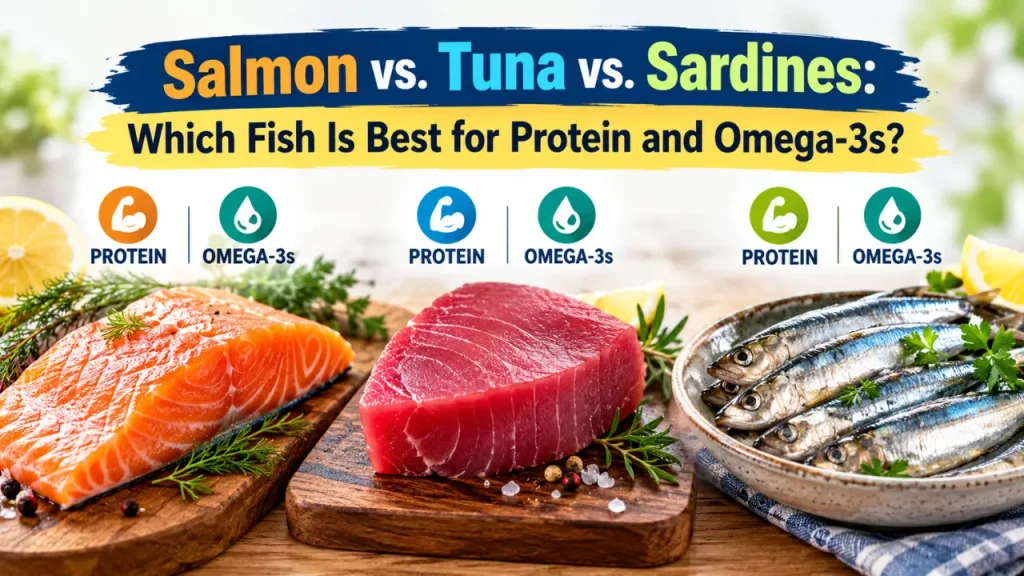
Ask anyone which fish wins for protein and omega-3s and they’ll point you to a chart with three serving sizes lined up like they’re equivalent. They’re not. One column is weighed at 85 grams, another at 56 grams, another at 3 ounces — which is also roughly 85 grams. Put them side by side and you’re not comparing fish. You’re comparing a fish that’s 52% bigger than its neighbor and calling it a fair fight.
So here’s the straight answer first: there is no single winner. Tuna wins on protein per calorie. Sardines win on omega-3s per serving. Salmon wins on vitamin D, calcium, and selenium, and it’s the one fish that gives you hard numbers to check your own label against. Which one actually belongs on your plate depends on your sodium ceiling, your calcium needs, whether you’re pregnant, and whether you eat fish once a week or every day. Here’s the math nobody runs.
The serving-size sleight of hand
When salmon gets measured at 56 grams while tuna and sardines get measured at 85 grams, salmon starts the comparison already down nearly a third of its weight. That alone explains a chunk of why salmon looks like the “smaller” option in protein and omega-3 charts. It isn’t smaller fish for fish — it’s smaller serving.
Scale canned sockeye salmon up to 100 grams, the size researchers actually use for apples-to-apples comparisons, and the picture is very different from the 56-gram snapshot. USDA data on canned sockeye salmon puts a 100-gram serving at 20.6 grams of protein, 153 calories, 7.17 grams of total fat, and 19 micrograms of vitamin D. Measured at the undersized 56-gram serving, that same fish only delivers about 11.5 grams of protein — nearly half of what the 100-gram number suggests. The fish didn’t change. The ruler did.
Sardines and tuna still come out ahead on the specific metrics they’re known for — sardines for omega-3 density, tuna for protein relative to calories — but once everyone is measured on the same 100-gram scale, the gaps between all three fish shrink considerably compared to what the mismatched-serving charts imply. The ranking order mostly holds, but the margins that looked decisive at mismatched serving sizes turn out to be a few grams, not a lopsided victory. That’s the part the chart never tells you: a “winner” by a nose still gets printed as if it lapped the field.
Sodium: the number that flips the winner
Protein and omega-3s get all the attention, but sodium is the variable that actually changes which fish makes sense for a given person, and it almost never shows up in the headline comparison. Canned sardines packed in oil or brine can run high in sodium per serving, canned tuna varies widely depending on whether it’s packed in water or oil and whether it’s labeled low-sodium, and canned salmon sits somewhere in between depending on brand and whether the liquid is drained. None of that variation shows up when a chart only lists protein and fat.
This matters because sodium and cardiovascular risk have a well-documented relationship, and for someone already managing blood pressure, the sodium content of a canned fish can outweigh whatever marginal protein advantage it has. Research on sodium intake and health outcomes, including findings published in JAMA Internal Medicine, is part of why dietary guidance treats sodium as a number worth tracking on its own, separate from the protein-per-calorie race. If you’re the kind of person who checks a nutrition label for sodium before anything else, the “best fish” conversation needs to include that column, not just protein and omega-3s. A practical step: rinse canned fish under water before eating it, which can meaningfully reduce the sodium clinging to the surface of the flesh, especially with sardines packed in brine.
Calcium hiding in the bones
Here’s a detail that rarely makes it into the protein-versus-omega-3 debate: canned sardines and canned salmon, when the bones are left in and softened by the canning process, carry meaningfully more calcium than a fillet of fresh tuna ever will. Tuna doesn’t come with edible bones, so no matter how you prepare it, it isn’t going to contribute much calcium to your day. That makes sardines and bone-in canned salmon genuinely useful for someone who doesn’t eat dairy, or who’s trying to hit a calcium target through food rather than a supplement.
This is also a case where the “best fish” answer changes depending on who’s asking. For someone with a diagnosed sodium sensitivity, the lower-sodium tuna might win outright despite its lighter calcium and vitamin D numbers. For someone building bone density, especially post-menopausal women or older adults for whom protein and bone health intersect, the research summarized in Clinical Nutrition on protein intake and musculoskeletal outcomes points toward keeping both the protein and the micronutrient side of the ledger in view, not just the headline macronutrient.
Mercury and contaminants: the caveat nobody puts on the chart
No comparison of canned fish is complete without mentioning mercury, because it’s the one variable that can override every other number on the label. Larger, longer-lived predatory fish accumulate more mercury over their lifespan, which is part of why tuna — depending on species and whether it’s light or albacore — generally carries more mercury than sardines, a small, short-lived fish low on the food chain. Salmon sits closer to sardines on this scale than to tuna.
This isn’t a reason to avoid tuna altogether, but it is a reason the “best fish” answer shifts for pregnant women, young children, and anyone eating fish several times a week rather than once. Research tracking environmental contaminant exposure through diet, including work published in Environment International and in the International Journal of Hygiene and Environmental Health, is part of why public health guidance recommends limiting high-mercury fish for these groups specifically, while treating sardines and salmon as lower-concern options for frequent consumption. If you fall into one of those groups, the protein-per-calorie crown tuna wears on paper stops being the deciding factor, and sardines or salmon become the more sensible everyday choice regardless of what the macronutrient chart says.
Omega-3s: why the ratio matters more than the raw gram count
Sardines win the omega-3-per-serving contest, but the number that actually predicts health outcomes isn’t just total omega-3 grams — it’s the balance of omega-3 to omega-6 fatty acids in your overall diet, and how consistently you’re eating fatty fish rather than how much you eat in one sitting. A single large serving of sardines once a month doesn’t do what a smaller, regular serving does. Research on omega-3 intake and cardiovascular and inflammatory markers, including findings published in Nutrients, supports the idea that frequency and consistency carry at least as much weight as the gram count on a single can’s label. That reframes the “sardines win” headline: they win the serving-size contest, but the real benefit shows up with the person who eats modest amounts of any of these three fish twice a week, not the person who eats one large sardine tin once and checks the box.
So which fish should actually go in your cart?
If you’re optimizing for the lowest sodium per can and don’t need the calcium, water-packed tuna is the practical answer, with the caveat that it shouldn’t be the only fish on your plate if you eat fish daily, given the mercury consideration above. If you want the most bone-supporting calcium and vitamin D in one can, bone-in canned salmon or sardines beat tuna outright, and the gap doesn’t shrink the way the omega-3 and protein gaps do when you fix the serving-size math. If you’re pregnant, feeding young children, or simply eating fish several times a week, sardines and salmon are the lower-contaminant everyday choices, and tuna becomes the occasional option rather than the default.
None of this applies the same way to someone who eats fish once every week or two and isn’t managing a sodium-sensitive condition — at that frequency and that level of health risk, the differences between all three fish are small enough that personal taste and price are reasonable tiebreakers. The math above matters most for the person eating canned fish as a routine protein source, where small per-serving differences compound week over week into a real difference in sodium, calcium, or contaminant exposure. For everyone else, the honest answer is that any of the three, eaten at an actual 100-gram serving instead of a chart’s mismatched one, is a solid choice.
Sources

Mick Hudson
Low-and-slow recipes, rubs, sauces and fire management from our pitmaster team.