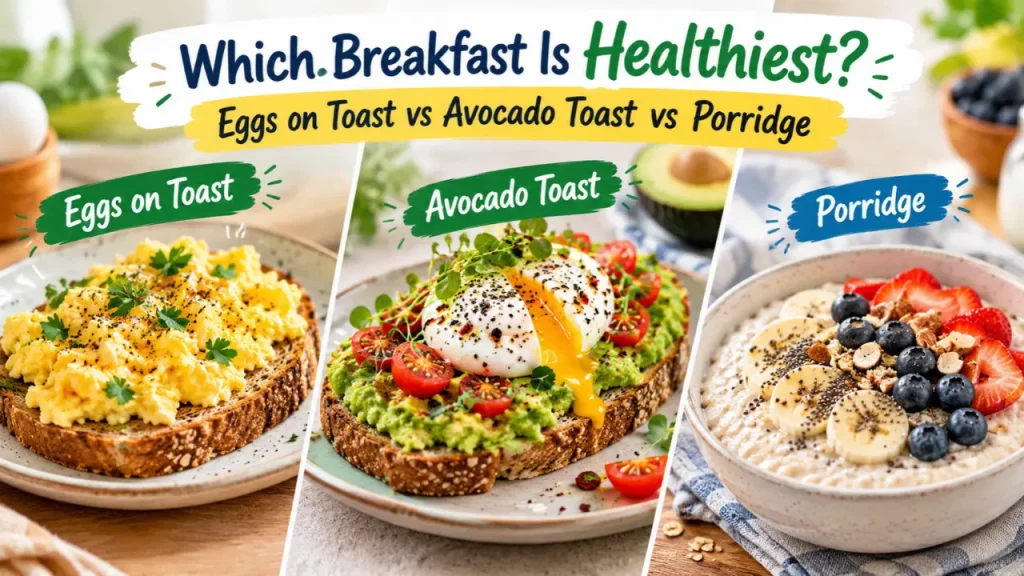
Which Breakfast Is Healthiest? Eggs on Toast vs Avocado Toast vs Porridge
Real glucose and satiety-hormone data show porridge can spike blood sugar more than a protein-based breakfast, with caveats for diabetes, reflux and IBS.
It’s 11:40 a.m. and your stomach is doing the thing again — that hollow, distracted growl that makes you stare at the clock instead of your screen. Three hours ago you ate breakfast. The question nobody answers with real numbers is why some mornings that breakfast holds you steady until lunch, and other mornings it doesn’t even make it to mid-morning.
Eggs on toast, avocado toast and porridge are usually ranked on nutrients alone — protein grams, fiber grams, fat type. That tells you what’s on the plate. It doesn’t tell you what your blood sugar and hunger hormones actually do for the next four hours, which is the part that decides whether you snack at 10 a.m. or cruise to noon. Here’s what the glycemic and satiety research actually shows, and who should think twice before leaning on each option daily.
Myth: Porridge Is Always the Gentlest Option on Blood Sugar
Oats have a reputation as the calm, steady carbohydrate, largely because of beta-glucan fiber. But when researchers directly measured what oats do to glucose compared with a protein-based alternative, oats came out worse. In a randomized, controlled crossover trial in adults with type 2 diabetes, instant oatmeal produced a significantly higher glucose area-under-the-curve after eating than an isocaloric high-protein, low-fat shake — the shake’s glucose response was significantly lower (P = .021), and it also raised GLP-1, the gut hormone that signals fullness to the brain, by 213% more than the oatmeal did, measured across 240 minutes after eating (postprandial glucose and GLP-1 crossover trial in type 2 diabetes). That trial compared oats with a shake, not with eggs or avocado toast directly, and it was run in only 24 people with diabetes, so it isn’t a verdict on porridge for everyone. But it is a real, measured signal that a carbohydrate-heavy bowl without much protein can produce a bigger blood sugar swing and a weaker fullness-hormone response than a protein-forward breakfast does — which runs against the assumption that “oats equal stable blood sugar” by default.
Myth: Protein Fills You Up and That’s the Whole Story
It’s true that eggs bring protein and avocado toast doesn’t bring much. But the research on preload meals shows the magnitude matters more than the presence. In a 12-week randomized, double-blind trial in 206 overweight and obese adults, a shake with 17 grams of protein and 6 grams of fiber taken before meals was compared with a near-empty placebo shake containing just 1 gram of protein and 3 grams of fiber. Both groups, on the same calorie-restricted diet, lost weight — but the higher protein-and-fiber version produced additional shifts in metabolic blood markers that the low-protein version didn’t (12-week randomized trial of a protein-and-fiber preload), a finding echoed in an earlier multicenter version of essentially the same trial design (multicenter nutrient-dense shake trial). The gap between 17 grams of protein and 1 gram of protein is enormous — more than sixteen-fold — which is a useful reminder that two eggs (roughly 12 to 13 grams of protein) sit much closer to the “effective” end of that range than a smear of avocado with almost no protein at all.
Myth: Avocado Toast’s Fiber Cancels Out the Bread’s Sugar Spike
Fiber genuinely slows digestion, but fiber alone doesn’t neutralize a refined-carbohydrate base the way people assume. A small longitudinal study in 17 patients with type 2 diabetes tested what happened when a habitual free-living diet was swapped, during one period, for structured meals built around low-glycemic-index, moderately high-protein products at breakfast and in the afternoon. That structured, lower-glycemic, protein-supported pattern led to measurable fat mass loss compared with the volunteers’ own ad-lib habitual eating (chronologically scheduled low-glycemic snacking study). The study was small, single-group and not blinded, so it can’t prove cause and effect on its own. But the pattern it points to is consistent with the oatmeal-versus-shake data above: the glycemic load of the base carbohydrate — white toast, wholemeal toast, or a starchy bowl of oats — interacts with how much protein rides alongside it. A thin layer of healthy fat from avocado doesn’t carry the same blood-sugar-blunting job that protein does, which is why avocado toast’s fiber and fat don’t simply “cancel out” a white-bread base the way marketing language implies.
Myth: Whatever You Eat at Breakfast, the Effect Wears Off by Lunch
There’s an assumption that breakfast only matters for the first two or three hours. But the trials measuring full-day weight outcomes suggest the effect of breakfast composition persists. The 206-person preload trials above tracked outcomes across 12 weeks, with blood draws at days 0, 28, 56 and 84, and reported ongoing shifts in metabolic markers over that entire period, not just on the morning the shake was taken (12-week randomized trial of a protein-and-fiber preload). A newer factorial trial currently underway — the GenOn Programme, an 18-week study of 120 adults with obesity — is specifically testing whether a high-protein breakfast combined with daily granola and behavioral support improves satiety perception and weight outcomes more than standard dietary counseling, including whether genetic obesity-risk variants change the response (GenOn precision-nutrition trial protocol). That trial hasn’t reported results yet — it’s a published protocol, not findings — but its existence confirms that researchers now treat “high-protein breakfast” as a variable worth isolating for whole-day weight control, not just a morning comfort measure.
Myth: The Only Risk Is Too Much Cholesterol From Eggs
Eggs get singled out for cholesterol, but the sharper, better-evidenced caution from this research is about blood sugar control, not cholesterol alone. The oatmeal-versus-shake data came specifically from people with type 2 diabetes, and the glucose and GLP-1 differences were large enough to matter for daily glucose management (postprandial glucose and GLP-1 crossover trial in type 2 diabetes). For that group, a carbohydrate-only porridge without a protein anchor may be the option to reconsider, not automatically the safe one. Separately, people with acid reflux or IBS often find oats’ fermentable fiber or avocado’s fat content trigger symptoms, and anyone told by a clinician to watch dietary cholesterol specifically should treat daily eggs as a frequency question worth raising at that appointment, rather than a blanket yes or no. None of the three breakfasts in this comparison is universally “healthiest” — the research instead points to pairing whichever carbohydrate you choose with a real dose of protein, because that combination, not the single ingredient, is what the glucose and hunger-hormone numbers actually track.
Sources
- Consuming a Protein and Fiber-Based Supplement Preload Promotes Weight Loss and Alters Metabolic Markers in Overweight Adults (2022)
- Precision nutrition in weight loss and neuroendocrine control of people with obesity: GenON Programme protocol (2026)
- Postprandial glycemic response to a high-protein diabetes-specific nutritional shake compared to isocaloric instant oatmeal in type 2 diabetes (2024)
- A Nutrient-Dense Supplement Shake Improves Weight Loss and Metabolic Markers in Overweight Individuals (2020)
- Chronologically scheduled snacking with high-protein products in type-2 diabetes patients leads to fat mass loss (2011)
