Dry Fruits vs Fresh Fruits: Which Is Healthier and Higher in Protein?
Not all dried fruit raises blood sugar the same way — a per-fruit sugar and GI ranking shows which ones actually work for diabetics and dieters.
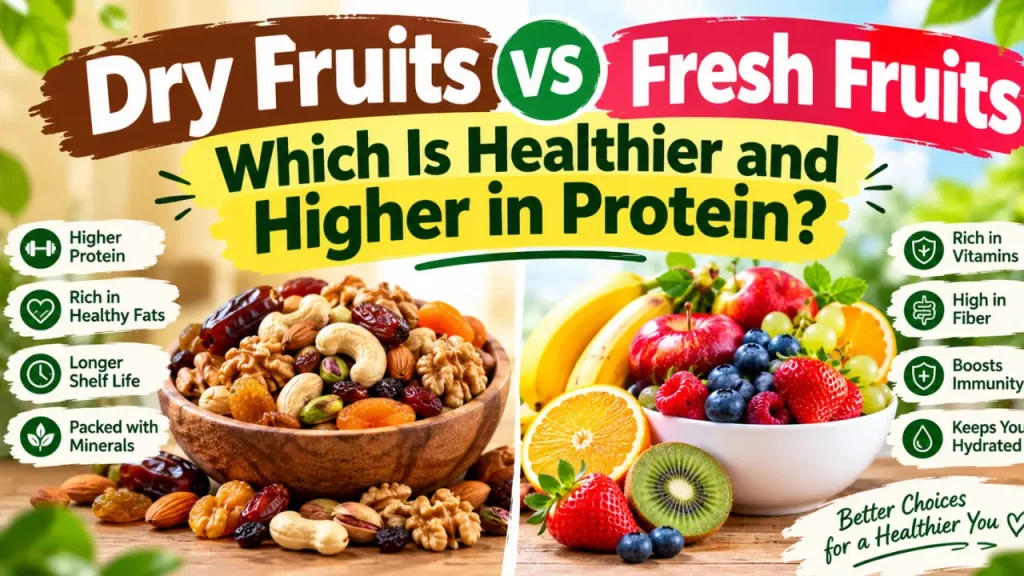
Can a small handful of dates really move your blood sugar more than a candy bar? For most people the answer is yes, and for a surprising number of “healthy” dried fruits, the answer is also yes. The fresh-versus-dried debate usually ends with a vague instruction to check the label. That’s not enough if you’re actually managing blood sugar, trying to lose weight, or dealing with a sensitive gut. The real answer depends on which dried fruit you’re eating, not just whether it’s fresh or dried.
On protein, the headline question has a quick, unglamorous answer: neither fresh nor dried fruit is a meaningful protein source. Removing water does concentrate protein slightly per 100 grams, but we’re talking about roughly 2 to 3.5 grams of protein per 100 grams of dried fruit versus 0.5 to 1.5 grams in the fresh version — a rounding error next to a handful of nuts. If protein is your goal, fruit of any kind is the wrong tool. The more useful question, and the one nobody answers with real numbers, is which dried fruits are lowest in sugar and least disruptive to blood sugar.
Myth: All Dried Fruit Is Basically the Same Sugar Bomb
It isn’t. Drying concentrates sugar in every fruit, but the starting sugar content and fiber structure differ enough that the end products land in very different places. Using standard USDA composition data for sugar content per 100 grams, and published glycemic index (GI) figures, the spread is wide:
| Dried fruit (100 g) | Total sugars (approx.) | Glycemic index (approx.) |
|---|---|---|
| Prunes | 38 g | 29 (low) |
| Dried figs | 48 g | 61 (high) |
| Dried apricots | 53 g | 31 (low) |
| Raisins | 59 g | 64 (high) |
| Dates | 63 g | 42-55 (medium) |
| Sweetened dried cranberries | 65 g | 64-72 (high) |
Notice the mismatch: figs have less sugar by weight than dates but a higher glycemic index, because fiber and fruit-sugar type (fructose versus glucose) affect how fast that sugar hits the bloodstream, not just how much is there. By both measures together, prunes and dried apricots come out ahead — lower sugar content and a low GI. Dates are sugar-dense but digest more slowly than raisins or sweetened cranberries, which are the two worst choices on this list for anyone watching blood glucose.
Myth: If It Has More Sugar, It Must Be Worse for Diabetes
This is where dried fruit gets more interesting than its sugar panel suggests. A multi-state analysis of 429,886 adults in the UK Biobank, followed for an average of 12.6 years, found that people eating two or more pieces of dried fruit a day had a 18% lower hazard of progressing from no diabetes to incident type 2 diabetes compared with people eating less than one piece a day, along with lower hazards for progressing to death and to diabetes complications (UK Biobank cohort study on fruit, vegetables and type 2 diabetes progression). That’s an observational finding, not proof that dried fruit lowers risk — people who eat dried fruit regularly may simply have healthier diets overall — but it undercuts the assumption that dried fruit is automatically dangerous for blood sugar.
A separate, smaller randomized trial gives a more direct signal for one specific dried fruit: in 76 adults with type 2 diabetes, 30 grams a day of dried Ziziphus vulgaris (jujube) for 12 weeks improved insulin resistance markers (HOMA-IR), the QUICKI insulin sensitivity index, and inflammatory markers compared with placebo, alongside small reductions in weight and BMI (randomized trial of dried Ziziphus vulgaris in type 2 diabetes). This is one trial on one fruit at a controlled 30-gram dose — it doesn’t license unlimited dried fruit, but it shows dose and fruit choice matter more than a blanket “dried fruit is bad” rule.
Myth: More Fiber and Antioxidants Per Ounce Always Wins
Dried fruit does pack more fiber, potassium and polyphenols per gram than fresh fruit, and a review of bioactive compounds in dried fruit found that raisins, cranberries, dates and prunes may favorably shift gut bacteria such as Bifidobacteria and Faecalibacterium prausnitzii (review of dried fruit bioactives and gut microbiota). But concentrated nutrients come with concentrated sugar and calories in the same bite, and a systematic review of meta-analyses covering fresh, dried, and processed fruit found that both fresh and dried fruit tend to show a neutral-to-protective association with chronic disease risk, while fruit juice does not (systematic review of fruit processing and chronic disease). In plain terms: the fiber and antioxidant edge is real, but it’s not a reason to eat dried fruit in fresh-fruit-sized portions. The trade-off is worth it only if you adjust the amount you eat.
Myth: A Handful of Dried Fruit Equals One Piece of Fresh Fruit
This is the practical gap nobody fills in. Because drying removes most of the water weight, a “serving” of dried fruit looks tiny next to its fresh equivalent:
- One fresh apricot (about 35 g) shrinks to roughly one dried apricot half — yet a typical snack portion is 6 to 8 dried halves, which is closer to 6 to 8 fresh apricots.
- A cup of fresh grapes dries down to about a quarter of that volume in raisins; a small box of raisins (28 g) represents considerably more grapes by sugar content than it looks like it should.
- Three fresh plums dry down to roughly three to four prunes — prunes are one of the few dried fruits where the fresh-to-dried ratio stays close to 1-to-1 by piece count, which partly explains their lower sugar density on the table above.
The practical rule: treat dried fruit portions by weight (check the gram amount on the label) rather than by what looks like “a handful,” and mentally multiply by four or five to picture how much fresh fruit you’re actually eating in sugar terms.
Myth: Dried Fruit Is a Safe Snack for Everyone Trying to Eat Healthy
It isn’t, for several groups specifically:
- People with prediabetes or insulin resistance should favor prunes or dried apricots over raisins, dates, figs, or sweetened cranberries, and keep portions near 30 grams, roughly the dose used in the jujube trial above.
- People actively losing weight should recognize that dried fruit’s calorie density per gram is several times higher than the fresh version, which makes portion control, not avoidance, the real lever.
- People with IBS or on a low-FODMAP plan often react to dried fruit’s concentrated fructans and polyols — dates, figs, and dried apricots are common trigger foods even when fresh portions are tolerated.
- Sulfite-sensitive individuals, including some people with asthma, can react to sulfur dioxide used to preserve color in commercial dried apricots and some raisins; unsulfured, darker-colored dried apricots are the safer pick.
For everyone else, pairing a small portion of dried fruit with a handful of nuts is one of the more evidence-backed combinations: a review of U.S. dietary patterns found that pairing nuts with dried fruit, particularly raisins and pistachios, is linked to improved cardiometabolic risk markers, even though dried fruit intake itself remains low in the population — only about 6.9% of U.S. adults report eating any on a given day (review on pairing nuts and dried fruit for cardiometabolic health).
Sources
- UK Biobank multi-state cohort study on fruit, vegetable intake and type 2 diabetes progression (2024)
- Systematic review of meta-analyses on fruit processing and chronic disease (2019)
- Review of dried fruit bioactives and gut microbiota (2023)
- Review on pairing nuts and dried fruit for cardiometabolic health (2016)
- Randomized controlled trial of dried Ziziphus vulgaris in type 2 diabetes (2021)
