Why Pumpkin Prices Rise Around Halloween: Demand, Supply & Seasonal Trends
The real story isn't that pumpkins get pricier near Halloween — it's which pumpkin, which pound, and which zip code.
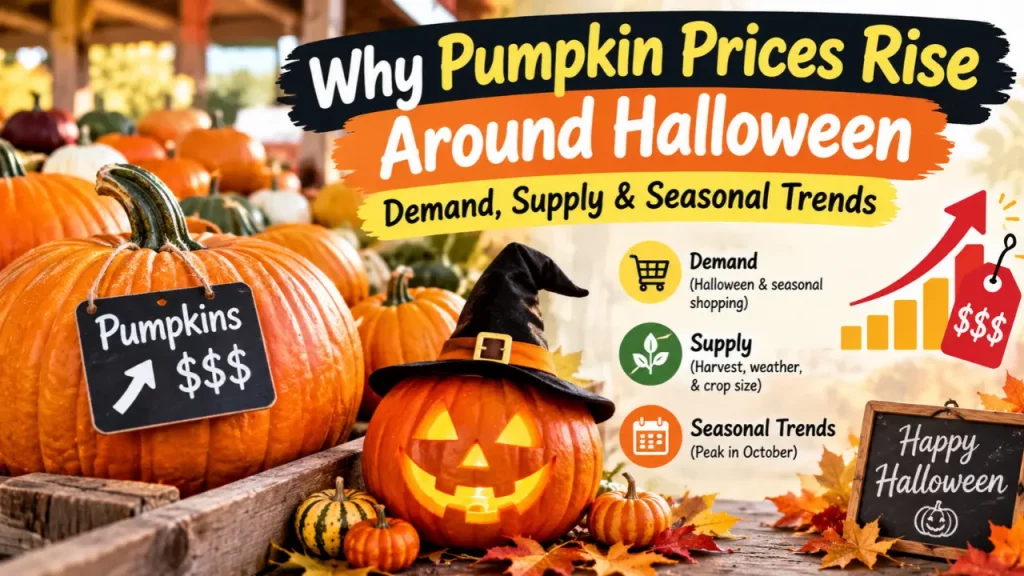
She’s standing between two bins at the farm stand, one hand on a squat, pale pumpkin the size of a soccer ball, the other hovering over a lopsided giant that looks like it rolled straight off a hayride. The sign over the first bin says “pie pumpkins, $0.79/lb.” The sign over the second just says “$8.” She does the math twice, looks at her cart, and still can’t decide which one is actually the better deal — or whether she should just come back in November and let someone else pay full price.
That hesitation is the whole story. Pumpkin pricing isn’t one number that climbs every October and crashes every November. It’s several different pricing systems running at once — by weight, by variety, by region — and the advice that works for one of them can quietly fail for another.
Per Pound, Per Pumpkin, Per Problem
Most shoppers compare pumpkins the way they compare watermelons: biggest for the buck. But large carving pumpkins and small pie pumpkins aren’t priced on the same logic. Big jack-o’-lantern varieties are often sold as a flat price per pumpkin, because farm stands know buyers want “the giant one for the porch” regardless of exact weight. Pie and sugar pumpkins, by contrast, are frequently sold by the pound, because bakers are paying for usable flesh, not porch presence.
That difference matters more than people realize. A carving pumpkin’s price per pound can actually work out cheaper than a pie pumpkin’s, even though the pie pumpkin looks like the “small, humble” option. You’re not paying for size with a baking pumpkin — you’re paying for a denser, sweeter flesh that’s harder to grow at scale and less forgiving of weather damage, so growers price it closer to its real cost. Comparing the two on sticker price alone is like comparing a whole chicken to a pack of chicken breast and wondering why the breast meat seems “overpriced.”
The Wholesale-to-Checkout Gap
Industry conversations about pumpkin economics over the past decade have often pointed to a sizable rise in wholesale pumpkin prices — sometimes described as an increase of roughly two-thirds compared with years earlier, though the exact figure shifts depending on the season and the source quoted. What almost never gets explained is why that increase doesn’t show up at the register in the same proportion.
The answer is that retailers and farm stands absorb a meaningful share of that wholesale jump rather than passing it straight through. A grocery chain that sells pumpkins mainly as a seasonal traffic-driver — something to get families in the door for cider, mums, and Halloween candy — has an incentive to keep the pumpkin price looking friendly even if its own cost per pumpkin rose. The markup on pumpkins is often thinner than on almost anything else in the store that month, because the real profit is coming from everything else in the cart. Smaller farm stands have less room to do this; they’re closer to the actual growing cost, which is part of why their prices can feel less “stable” than a supermarket’s year to year.
Shortage, or Just a Loud Season?
Every fall, some headline suggests a pumpkin shortage, usually timed to a single bad-weather story out of one region. In most years, this isn’t a true nationwide shortage — it’s a local supply hiccup getting framed as a national trend because “pumpkin shortage” is a catchier headline than “one region had a wet August.” Total pumpkin acreage across the country tends to be steady enough that a poor season in one growing area gets offset by an average or good season elsewhere. The exception is when weather problems hit multiple major growing regions in the same year — that’s the scenario that actually tightens supply broadly, rather than just locally.
The Pie Pumpkin Exception
Here’s where the standard “buy early, or wait for post-Halloween discounts” advice runs into trouble. That advice is built around carving pumpkins, which lose their purpose the moment Halloween ends — nobody needs a jack-o’-lantern on November 1st, so prices drop because demand genuinely disappears. Pie pumpkins don’t follow that pattern. Demand for baking pumpkins doesn’t vanish after October 31st; it often continues or even rises heading into Thanksgiving, when home bakers start thinking about pies, soups, and breads. A shopper who waits for a discount on pie pumpkins the way they would on carving pumpkins can end up paying the same or more, not less. For Thanksgiving baking, buying a pie pumpkin in late October, before the Halloween rush clears shelves of the good ones, often makes more sense than waiting. The “wait it out” strategy, in other words, is really a carving-pumpkin strategy wearing a general pumpkin-season costume.
A Different Map for Every Shopper
Where you live changes which of these patterns you’ll actually see. In cold-climate growing regions with a short, intense local harvest window, pumpkin prices can be driven heavily by how good or bad that single local season was — a rough early frost or a wet patch during flowering can tighten local supply noticeably, since there’s less time to recover with a second planting. In regions with longer growing seasons and larger-scale commercial acreage, the market tends to smooth out local weather problems because supply is pulled from a wider area. A shopper in a dense Northeast farm-stand market is often reacting to that one nearby farm’s season; a shopper in a Midwest region with large-scale pumpkin acreage is more likely seeing a blended, regional price that one bad week on one farm barely moves. Neither shopper is wrong about what they’re seeing — they’re just looking at different markets wearing the same name.
Back at the farm stand, the choice isn’t really about which pumpkin is “better value” in the abstract. It’s about what she’s planning to do with it. If it’s going on the porch for two weeks, waiting for the post-holiday markdown is the smarter bet. If it’s going into a pie plate in November, the bin she’s standing in front of right now — the one priced by the pound — is probably as good as it gets.