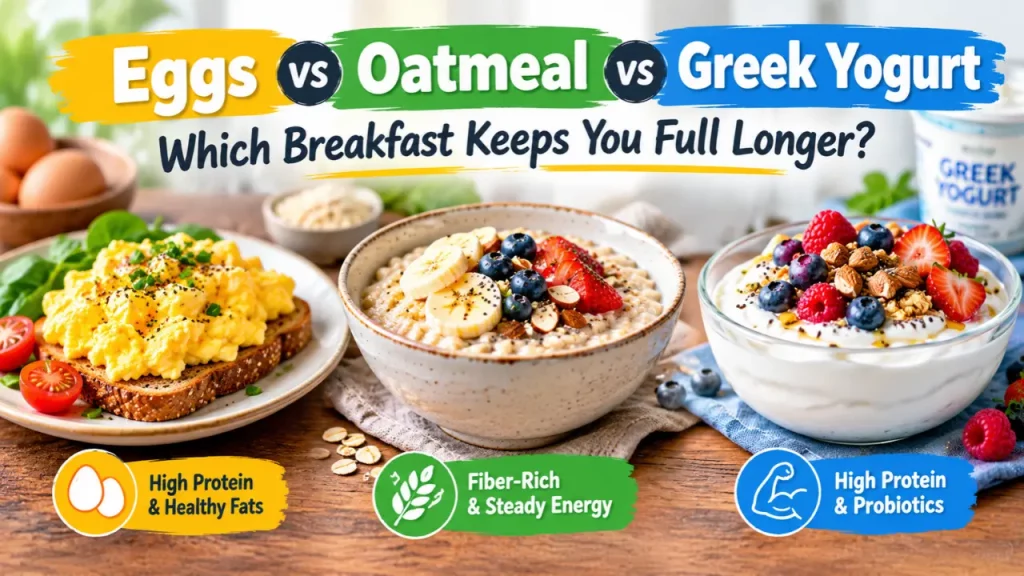
Eggs vs Oatmeal vs Greek Yogurt: Which Breakfast Keeps You Full Longer?
The real answer isn't which food wins, it's how you're testing fullness in the first place — and almost no one explains that part.
It’s 10:40 a.m. The meeting is dragging, your stomach growls loud enough that the person next to you glances over, and you’re trying to remember whether it was the eggs, the oatmeal, or the yogurt you had this morning that was supposed to carry you to lunch. Spoiler: whichever one you ate, you’re hungry now. That’s not a failure of willpower. It’s a sign that the question “which breakfast keeps you full longer” is more complicated than any ranking makes it sound.
Most coverage of this topic treats fullness like a leaderboard — eggs win, or oatmeal wins, or yogurt wins — based on a single number from a single study. What almost never gets explained is what “fullness” even means in these comparisons, why the exact same food can perform differently depending on who eats it and how it’s prepared, and why the portion size and toppings usually matter more than the base ingredient itself. That’s the gap this guide fills.
Step 1: Understand that “fullness” is measured at least three different ways
When researchers study satiety, they’re usually tracking one of three things: how full a person says they feel on a questionnaire, how many calories they eat at the next meal, or how long it takes before hunger hormones rise again. These don’t always agree with each other. A food can make you report feeling stuffed right after eating it and still leave you reaching for a snack two hours later. A different food might not feel dramatically filling at the table but genuinely reduce how much you eat later in the day.
Tip: When you read a claim that one breakfast “wins,” ask yourself which kind of fullness is being described. A subjective rating thirty minutes after eating is a very different claim than fewer calories eaten at lunch four hours later.
Step 2: Separate the protein from the package it comes in
Eggs, oatmeal, and Greek yogurt aren’t really three competitors in the same category. Eggs are almost purely protein and fat with essentially no fiber or carbohydrate. Oatmeal is a slow-digesting carbohydrate with fiber but comparatively little protein unless you add something to it. Greek yogurt sits in between, offering protein alongside carbohydrate, with the fat content swinging widely depending on whether you buy full-fat, low-fat, or nonfat.
Protein and fiber are the two nutrients most consistently linked to feeling fuller for longer, but they work through different mechanisms — protein tends to blunt appetite hormones and requires more digestive effort, while fiber adds bulk and slows stomach emptying. A breakfast that only has one of the two is missing half the equation, which is exactly why plain oatmeal and plain Greek yogurt often underperform compared to eggs in head-to-head comparisons — not because carbohydrate or dairy protein is inferior, but because the plain versions are missing the second lever entirely.
Tip: Instead of asking “which food is best,” ask “does this bowl or plate have both protein and fiber in it.” That single question predicts satiety better than brand loyalty to any one food.
Step 3: Account for how much you’re actually eating
A lot of comparisons quietly use mismatched portions — a couple of eggs against a small bowl of oatmeal against a modest cup of yogurt — and then declare a winner based on calories or grams that aren’t equivalent in any meaningful way. If one option is served in a noticeably larger or more calorie-dense portion, of course it holds you longer; that’s volume and energy density talking, not some special property of the food group.
Tip: When comparing breakfasts for yourself, try to match them roughly on calories for a week or two before deciding which one actually keeps you satisfied. Otherwise you’re comparing a snack to a meal.
Step 4: Factor in your own biology, not just the food
Satiety research consistently shows wide differences between individuals. Sleep the night before, stress levels, how much you exercised, your usual eating pattern, and even your sensitivity to blood sugar swings all shape how long a breakfast holds you. Someone who tends toward blood sugar dips after refined carbohydrates may find plain oatmeal leaves them hungrier than eggs, while someone else notices no difference at all. This is why personal experimentation tends to be more useful than a generic ranking.
The biggest thing missing from most “which breakfast wins” advice is this: fullness isn’t a property of a food, it’s a product of the food’s protein and fiber, the portion you actually eat, and your own body on that particular day.
Tip: Keep a simple one-week log — what you ate, your energy level, and the time you first felt hungry again. Patterns usually show up faster than people expect, and they’re specific to you in a way no article can be.
Step 5: Build the version of each breakfast that’s actually designed to fill you up
Rather than picking a single winner, build each option so it’s doing its best possible job. Eggs paired with vegetables and a slice of whole grain toast add fiber the eggs alone lack. Oatmeal gains real staying power once a scoop of protein — nut butter, nuts, or dairy — is stirred in rather than eaten plain. Greek yogurt becomes far more filling with fiber mixed in, such as berries, seeds, or a small handful of a high-fiber cereal, instead of being eaten by itself or with sugary toppings that spike and crash blood sugar.
Tip: Think of each breakfast as a base that needs one missing nutrient added, not a finished product to be judged as-is.
Common mistakes people make with this comparison
- Comparing a small portion of one food to a large portion of another and calling it a fair test.
- Judging fullness only by how stuffed they feel in the first thirty minutes, ignoring the hours that follow.
- Eating oatmeal or yogurt plain, then blaming the food group when hunger returns quickly, rather than noticing the missing protein or fiber.
- Assuming a result from one study, often with a small group of participants over a single morning, applies the same way to everyone.
- Switching breakfasts every few days based on headlines instead of giving one version a real week-long trial.
So which one actually keeps you fuller — eggs, oatmeal, or Greek yogurt? The honest answer is that it’s less about the food on the label and more about whether your plate has enough protein and fiber working together, matched to a portion that fits your morning and your own body’s patterns. Which one has worked best for you, and did changing what you added to it change the outcome?

Tom Fletcher
The latest from the Australian and global BBQ scene — comps, cooks and culture.