Seafood Boil vs Shrimp Boil: Which One Should You Try?
The real choice isn't flavor — it's timing, who's at the table, and what each pot actually costs per person.
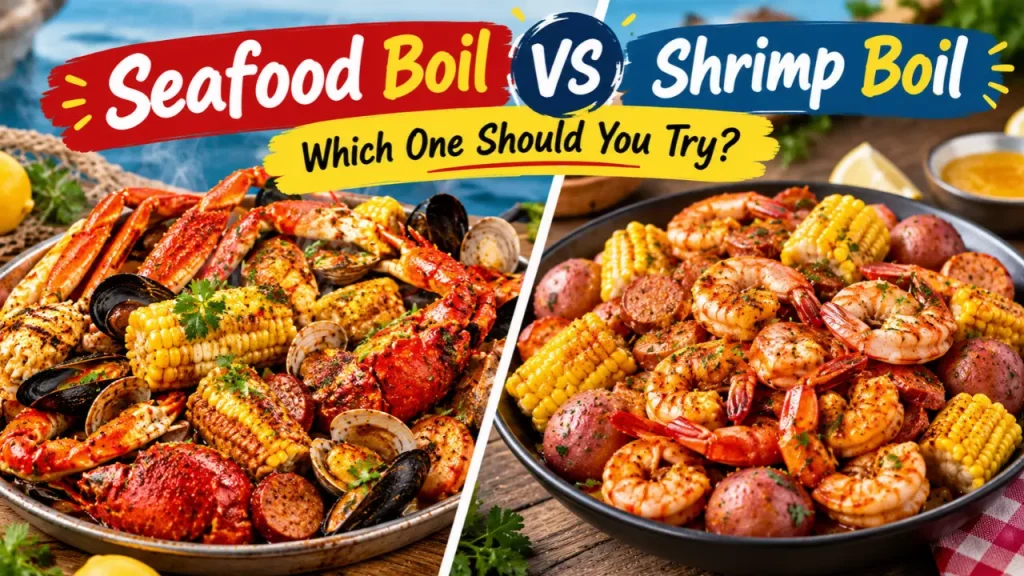
Most people assume the only real difference between a seafood boil and a shrimp boil is how much is dumped into the pot — more shellfish, more money, more mess. That assumption falls apart the moment you actually try to cook crab, clams, mussels, crawfish, and shrimp in the same water at the same time. Shrimp turns to rubber while the crab is still cold in the middle. One unopened clam can mean dinner for six just turned risky. And before anyone decides which boil to throw, there’s a quieter question worth asking: should everyone at that table even be eating it?
1. So, which one should you try?
If you want something fast, cheap, and forgiving of beginner mistakes, a shrimp boil wins — shrimp is the only variable, and it’s hard to ruin. If you want range of texture and flavor for a bigger occasion, and you’re comfortable managing multiple cook times in one pot, a seafood boil wins. The catch competing guides leave out: a seafood boil isn’t just “a shrimp boil plus more ingredients.” It’s a timing puzzle, and getting that puzzle wrong is the single most common reason people say they “don’t like” seafood boils — the food was fine, the sequencing wasn’t.
2. The minute-by-minute pot sequence
Everything in a mixed boil should hit the water in reverse order of how long it needs. Here’s a sequence that keeps crab from being underdone while shrimp isn’t turned to eraser:
- 0:00 — Bring seasoned water (or broth) to a rolling boil, then drop to a strong simmer. Add live or pre-cooked crab clusters/claws first.
- 8:00 — Add crawfish (live crawfish need the longest post-boil steep of the softer shellfish).
- 12:00 — Add clams and mussels together; they cook at nearly the same rate.
- 15:00 — Add shrimp (shell-on, large/jumbo size).
- 17:00–18:00 — Kill the heat entirely and let everything steep, covered, for 5–10 minutes. This is the step most home cooks skip, and it’s why shrimp and clams often arrive at the table overcooked: steeping finishes delicate shellfish gently, while a rolling boil the whole time punishes them.
Boiling versus steeping is not a small distinction — a full rolling boil toughens shrimp and shrinks clam and mussel meat noticeably within a couple of extra minutes, while steeping in hot, already-seasoned liquid lets residual heat finish the job without that shrinkage.
3. Doneness, safe temperatures, and when to throw it out
Shellfish are done when they hit an internal temperature of 145°F, which lines up with visual cues: shrimp turns opaque and curls into a “C” shape (a tightly curled “O” usually means overcooked); crab meat turns white and opaque with red/orange shell; crawfish tails curl and the shell turns bright red.
Clams and mussels carry a hard rule that doesn’t get enough attention: discard any that do not open after cooking. An unopened shell after a full steep isn’t “just a tough one” — it’s a sign the animal was dead before cooking and should not be eaten. Also discard any that were already open and did not close when tapped before cooking. These two checks take ten seconds and are the difference between a good boil and a trip to urgent care.
4. Who should think twice: shellfish allergy
Shellfish allergy is one of the most common triggers of food-related anaphylaxis, and it doesn’t always show up in childhood and then fade the way milk or egg allergies often do. In U.S. children, a national survey found shellfish allergy prevalence of 1.3%, with allergy to crustaceans — shrimp, crab, crawfish — more common at 1.2% than allergy to mollusks like clams and mussels at 0.5%, and diagnoses skewing toward school-age children rather than infants, according to a national pediatric food allergy prevalence survey. A broader review of hypersensitivity reactions across all ages notes that fish and shellfish are the most common allergens in adults specifically, with IgE-mediated food allergy overall affecting an estimated 5–10% of people, per a 2022 review of food allergy and hypersensitivity. Adult self-reported food allergy has also been climbing: a tracking survey across 2001, 2006, and 2010 found self-reported food allergy rose from 9.1% of adults in 2001 to 14.9% in 2006 and 13% in 2010, though physician-diagnosed rates were lower and steadier — 5.3%, 7.6%, and 6.5% across those same years. The practical takeaway: a mixed seafood boil exposes someone to both crustacean and mollusk allergens in one meal, so anyone with a known shellfish allergy shouldn’t be persuaded by “it’s just a little clam broth” — cross-contact in shared boiling water is real.
5. Who should think twice: gout
Shellfish, like red meat, is purine-rich, and purines break down into uric acid — the compound that crystallizes in joints during a gout attack. A 12-year prospective study of 47,150 men with no history of gout found that those in the highest quintile of meat intake had 1.41 times the risk of developing gout compared with those in the lowest quintile, a finding from a long-running dietary and gout risk study. That study’s strongest documented number is specific to meat intake rather than shellfish alone, so it shouldn’t be read as “shrimp causes gout at this exact rate” — but the underlying purine-load logic applies to crab, shrimp, crawfish, and mussels too, and anyone with a gout history or elevated uric acid has reason to treat a shellfish-heavy boil as an occasional plate, not a weekly one.
6. Who should think twice: blood pressure and pregnancy
Boil seasoning is built on salt, cayenne, and often pre-salted broth bases, and the shellfish itself adds sodium on top of that — a real concern for anyone managing high blood pressure, where a single sitting can represent a large share of a daily sodium target. People who are pregnant are generally advised by public health guidance to favor lower-mercury shellfish like shrimp, crab, and crawfish while limiting intake frequency and ensuring everything is fully cooked rather than lightly steamed — a reason the “quick dip” style of boil service, where shellfish is pulled early for texture, is worth skipping during pregnancy in favor of the full 145°F standard.
7. Low Country Boil vs Cajun Boil: not the same pot
A Low Country Boil (sometimes called Frogmore Stew) is built on a lighter, Old Bay–style seasoning, boiled in stages with corn, potatoes, and sausage, and served with minimal heat beyond black pepper and seafood seasoning. A Cajun Boil leans on a cayenne- and garlic-forward spice blend, often finished by tossing the drained shellfish in a butter-and-seasoning sauce before serving, pushing both the heat level and the sodium load higher. If a recipe or menu says “boil” without naming a style, assume Low Country unless cayenne or a butter toss is mentioned — the seasoning difference, not the shellfish list, is what separates them.
8. What it actually costs per person
Rough U.S. retail shellfish pricing makes the per-person gap concrete rather than vague. A shrimp-only boil built around 1/2 lb of shell-on shrimp per person plus corn, potatoes, and sausage typically lands near $9–$12 per person. A mixed seafood boil adding snow crab clusters, mussels, and crawfish alongside a smaller shrimp portion typically runs $20–$28 per person once crab is included, since crab clusters alone often cost more per pound than shrimp, crawfish, mussels, and clams combined. That’s not “a bit more” — it’s commonly double to triple the shrimp-only total, which is the real-dollar version of “costs more” that vague comparisons skip.
9. The mistakes that ruin either boil
Overcrowding the pot is the most common failure: too much shellfish per quart of liquid drops the temperature and causes uneven cooking, so shrimp at the bottom finish while shrimp near the surface stay underdone. A second mistake is guessing on the water-to-seasoning ratio — seasoning packets are built for a specific water volume, and adding “extra for flavor” without more liquid just concentrates sodium. The third is boiling straight through instead of steeping at the end, which, as covered above, is the single biggest reason delicate shellfish turns tough.
Which pot are you planning for your next gathering — and does the per-person math change your answer? Tell us in the comments.
Sources
- Prevalence and Characteristics of Shellfish Allergy in the Pediatric Population of the United States (2020)
- Prevalence of self-reported food allergy in U.S. adults: 2001, 2006, and 2010 (2015)
- Prevalence of self-reported food allergy in American adults and use of food labels (2007)
- Purine-rich foods, dairy and protein intake, and the risk of gout in men (2004)
- Food allergy and hypersensitivity reactions in children and adults — A review (2022)