Chicken Soup vs Vegetable Soup vs Lentil Soup: Which Is More Filling?
Lentil soup wins on paper, but FODMAP science and satiety research show the "most filling" soup depends on your gut and the clock.
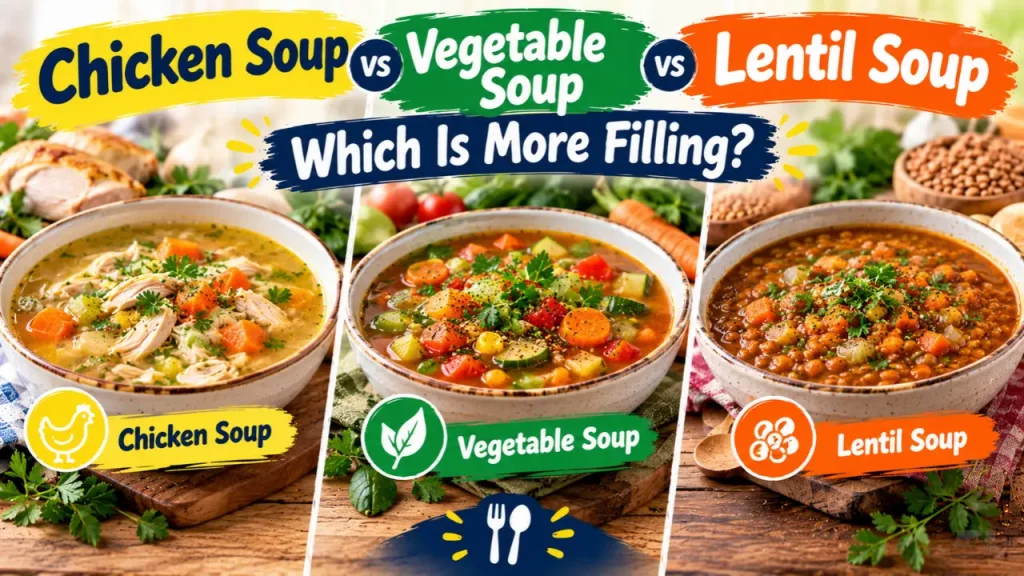
The common assumption is simple: more fibre and more protein equals more fullness, so lentil soup — the soup with the biggest numbers on both counts — must be the most filling choice, full stop. That assumption holds up fine in a lab spreadsheet. It falls apart the moment you put it inside a body that reacts badly to fermentable fibre, or that needs fullness to last through a 3pm meeting rather than fade by 1pm.
- Lentil soup has the highest protein-plus-fibre total of the three, but for a large share of people its fibre ferments into gas and bloating before it delivers “comfortable” fullness.
- A controlled preload study found soups are more satiating than their liquid form would predict, and tracked that fullness for a full four hours — not just the first hour after the bowl.
- Protein-rich preloads produced stronger, more accurate appetite compensation at the next meal than carbohydrate-rich preloads of equal calories.
- There is no single “most filling soup” — the right answer depends on your gut sensitivity, the time of day, and whether you need fullness that lasts two hours or four.
What “filling” actually means in a lab, not just on a label
Most comparisons of chicken, vegetable, and lentil soup stop at grams of protein and fibre per serving. That tells you what a soup could theoretically do to appetite hormones like GLP-1 and PYY, but not what it actually does over the following hours in a real stomach. A preload study on soup and satiety took a more direct approach: 31 adults ate 300-calorie versions of the same foods, some solid and some liquefied, high in protein, fat, or carbohydrate, then had their fullness, hunger, and mood rated at 15-minute intervals for the first hour and every 30 minutes for three more hours after that. The point of the design was to separate “tastes filling” from “stays filling,” and it found that soups held onto satiety for longer than their watery, low-density form would suggest. That four-hour measurement window is the piece missing from grams-on-a-label comparisons — it is the difference between a soup that feels fine at 1pm and one that still feels fine at 4pm.
Why lentil soup’s fibre advantage can misfire
Lentils are rich in galacto-oligosaccharides, a type of fermentable carbohydrate that the small intestine cannot break down. Bacteria in the colon ferment it instead, producing gas. For most people that is a mild, unremarkable process. For people with irritable bowel syndrome, reflux, or anyone following a low-FODMAP diet, that fermentation produces bloating, cramping, and a stretched, uncomfortable stomach rather than the calm, settled fullness the fibre numbers promise. The paradox is real: the soup with the “best” satiety profile on paper can leave the FODMAP-sensitive eater feeling worse-full rather than better-full, and more likely to reach for something else within the hour to settle their stomach — which defeats the entire point of eating something filling.
How fast each soup’s fullness actually fades
Fullness is not a single number; it is a curve that rises and falls. Chicken soup’s protein digests relatively slowly and steadily, and protein has a well-documented edge in keeping that curve flat for longer. A soup-preload study found that protein-rich soup preloads improved energy compensation at the next meal — participants who had a protein-heavy soup first ate measurably less afterward, and did so more accurately than those given an equal-calorie carbohydrate-heavy soup. Lentil soup’s carbohydrate load, even wrapped in fibre, digests faster than chicken soup’s protein matrix, so its fullness curve can start higher but drop sooner — compounded, for sensitive eaters, by the bloating discomfort arriving before the genuine hunger signal returns. Vegetable soup, being lowest in both protein and calories, produces the shortest curve of the three almost by definition — which is exactly why it works as a starter rather than a meal. In one trial, a 200ml vegetable soup preload with added umami seasoning (monosodium glutamate, at equal sodium to the control) lowered energy intake at the following meal in overweight and obese women, suggesting flavour intensity, not just mass, can nudge how much a light soup holds back hunger. That umami effect is not universal, though — a similarly designed trial in 9-to-11-year-old children across three ethnic groups found no difference in appetite or later intake between soup with and without the same seasoning, a reminder that satiety research does not always agree, and that age and population matter.
Who should not default to lentil soup
The “lentil soup is the safest bet” advice assumes a digestive system that tolerates fermentable fibre without friction. Several groups should treat that advice with caution:
- People with IBS or diagnosed FODMAP sensitivity — the same galacto-oligosaccharides that boost lentil soup’s fibre score are a known trigger for bloating and pain in this group.
- People with reflux or slow gastric emptying — a dense, high-fibre legume soup sits in the stomach longer, which can worsen reflux symptoms rather than simply “fill you up.”
- Anyone eating post-exercise — recovery nutrition favours faster-digesting protein, which points toward chicken soup’s protein rather than lentil soup’s slower-fermenting fibre-carbohydrate mix.
- Anyone eating close to bedtime — a soup that is still fermenting four hours later is not an asset at 10pm.
What to do: a decision rule instead of one blanket answer
Rather than picking one “winner,” match the soup to the situation. If your goal is a short, light appetite-opener before a main course, vegetable soup is designed for that and nothing more. If your goal is fullness that holds through a long afternoon and you digest fibre comfortably, lentil soup’s combined protein and fibre genuinely does the most physiological work — but test it on a quiet day first, not before an important meeting, if you have never gauged how your gut handles it. If you have IBS, reflux, or simply need fast, reliable fullness without bloating risk — especially after a workout or late in the evening — chicken soup’s protein-forward, lower-fibre profile is the more dependable choice, even though it scores lower on a fibre chart. On sodium, canned versions of all three soups typically run notably saltier than homemade broth-based versions made without added salt, so anyone managing blood pressure should check the label regardless of which soup they choose.
- Lentil soup’s fibre can trigger fermentation and bloating in IBS-prone or FODMAP-sensitive eaters, undercutting its “most filling” reputation.
- A four-hour satiety study shows soup’s fullness is a curve, not a single score — protein-rich soups tend to hold that curve flatter for longer.
- Vegetable soup is built for short-term appetite control before a meal, not sustained fullness.
- Choose by context: gut sensitivity, time of day, and whether you need two hours of fullness or four.
Which of these three soups actually keeps you full the longest, and did it ever backfire on you the way lentils can for a sensitive gut?
Sources
- Soup and satiety (2005)
- Monosodium L-glutamate in soup reduces subsequent energy intake in overweight and obese women (2016)
- No effect of monosodium glutamate on subjective appetite in children of different ethnicities (2021)
- Monosodium glutamate delivered in a protein-rich soup improves subsequent energy compensation (2014)
