Black Coffee vs Milk Coffee: Which Is Better for You?
Milk doesn't cancel coffee's benefits across the board — but for reflux, anemia, and fatty liver, the right choice depends on your body.
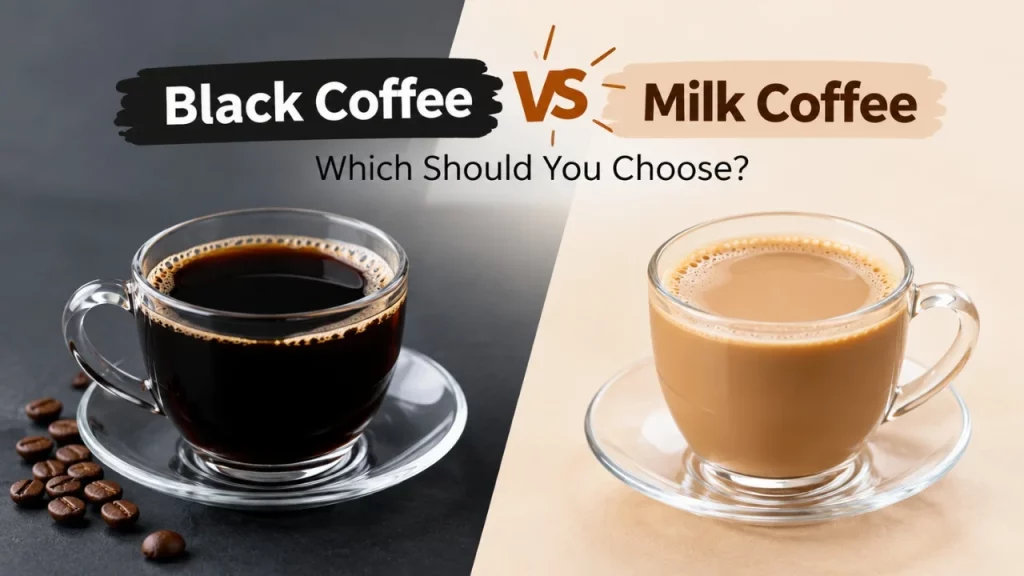
The kettle clicks off, the carton of milk is already in hand, and for half a second there’s a pause before pouring — a pause that, for someone with a reflux diagnosis scribbled on a prescription pad or an iron count that’s always a little too low, is really a small health decision disguised as a breakfast habit. Black or white isn’t a style question for everyone. For some people it’s closer to a medical one.
There is no single winner here. Black coffee and milk coffee behave differently depending on what you’re trying to protect — your liver, your stomach lining, your blood iron, your teeth, or your energy curve. Below are the specific comparisons worth settling, backed by what the research actually shows rather than what sounds true.
Myth: Milk neutralizes coffee’s antioxidants
Coffee’s chlorogenic acids are the compounds most often credited with its metabolic benefits, and it’s true that milk proteins, particularly casein, can physically bind to some polyphenols in a cup. Laboratory chemistry supports that interaction happening in the mug. What’s far less settled is whether this binding meaningfully blocks absorption once the drink reaches a real digestive system — human trials on this exact question are small, inconsistent, and nowhere near the scale of the liver research below. Treat “milk cancels coffee’s antioxidants” as plausible chemistry, not a proven human outcome. It’s overstated as a blanket warning.
Myth: Milk coffee is automatically safer for a fatty liver
This is where the actual evidence is strongest, and it points toward coffee itself, not the milk. A meta-analysis of nonalcoholic fatty liver disease studies found coffee drinkers had a 29 percent lower risk of NAFLD than non-drinkers (pooled risk ratio 0.71), and among people who already had NAFLD, coffee drinkers had a 30 percent lower risk of liver fibrosis (risk ratio 0.70). A separate dose-response review of coffee and NAFLD covering nearly 55,000 people found no significant protection at low, roughly two-cups-a-day intake, but a clear drop in NAFLD risk at higher intake, with more than three cups daily showing the strongest effect, and the highest-versus-lowest intake comparison showing a 6 percent reduction in risk (relative risk 0.94). An older study of patients with biopsy-confirmed liver disease found that people with more advanced fibrosis reported lower average caffeine and coffee intake than those with milder disease, a pattern the Hepatology study on caffeine and liver fibrosis described as consistent with a protective association, though it was observational and can’t prove cause. A genetic analysis using Mendelian randomization on habitual coffee intake and NAFLD found the same protective direction but did not reach statistical significance, which the researchers themselves flagged as inconclusive rather than negative.
None of this research credits milk with anything. The protection tracks with coffee intake, not with how it’s served. What does work against a fatty liver is the thing milk coffee quietly carries in: extra calories that add to the weight gain that drives the disease in the first place. A separate analysis of lifestyle and metabolic risk factors for NAFLD found body mass index raised NAFLD risk by 33 percent per standard-deviation increase and waist circumference raised it by 82 percent per standard-deviation increase. A milky, sugared coffee habit that nudges weight upward over years works against the very protection plain coffee seems to offer.
The liver research keeps pointing to the same idea: coffee itself appears protective, and anything added to the cup only matters if it changes your weight or blood sugar over time.
Myth: Black coffee is worse for an already acidic stomach
Black coffee is more acidic on contact, which is why it’s the one people blame for heartburn. But acidity isn’t the whole story for reflux. Milk adds fat, and fat slows stomach emptying, which means the coffee (and its acid) sits in the stomach longer before moving on — a mechanism that can work against people prone to reflux just as much as raw acidity does. Full-fat milk is the more likely culprit in a slow-digesting, reflux-triggering cup; a smaller splash of low-fat milk, or none at all but taken with food rather than on an empty stomach, tends to be the gentler route in practice. Neither version is “safe” for someone with frequent reflux without also watching portion size and timing.
Myth: Milk makes coffee worse for iron absorption
Coffee’s plant compounds, chlorogenic acids among them, are known to interfere with the absorption of non-heme iron, the type found in plants, eggs, and dairy rather than meat. This is why people with anemia are often told to leave a gap between meals and coffee. Milk doesn’t rescue this problem, but it doesn’t clearly make it worse either — the interference is driven by the coffee itself, not by what’s poured into it. For someone managing low iron, the practical fix isn’t choosing black over milk coffee; it’s timing the cup away from iron-rich meals and iron supplements by an hour or two, regardless of how the coffee is made.
Myth: Milk coffee hits you slower, so it’s weaker
The caffeine amount in a cup comes from the beans and brew method, not the milk — that part is well established and not in question here. What does change is the feel of the lift. Fat and protein slow gastric emptying, which can smooth out how quickly caffeine enters the bloodstream after a milky cup compared with black coffee on an empty stomach. The total caffeine absorbed doesn’t disappear; the curve is just flatter and slower to peak, which is why a milk coffee can feel like a gentler, longer buzz rather than a weaker one.
Myth: Milk protects your teeth from staining
Milk coffee does look less likely to stain, but that’s mostly an optical effect — a paler drink shows pigment less obviously on contact. The staining compounds in coffee, mainly tannins, still reach the enamel either way. Milk doesn’t coat or shield teeth from that pigment settling into enamel’s microscopic ridges over months and years of daily cups; it just makes a single cup look lighter going down.
Quick recap of what actually changes with milk, and what doesn’t:
- Milk’s effect on chlorogenic acid absorption is plausible in a lab but unproven at the level of real human benefit
- Coffee itself, not the milk, is linked to lower fatty liver and fibrosis risk in multiple studies; milk’s calories can work against that over time via weight gain
- Milk’s fat can slow stomach emptying, which may matter more for reflux than black coffee’s raw acidity
- Iron interference comes from coffee compounds, not milk — timing matters more than milk or no milk
- Milk slows the caffeine curve rather than lowering the dose
- Milk hides stains visually; it does not block the pigment from reaching enamel
Sources
- Coffee dose and nonalcoholic fatty liver disease, dose-response meta-analysis (2019)
- Coffee consumption and risk of nonalcoholic fatty liver disease, meta-analysis (2017)
- Habitual coffee intake and NAFLD, Mendelian randomization study (2021)
- Coffee and caffeine consumption with fatty liver disease and fibrosis (2012)
- Lifestyle and metabolic factors for NAFLD, Mendelian randomization study (2022)
