Paneer vs Tofu vs Chicken: Which Has the Most Protein?
Grams on the label aren't grams your body uses — here's the real math for hitting 25g of usable protein from each.
You’ve got three things on the cutting board: a slab of paneer sweating on a plate, a block of tofu still dripping from its tub, and two raw chicken breasts. The fitness app on your phone says you need 25 grams of protein at this meal. You weigh out what the label says will get you there. But the label is lying to you, a little — not about what’s in the food, but about what you’ll actually keep.
The quick answer, before the nuance
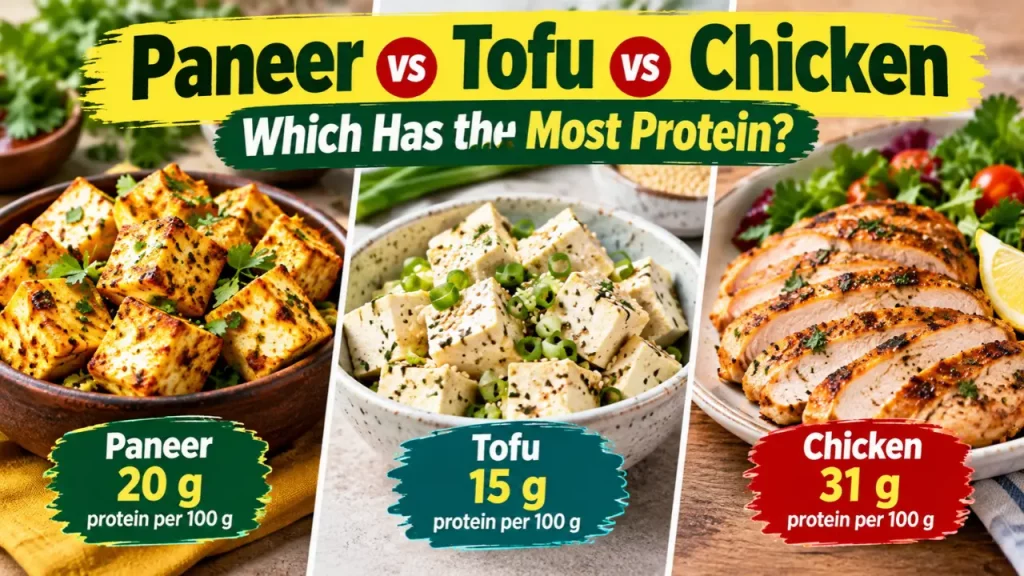
Gram for gram, chicken breast wins on paper, and it isn’t close. It runs around 31g of protein per 100g, paneer sits around 18-20g per 100g, and tofu swings anywhere from 8g to 17g per 100g depending on how firm it is. That’s the number every other article stops at. It’s also the number that overstates how much protein you actually absorb and put to use, because not all of those grams make it into your bloodstream and muscles the same way.
Grams on the label aren’t grams in your muscle
Protein quality isn’t just about amino acid completeness — it’s about how efficiently your gut breaks the protein down and ships the amino acids where they’re needed. This is where soy and dairy protein genuinely behave differently from chicken muscle protein. A meta-analysis of nine resistance-training studies involving 266 participants compared soy protein supplementation against animal protein supplementation over six weeks or longer. The result, somewhat surprisingly, was no meaningful difference in strength or lean body mass gains between the groups. So the long-standing assumption that soy protein is a poor substitute for animal protein doesn’t fully hold up once you look at actual training outcomes over weeks, not just lab digestion curves.
That matters for tofu. Its per-100g protein number already looks modest next to chicken. The digestibility gap narrows that further, but the real-world training data suggests the gap closes more than raw digestibility scores imply. Still, narrower isn’t zero — you’re not getting a one-to-one swap.
Paneer digests like a slow drip, not a shot
Paneer’s protein is mostly casein, the same slow-digesting dairy protein that’s been studied extensively in isolation. Casein doesn’t dump amino acids into your blood fast. In a crossover study of 11 healthy young men, researchers compared casein delivered directly into the gut versus the stomach and found gastric delivery slowed digestion and amino acid absorption even further, stretching the process out over hours rather than minutes. Separate work comparing intact casein against a pre-broken-down casein hydrolysate in elderly men found the hydrolysate raised blood amino acid levels 27% faster, confirming that whole casein — the form paneer protein actually is — is the slow version. A related study found that hydrolyzed casein sped up how quickly nitrogen reached peripheral tissue, even though total whole-body retention ended up similar either way. And gastric emptying research on whole milk proteins versus their hydrolysates found broadly similar emptying half-times around 18 to 21 minutes across forms, meaning the slowdown with intact casein happens more in digestion and absorption than in how fast it simply leaves the stomach.
Practically: paneer’s protein trickles in over a long stretch. That’s a feature if you’re trying to stay fed through a long gap between meals or overnight, and arguably a drawback if you want a fast post-workout spike.
The leucine catch nobody mentions
“Complete protein” gets treated as a pass/fail label, but it hides a bigger variable: leucine content, the specific amino acid that triggers the muscle-building switch. The same meta-analysis on soy versus animal protein noted that acute studies show whey stimulates muscle protein synthesis more than soy or casein, likely because of its higher leucine density — even when total protein and amino acid completeness are matched. Chicken isn’t whey, but its leucine profile tracks closer to animal muscle protein generally. Tofu’s soy-based leucine content and paneer’s casein-based leucine content both sit below that animal-muscle benchmark. None of this showed up as a meaningful long-term strength difference in the training data above, but if you’re chasing the fastest possible muscle-building signal from one single meal, grams alone don’t tell the whole story.
How much you’d actually need to eat
Here’s the math nobody runs. To hit a flat 25g of protein from each food, using their raw per-100g numbers:
| Food | Protein per 100g | Amount needed for 25g |
|---|---|---|
| Chicken breast | ~31g | ~81g |
| Paneer | ~19g | ~132g |
| Firm tofu | ~17g | ~147g |
| Soft/silken tofu | ~8g | ~313g |
That last row is the number that should change your shopping list. Soft tofu requires nearly four times the weight of chicken to hit the same protein target, before you even account for digestibility. Firm tofu closes most of that gap. Cooking adds another wrinkle: chicken loses water weight as it cooks, which concentrates its protein per gram on the plate, so a cooked serving looks more protein-dense than the raw number suggests — plan your raw weight accordingly, not your cooked weight.
Who this comparison doesn’t apply to
If you have chronic kidney disease, total protein load matters more than source — talk to your doctor before optimizing for “more,” regardless of which food wins here. If you’re lactose intolerant, fresh paneer still carries some residual lactose unlike aged hard cheeses, so it isn’t automatically safe. If you’re wary of soy’s phytoestrogen content, the training-outcome data above addresses muscle performance, not hormonal concerns, which is a separate conversation. And if you’re deciding what to eat before bed versus right after a workout, the casein-kinetics research above is the actual reason paneer and fast-digesting whey aren’t interchangeable — timing, not just total grams, changes which food serves you better.
The deciding factor that’s often just money
Once digestibility and serving size are accounted for, the tie-breaker for most people is cost per gram of usable protein, not the nutrition label. That number swings heavily by region, season, and brand, so there’s no honest single figure to quote — but it’s worth doing the division yourself: price divided by protein grams in the package, not price divided by package weight.
The real takeaway: chicken gives you the most usable protein per bite and per dollar in most cases, paneer gives you a slow, steady release worth timing deliberately, and tofu can match either one — but only if you reach for the firm block and eat considerably more of it than the per-100g number implies.
Sources
- No Difference Between the Effects of Supplementing With Soy Protein Versus Animal Protein on Gains in Muscle Mass and Strength in Response to Resistance Exercise (2018)
- Jejunal Casein Feeding Is Followed by More Rapid Protein Digestion and Amino Acid Absorption When Compared with Gastric Feeding in Healthy Young Men (2015)
- <a href=”https://doi
