Apple Crumble vs Apple Pie vs Apple Cake: Which Autumn Dessert Should You Make?
Forget vague effort comparisons — here's which apple dessert fits your actual time, equipment, shelf-life and dietary constraints.
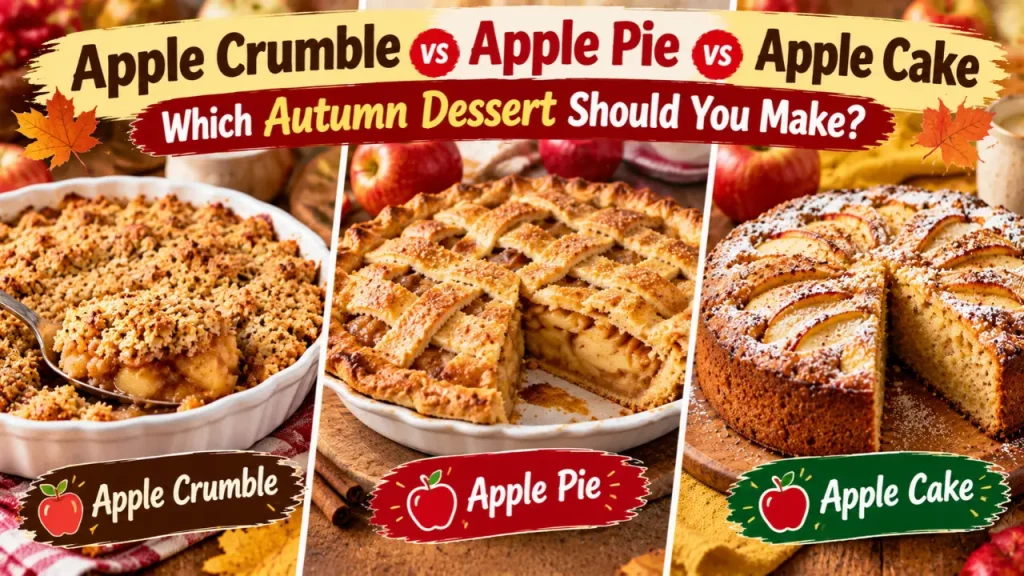
Do you have forty-five minutes or four hours? Is there a stand mixer in the cupboard or just a wooden spoon? Does this dessert need to survive until Thursday, or is it gone by Sunday night? Those questions, not vague talk of “effort,” are what actually decide whether you should be making a crumble, a pie, or a cake this week.
- Apple crumble is the fastest and most forgiving option: under an hour of hands-on-to-oven time, one bowl, no pastry skills required.
- The “crumble is healthier than pie” idea is mostly a myth — the apple itself carries the known health benefits, and butter-and-sugar toppings or pastry crusts both add roughly similar amounts of fat and sugar.
- Crumble, crisp, and cobbler are genuinely different builds, not regional synonyms, and that distinction changes how long each one keeps.
- Using a soft variety like Red Delicious doesn’t just taste worse — it collapses into mush in a pie shell or crumble dish because the apple’s own structure gives way during baking.
The direct answer: it depends on three numbers, not your mood
If you have under an hour and only one bowl and one baking dish, make the crumble. Prep is roughly 15 minutes of slicing and rubbing butter into flour and sugar (or oats, if you’re using a crisp-style topping), and it bakes in 35 to 45 minutes with zero resting time. There is no pastry to chill, roll, or blind-bake.
If you have two to three hours and actually enjoy using a rolling pin, pie is worth it — but only because of the pastry, which needs 30 to 60 minutes of chilling before it will roll without tearing, plus a 45 to 55 minute bake. Skip the chill and you’ll fight shrinking, tough dough.
If the dessert needs to last the longest and travel well, cake wins. It needs a mixer (or strong arm) for creaming butter and sugar, 45 to 60 minutes in the oven, and a full cool-down before slicing — which makes it the one dessert that genuinely improves by being made a day ahead, since the crumb settles and the flavor deepens overnight.
Crumble, crisp, cobbler — and why the labels keep getting confused
These three get used interchangeably online, but they’re built differently, and that affects both texture and shelf life. A crumble, in its traditional British form, uses a dry rubbed mixture of butter, flour, and sugar with no oats. A crisp is the American sibling — essentially the same idea, but oats (and often nuts) are folded into the topping, giving it more chew and a longer-lasting crunch once baked. A cobbler ditches the crumbly topping altogether in favor of spoonfuls of biscuit or scone dough dropped over the fruit, so the top is soft and bread-like rather than crisp. A “crumble pie” is a separate hybrid again — a pastry base with a crumble topping instead of a second pastry lid, which is why some pie recipes get mistaken for crumbles and vice versa. None of these distinctions are cosmetic: a true crumble topping dries out and can be refreshed in a hot oven for a few minutes, while a cobbler’s soft dough goes stale the way bread does, not the way a biscuit does.
Is crumble actually lower in calories, or is that just assumed?
This is one of the most common direct questions, and the honest answer is: not reliably. A crumble topping is still butter, flour, and sugar; a pie crust is butter (or shortening), flour, and a little water; a cake batter is butter, sugar, flour, and eggs. None of the three strips out fat or sugar by design — they just distribute it differently. What the research actually supports is a sharper distinction: the demonstrated health benefits of apples come from the fruit itself, not from what you bake around it. In a randomized crossover trial, adults with mildly high cholesterol who ate two whole apples a day for eight weeks saw improvements in blood lipids and vascular markers compared with a sugar-matched apple drink — benefits tied to the fiber and polyphenols in the whole fruit, not to sugar content (two-apples-a-day cholesterol trial). Bury that same apple under a buttery crumble or a sugared pastry crust and you’re adding calories and sugar on top of, not instead of, the fruit’s benefits. Calorie counts you see floating around for “a slice of crumble” versus “a slice of pie” vary enormously by recipe and portion size, so treat any single number with suspicion — the more useful question is how much added sugar and fat sits on top of the apple, which is a recipe choice, not a dessert-category rule.
Why the sugar matters more than the calorie count
Sugar load, not just calories, is where these desserts actually diverge in effect. A small adult study found that people who had a larger blood sugar spike after a high-sugar drink performed differently on cognitive tests depending on whether they’d had a low-sugar option like milk or a higher-sugar one like apple juice afterward, suggesting individual glycemic response matters for how a sugary food hits you after eating (postprandial cognition and glycemic response study). Separately, a small study in 44 healthy adults found that a concentrated dose of apple juice raised markers tied to short-term metabolic stress, and that drinking water alongside it blunted some of those changes (salt, fructose and hydration study). Both studies are small, short-term, and not about baked desserts specifically — but they point to a practical takeaway for anyone serving a crowd with blood sugar concerns: a dense, sugar-heavy slice of any of these three desserts, eaten without water or protein alongside it, is going to hit harder than the same slice eaten with a glass of water or a scoop of plain yogurt.
What happens when you use the wrong apple
Red Delicious is the classic mistake, and the failure is specific, not vague. Its cell walls break down fast under heat and it holds comparatively little acid, so instead of holding a slice shape it collapses into a wet, grainy paste. In a pie, that means a soggy, sunken filling and a crust that can’t support its own structure when sliced. In a crumble, it’s more forgivable because the topping hides the collapse, but you still lose the contrast between soft fruit and crisp topping that makes a crumble work. In a cake, where apple pieces are folded into batter rather than baked as the main mass, a soft variety mostly disappears — which is actually fine for cake, since a smooth apple presence is less noticeable than visible slices.
Storage: how long each one is actually good for
| Dessert | Room temperature | Refrigerated | Freezer |
|---|---|---|---|
| Crumble | 1 day (topping softens fast) | 3 to 4 days | About 1 month, topping re-crisps in a hot oven |
| Pie | 1 to 2 days, covered | 4 to 5 days | About 1 to 2 months, baked or unbaked |
| Cake | 2 to 3 days, covered | Up to a week | 2 to 3 months, wrapped well |
These are practical kitchen ranges, not laboratory figures, and they assume the dessert is covered and kept away from direct heat. Crumble topping is the most perishable part of any of these three — moisture from the fruit migrates upward and turns a crisp topping soft within a day at room temperature, which is why crumble is the one dessert genuinely best eaten within a day or two of baking, not held for a dinner party later in the week.
Adapting for gluten-free or lower-sugar diets
Crumble adapts the most easily. Swap the flour in the topping for a gluten-free blend or ground oats, and the texture barely changes because the topping was never meant to be smooth or elastic — it’s supposed to be crumbly, which gluten-free flours handle well. Cutting the sugar in the topping by a third is also low-risk, since the sugar there is for flavor and light caramelization, not structure. Pie pastry is the hardest to convert: gluten gives the dough the stretch to roll without cracking, and gluten-free pastry blends tend to be more fragile and prone to shrinking or tearing, so expect a rustic, patched-together crust rather than a clean lattice. Cake sits in the middle — gluten-free flour blends with xanthan gum can produce a good crumb, but cutting sugar much below the recipe’s amount tends to affect browning and moisture, since sugar does real structural work in a batter, not just sweetening.
A quick decision checklist
- Under an hour, one bowl, eating within two days: crumble.
- Have a rolling pin, two to three hours, want it to last the better part of a week: pie.
- Need it to travel, keep the longest, or taste better the next day: cake.
- Gluten-free guest: crumble topping is the easiest and most reliable swap.
- Serving anyone watching blood sugar: smaller slices with water or plain yogurt alongside, regardless of which dessert you choose.
- Only soft apples like Red Delicious on hand: lean toward cake, where collapse is less visible, rather than pie.
Sources
- The Moderating Role of Response to a Blood Glucose Challenge in Postprandial Cognition Following Consumption of Milk, Fruit Juice, and Water (2019)
- Two apples a day lower serum cholesterol and improve cardiometabolic biomarkers in mildly hypercholesterolemic adults (2020)
- A study on the early metabolic effects of salt and fructose consumption: the protective role of water (2024)

James Carter
The EverBBQ editorial desk — covering BBQ news, features and everything off the grill.