7 Best Seeds for Fatty Liver: Nutritional Benefits for Liver Health
Real study doses, timeframes, and who should skip seed-loading despite the liver-friendly hype — before you add another spoonful.
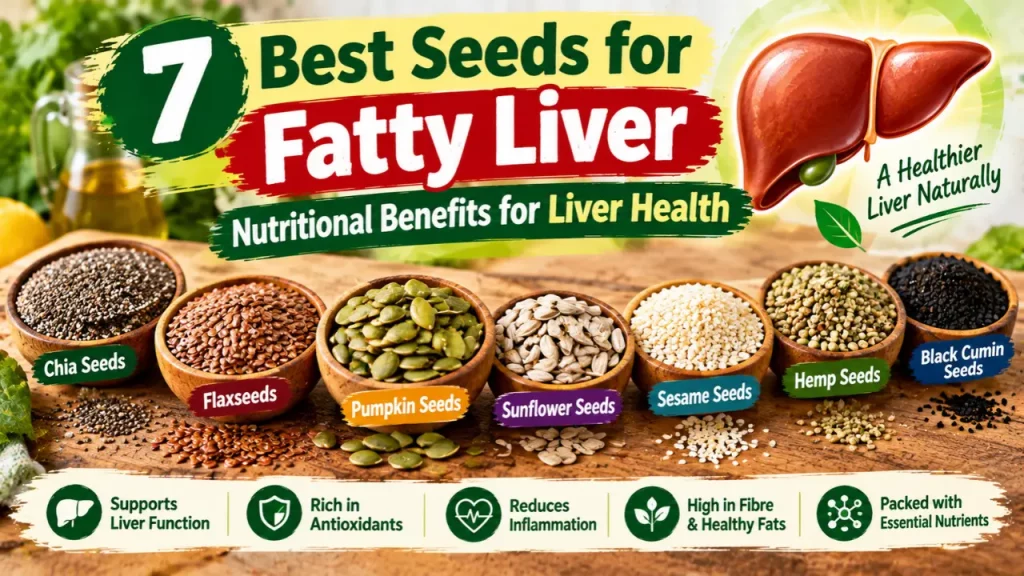
Here’s the assumption: fatty liver is a lifestyle problem, so the fix must be a lifestyle sprinkle — a tablespoon of flax here, a spoonful of chia there, maybe a jar of black seed oil capsules from the pharmacy aisle, and the liver slowly cleans itself up. Seeds get filed under “harmless extra,” something you add without really thinking about dose or timeline. That assumption falls apart the moment you look at what researchers actually gave people, for how long, and what changed — and what didn’t.
Flaxseed, chia, pumpkin, sunflower, sesame, hemp and nigella all show up on liver-health lists for the same general reasons: fiber, unsaturated fats and antioxidant compounds that can ease cholesterol and inflammation. That part is well covered elsewhere. What’s missing is the far more useful question — which seed, at what amount, for how long, actually moved liver enzymes or liver fat in a real human trial, and who shouldn’t be loading up at all.
The one seed with actual dosing data
Of the seven seeds usually named, nigella (black seed, Nigella sativa) is the one with a real cluster of randomized trials in people with nonalcoholic fatty liver disease. The doses used were not vague “a sprinkle” amounts — they were precise.
- In a 12-week trial, participants took 2 grams per day of whole nigella seed, compared against 2 grams per day of starch powder as placebo. By the end, inflammatory markers hs-CRP and NF-κB had dropped significantly only in the seed group, while TNF-alpha fell in both groups — a randomized trial on nigella and inflammatory markers that didn’t measure liver fat directly but hints at an anti-inflammatory effect at this dose.
- In an 8-week trial, patients took 1,000 mg (1 gram) of nigella oil per day. That shorter, lower-dose protocol found no significant change in adiponectin, leptin or blood pressure, according to a placebo-controlled trial on nigella oil and cardiometabolic markers — a useful reminder that not every nigella study produced a win.
- The strongest result came from a 3-month trial using 2.5 mL of standardized nigella seed oil twice daily (5 mL total per day). Ultrasound-graded hepatic steatosis improved significantly in the oil group compared with placebo, and ALT fell by an average of 32.6% in the oil group versus 14.2% in the placebo group, per a randomized trial on standardized nigella seed oil in NAFLD.
Pooling several of these trials, a meta-analysis covering 358 participants found that nigella supplementation improved ALT, AST, fasting blood sugar, HDL cholesterol, hs-CRP and ultrasound-graded fatty liver severity compared with placebo, though it had no effect on total cholesterol, LDL, triglycerides, insulin or TNF-alpha, according to a systematic review and meta-analysis of nigella sativa in NAFLD. A separate meta-analysis focused only on liver enzymes found AST dropped by a weighted average of 8.11 IU/L, but the drop in ALT — 7.26 IU/L on average — just missed statistical significance, according to a meta-analysis of nigella sativa and liver enzymes. In plain terms: the enzyme benefit is real but inconsistent across studies, and nobody should expect it in under two months.
The honest takeaway from these trials isn’t “seeds fix fatty liver” — it’s that one specific seed, at a measured daily dose, taken for two to three months, modestly nudges liver enzymes and ultrasound fat grading in people with early-stage disease, nothing more and nothing less.
What these trials don’t tell you
Every one of these studies enrolled people with garden-variety NAFLD — the kind picked up on routine ultrasound, without biopsy-confirmed fibrosis or NASH. None of them separated out people with scarring or advanced inflammation to see if seeds still helped once the disease progresses. So if your liver report mentions fibrosis staging or you’ve been told you have NASH rather than simple steatosis, these numbers simply don’t apply to you yet — nobody has tested it.
It’s also worth being honest about scale: the biggest trial here involved 120 people total, the smallest 44. These are small-to-modest studies, not the kind of large, long-term data that underpins something like vitamin E or pioglitazone, which clinical guidelines already recommend for biopsy-proven NASH. Seeds haven’t been tested head-to-head against vitamin E or fish oil in these same patients, so claiming a seed can substitute for either isn’t supported by anything above — it’s a gap, not a settled answer.
The omega-3 math people skip
Flax, chia and hemp bring plant omega-3 in the form of ALA, not the EPA and DHA found in fatty fish. The body has to convert ALA into those active forms, and that conversion is widely described as limited and inefficient. None of the trials above measured whether seed-derived ALA raised blood EPA/DHA enough to matter for liver fat — the nigella data, which is the only solid human dosing evidence we have, isn’t about omega-3 conversion at all, but about compounds like thymoquinone and its antioxidant effects. So treating a tablespoon of flax as a fish-oil replacement for liver purposes is an assumption, not a documented outcome.
Who should not seed-load
The liver-friendly label doesn’t mean liver-friendly for everyone. A few groups deserve a direct caution that these round-ups usually skip:
- Kidney disease patients — many seeds are dense in phosphorus and potassium, both restricted on renal diets, so a daily seed habit can quietly undercut those limits.
- Anyone on blood thinners or with a bleeding disorder — some seeds and their oils have mild antiplatelet effects, worth flagging to a prescriber before adding a daily dose.
- People with diverticulitis, IBS or SIBO — the fiber and small hard particles that make seeds useful for cholesterol can aggravate flare-ups or bloating in sensitive guts.
- Anyone on a calorie-restricted plan — seeds and seed oils are calorie-dense; “liver-friendly” doesn’t cancel out the fact that stacking several tablespoons a day can stall weight loss, which remains the single biggest lever for reducing liver fat.
Back to the jar on the shelf
So the person standing in front of the black seed oil capsules isn’t wrong to be curious — there’s real, if modest, human evidence behind nigella specifically, at doses between roughly 1 and 5 grams a day, over 8 to 12 weeks at minimum. But treating any seed as an interchangeable, consequence-free add-on skips the parts that matter: the dose that was actually tested, the stage of liver disease it was tested in, and the handful of health conditions where more seeds is not automatically better.
Have you tried adding a specific seed or seed oil to manage a fatty liver diagnosis, and did your follow-up bloodwork actually show a change?
Sources
- Effect of Nigella sativa in the treatment of nonalcoholic fatty liver disease: A systematic review and meta-analysis (2021)
- The effect of nigella sativa supplementation on cardiometabolic outcomes in NAFLD (2022)
- Nigella sativa and inflammatory biomarkers in NAFLD (2019)
- The Effects of Nigella sativa Supplementation on Liver Enzymes Levels: meta-analysis (2021)
- Standardized Nigella sativa seed oil ameliorates hepatic steatosis in NAFLD (2019)

James Carter
The EverBBQ editorial desk — covering BBQ news, features and everything off the grill.