Sweet Potatoes vs. White Potatoes: Which Is the Healthier Choice?
The right potato depends on your actual health goal — diabetes, blood pressure, kidney stones, or weight loss change the answer completely.
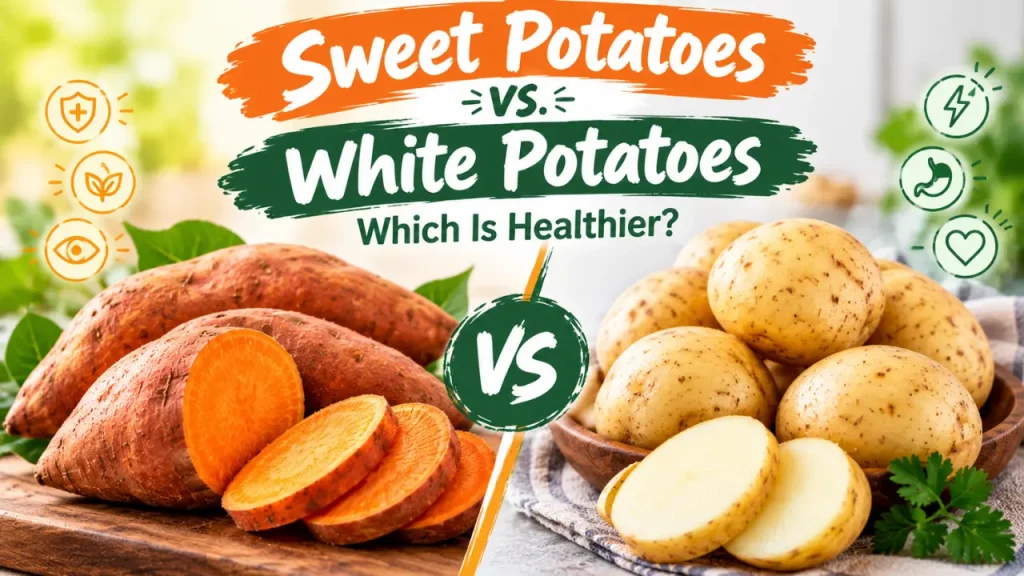
Which potato should actually be on your plate tonight — and does the answer change if you have diabetes, high blood pressure, or a history of kidney stones? Most comparisons stop at vitamin charts. The more useful question is narrower: which potato, cooked which way, fits your specific body.
- Cooking method can shift a potato’s glycemic impact more than the type of potato does.
- Sweet potatoes carry an oxalate load that white potatoes largely avoid, which matters if you form kidney stones.
- Neither potato is a meaningful protein source on its own, despite how often sweet potato is marketed as a “protein food.”
- Frying or hard-roasting either potato trades a lower glycemic index for other tradeoffs, including nutrient loss and acrylamide formation.
The real answer depends on what you’re protecting against
There is no single winner between sweet potatoes and white potatoes. A review of potatoes and cardiometabolic health found that potatoes and their components have been linked to lower blood pressure, better lipid profiles, and reduced inflammation markers in animal and human research — but the same review notes the human cohort data are mixed, and some population studies that lumped potatoes in with other calorie-dense foods found no cardiometabolic benefit at all. That inconsistency is the honest starting point: potato type matters less than what condition you’re managing and how you cook it.
Glycemic index moves with the pan, not just the plant
People searching for potato GI numbers usually get a single figure per potato type, as if cooking method were irrelevant. It isn’t. A 2022 study on protein-fortified sweet potato spaghetti measured how processing changes starch digestibility directly: plain sweet potato spaghetti had a higher glycemic index, but fortifying it with 15 percent chickpea flour or 15 percent whey protein concentrate brought the GI down to 59.43 and 58.73 respectively — a meaningful drop into the medium-GI range, achieved purely through formulation, not by changing the sweet potato itself. Separately, the cardiometabolic review above points out that a wide range of GI values has been reported for potatoes generally, and that data on how potatoes behave when eaten alongside other foods — which is how most people actually eat them — remain sparse. The takeaway: a sweet potato eaten mashed with nothing else behaves very differently on a glucose meter than the same sweet potato eaten with protein and fat, or reformulated into a denser, slower-digesting product.
Frying adds another twist. A 2020 study comparing baked and air-fried sweet potato chips noted that commercially fried sweet potato chips are typically fried in oil specifically because the added fat helps lower the glycemic index of the final product — but that same oil raises the calorie density and appears to accelerate the loss of heat-sensitive nutrients like beta-carotene, which the researchers used as a marker of nutrient degradation. In plain terms: frying can blunt the blood sugar spike, but it does so at the cost of the very nutrient advantage that makes orange-fleshed sweet potato nutritionally distinctive in the first place.
The oxalate problem nobody mentions with sweet potatoes
If you have ever formed a kidney stone, you have probably been told to watch spinach, beets, and nuts. Sweet potatoes belong on that same high-oxalate list, and they are rarely mentioned alongside it. White potatoes are comparatively low in oxalates. For most people this distinction is irrelevant — the body handles dietary oxalate without issue. But for anyone with a history of calcium oxalate stones, swapping white potatoes for sweet potatoes as a “healthier” move can quietly work against them, especially if sweet potato becomes a daily side dish rather than an occasional one. This is not a reason to avoid sweet potatoes outright; it is a reason to pair them with a calcium source at the same meal, which helps bind oxalate in the gut before it reaches the kidneys, and to avoid eating large portions of sweet potato every single day if stones are a recurring problem.
Acrylamide: a shared risk, not a sweet-potato-only issue
Roasting or frying starchy vegetables at high, dry heat encourages a browning reaction that produces acrylamide, a compound formed in both white and sweet potatoes when they are cooked hard and crisp rather than gently. Neither potato type gets a pass here. The practical difference shows up in texture cues: pale, soft-roasted edges mean less of the reaction has occurred; deeply browned, crisp-edged fries or chips — sweet potato or white — mean more. Boiling and steaming avoid the reaction almost entirely because the surface temperature never gets hot enough for that browning chemistry to kick in.
Quick tip: if you’re frying or roasting either potato for the crispness, aim for golden rather than deeply browned, and finish with a quick boil or steam step beforehand — parboiling before roasting cuts down the dry, high-heat exposure time needed to get a crisp exterior, which reduces both acrylamide formation and the nutrient losses described in the sweet potato chip research above.
Protein: why neither potato is a stand-in for an egg
Sweet potato is sometimes marketed as a plant-based protein food, but the fortification research is revealing precisely because of how much work it took to raise protein content. In the spaghetti study, researchers had to fortify sweet potato flour with whey protein concentrate or chickpea flour just to push protein content up by 192.20 percent and 150.08 percent over the unfortified control — meaning plain sweet potato starch started from a very low protein baseline that needed more than doubling through added ingredients to become nutritionally significant. White potatoes are in the same boat: filling, but not a protein source you should count on the way you would an egg. If a meal needs protein, pair either potato with something that actually supplies it — eggs, beans, fish, yogurt — rather than treating the potato itself as the protein component of the plate.
A decision rule if you’re managing more than one condition
If you have diabetes alone, cooking method and portion matter more than color: a boiled or steamed potato of either type, eaten with protein and fat, behaves more moderately than a baked or fried one eaten alone, and fortification research shows that composition changes (added protein or fiber-rich flours) can meaningfully lower glycemic index. If you have high blood pressure, the cardiometabolic review’s findings on potato components lowering blood pressure and improving lipids apply to potatoes broadly, not to one type specifically, so the skin-on, minimally processed version of whichever potato you prefer is the more defensible choice. If you have a personal or family history of kidney stones, lean toward white potatoes as the default and treat sweet potato as an occasional side eaten with a calcium-containing food, rather than a daily staple. If all three conditions overlap, the safest pattern is: white potato, boiled or baked with the skin, modest portion, eaten alongside a protein source — reserving sweet potato for less frequent meals rather than removing it altogether.
Sources

Tom Fletcher
The latest from the Australian and global BBQ scene — comps, cooks and culture.