7 Foods With More Iron Than Red Meat (Per Serving) | Easy Swaps
The milligrams on the label and the iron your body keeps are different numbers — here's the real math, food by food.
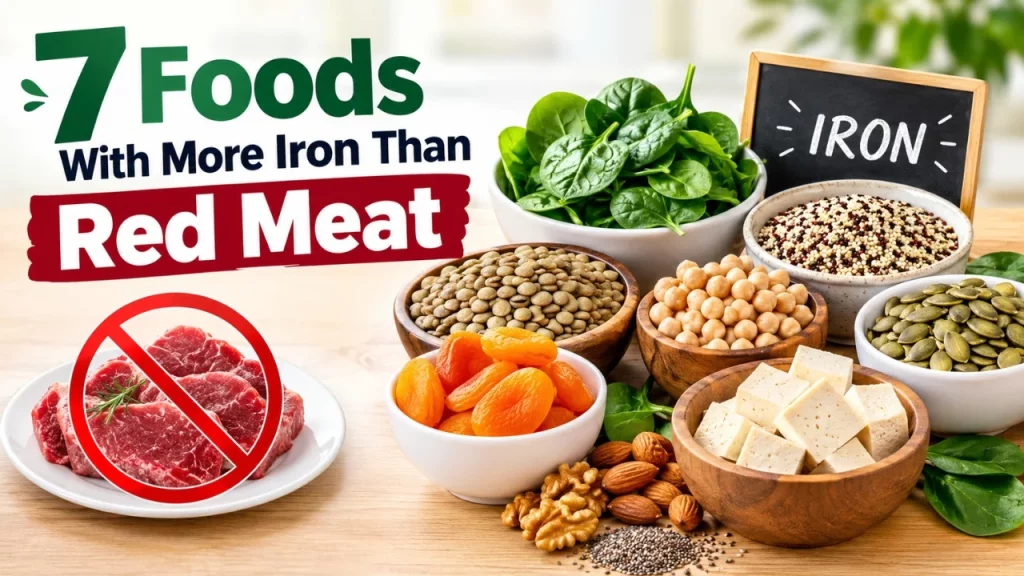
You’re standing in the kitchen with a printed list from your doctor’s office: ferritin low, come back in three months, eat more iron. Your phone says lentils, tofu, and spinach all beat red meat per serving. So you build a week of plant-heavy dinners, feel virtuous, and three months later the number has barely moved. Nobody told you that the milligrams printed on two different foods are not the same currency.
The milligrams on a nutrition label and the iron your body actually absorbs are two different numbers, and for most non-meat foods the gap is wide enough to change what counts as a fair swap.
The Label Math Nobody Shows You
Meat, poultry, and liver carry iron in a form called heme iron, which the gut absorbs efficiently. Plants, beans, nuts, and fortified grains carry non-heme iron, which is absorbed at a much lower and more variable rate, often cited in the range of roughly 2 to 10 percent depending on the rest of the meal, your current iron stores, and what you ate alongside it. That range alone explains why a food that lists more iron than steak can still hand your bloodstream less of it. If a plant food’s non-heme iron is absorbed at the low end of that range while a meat’s heme iron is absorbed several times more efficiently, matching the usable iron in one serving of red meat often takes two to three servings of the plant food, not a one-to-one swap. This is the step every “beats red meat” headline skips, and it’s the difference between a list that looks good on paper and a plate that actually fixes a blood test.
A food that lists more iron than meat can still deliver less of it into your bloodstream, because the body treats heme and non-heme iron as two separate substances with two separate absorption rules.
This isn’t just theory. A large cross-sectional analysis of iron status in Chinese adults eating predominantly plant-based diets found that even though red meat and heme iron intake varied fifteen to twenty-fold across the population, iron deficiency and deficiency anemia still affected 28.4 percent and 10.7 percent of women, respectively, versus just 1.6 percent and 0.7 percent of men. The intake was there on paper; the absorbed iron, especially in women, often wasn’t.
Chicken Liver: The Food Every List Skips
Organ meat is the one category most “more iron than red meat” lists leave out entirely, which is strange, because it’s also the only non-red-meat food where the math genuinely favors the swap. According to USDA FoodData Central values for cooked, simmered chicken liver, a single 1-ounce (28 g) portion delivers 3.29 mg of iron, and because it’s organ tissue, that iron is heme iron, absorbed at the same efficient rate as a steak’s. Scaled up, 100 g of chicken liver carries 11.6 mg of iron alongside 24.5 g of protein, 16.8 µg of vitamin B-12, and 578 µg of folate, nutrients that typically get worse, not better, on non-heme swaps. A roughly 3-ounce portion, comparable to a steak serving, lands near 10 mg of heme iron, several times what a typical red meat serving provides, with no absorption penalty. If the goal is usable iron per bite, liver is the actual winner on this list, not the lentils.
What Two Eggs Actually Get You
This is the question people type into search bars and never find answered directly: are two eggs enough iron? The honest answer is no, not on their own. Eggs carry a modest amount of non-heme iron concentrated in the yolk, nowhere near liver’s density and well under what a red meat serving provides even before absorption is factored in. Two eggs are a reasonable contributor to a day’s iron goal, especially stacked with a vitamin C source, but they are not a standalone replacement for a red meat serving, and treating them as one is a common reason people plateau on paper-based meal planning.
Building an 18-Milligram Day Without Meat
Because no single plant food matches red meat’s absorbed iron one for one, the realistic strategy is stacking, not swapping. A day that combines a cup of cooked lentils at breakfast, tofu at lunch, and cooked spinach at dinner can add up to a listed total near the standard 18 mg daily target for women, but because almost all of that is non-heme iron, the usable fraction absorbed from that whole day may still land well below what a single serving of liver or red meat delivers in heme form. This matches findings across multiple reviews: a systematic review of nutrient intake and status in plant-based diet consumers versus meat-eaters found plant-based eaters generally hit recommended iron intake levels on paper, and a separate review of plant-based diet definitions and nutritional adequacy reached a similar conclusion for intake, though both note that intake targets and absorbed status are not the same measurement. A 12-week randomized controlled trial that replaced animal protein with plant protein in healthy adults tracked iron alongside other minerals and found measurable shifts in nutrient status

Tom Fletcher
The latest from the Australian and global BBQ scene — comps, cooks and culture.