Top 10 Vitamin B12-Rich Foods in the World: Best Sources for Your Health
Why some people can eat every B12-rich food on every list and still turn up deficient — the problem isn't the menu, it's absorption.
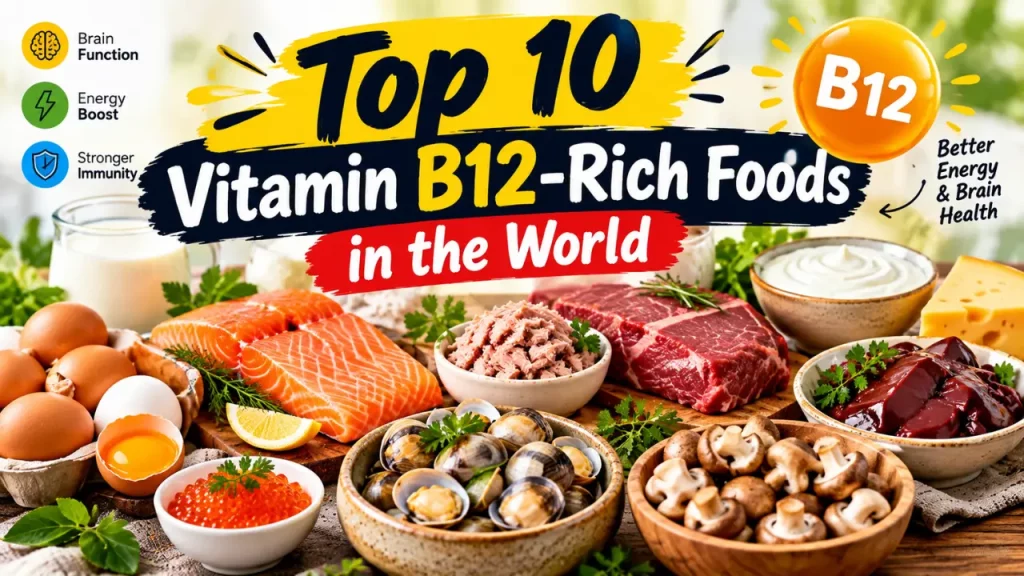
Most people assume that if blood tests show low vitamin B12, the fix is simple: eat more liver, clams, fish, beef, or fortified nutritional yeast, all regularly named as the richest natural and fortified sources, and the number will climb back to normal. For a large share of the population that assumption holds. For millions of others, it doesn’t, no matter how carefully they eat.
- The stomach can only process a limited dose of B12 per meal, so a huge serving of liver isn’t absorbed proportionally more than a modest one.
- PPI and H2-blocker users, long-term metformin users, adults over 50, people with autoimmune gastritis, and post-bariatric surgery patients often absorb B12 poorly even when their diet looks ideal on paper.
- Specific food cravings are not a documented symptom of B12 deficiency, despite how often that claim circulates online.
- Spacing B12 intake across several smaller meals or doses often raises blood levels more effectively than one B12-loaded dinner.
For a meaningful share of adults, eating more B12-rich food changes nothing in their bloodwork — the bottleneck sits in absorption, not on the plate.
What the “best sources” lists get right, and where they stop
Liver and clams are genuinely the densest natural sources, fish like salmon, trout, and sardines are dependable mid-range options, beef delivers B12 alongside iron and protein, and nutritional yeast remains the main fortified option for people who don’t eat animal products. All of that is accurate. None of it addresses whether the person eating these foods can actually turn them into usable vitamin B12 in their blood.
The absorption ceiling nobody mentions
Vitamin B12 from food doesn’t float freely into the bloodstream. It arrives bound to animal proteins, has to be stripped off by stomach acid and enzymes, then re-bound to a stomach-produced protein called intrinsic factor, which escorts it to a specific absorption site in the final section of the small intestine. That intrinsic-factor pathway is a saturable system — it has a practical ceiling of roughly 1.5 to 2 micrograms absorbed per meal, regardless of whether the meal contains a small portion of beef or an entire plate of liver loaded with dozens of micrograms. The surplus doesn’t wait around for the next digestive cycle; most of it is simply excreted. This is the physiological detail that a clinical review on cobalamin deficiency in adults describes when it separates true dietary insufficiency from “food-cobalamin malabsorption,” a distinct syndrome where the diet is adequate but the release-and-binding machinery fails.
Who can eat every item on the list and still come up short
The groups below aren’t eating the wrong foods. Their absorption machinery is impaired at one of the specific steps described above, so food choice stops mattering as much as people assume.
Long-term PPI and H2-blocker users
Acid-suppressing drugs blunt the first step of the process: without enough stomach acid, B12 can’t be cleaved from food proteins in the first place. A retrospective cohort study of adults on proton pump inhibitors for at least six months at primary-care clinics in Riyadh, Saudi Arabia, tracked paired serum B12 levels before and after sustained PPI use and found a significant decline associated with long-term therapy, reinforcing that this isn’t a theoretical risk but something measurable in routine patients. A separate screening study of 84 IT professionals attending routine health checkups found that 37.5% of those on chronic PPI use were B12 deficient, in a group where overall deficiency prevalence was already 33.34%, as reported in an opportunistic screening study of B12 status in working adults.
Long-term metformin users
Metformin interferes with calcium-dependent absorption of the B12-intrinsic factor complex in the intestine, a separate mechanical failure from the acid problem above. In that same IT-professional screening study, 33.34% of chronic metformin users were deficient. The effect shows up at far larger scale in a cross-sectional study of 3,124 adults with type 2 diabetes treated at a major hospital in Doha, Qatar, where metformin-associated B12 deficiency reached 30.7% prevalence (95% CI, 29.0%–32.3%). The deficient group’s median serum B12 was 129 pmol/L versus 286 pmol/L in those with normal levels — a more than twofold gap, in patients eating the same range of diets.
Adults over 50, especially those with reduced stomach acid
Acid production declines with age independent of medication. The cobalamin review notes that deficiency is “particularly common in the elderly,” commonly driven by atrophic gastritis combined with long-term antacid or biguanide use, which layers an age-related mechanical problem on top of whatever medications someone is already taking.
People with autoimmune gastritis or pernicious anemia
This is the most complete version of the failure: the immune system damages the stomach cells that make both acid and intrinsic factor, so there is often nothing left to carry B12 across the gut wall regardless of diet. It’s typically a disease of later adulthood, which is why a case report describing early-stage autoimmune gastritis in a 22-year-old man was notable enough to publish — the authors stress that complications like pernicious anemia and B12 malabsorption usually only become apparent at an advanced stage, decades later in most patients. It’s a single case report, not a population study, but it illustrates how silently the condition can progress before bloodwork catches it.
People after gastric bypass or sleeve surgery
Removing or bypassing the stomach tissue that produces acid and intrinsic factor creates the same bottleneck surgically that autoimmune gastritis creates immunologically. Food sources become largely irrelevant for this group because the absorption site itself has been altered or reduced.
Is craving meat or fish really a B12 symptom?
This claim circulates widely but isn’t supported by the clinical literature reviewed here. The documented features of cobalamin deficiency are neurological and hematological — fatigue, numbness or tingling, memory and mood changes, and megaloblastic anemia — not specific food cravings. If a craving for red meat shows up alongside genuine symptoms, it’s worth getting bloodwork done, but the craving itself isn’t diagnostic of anything.
Which drink actually delivers B12
Dairy milk contains B12 naturally, but in modest amounts relative to what a single feeding can absorb. Fortified plant milks are different in kind, not degree: manufacturers add synthetic B12 directly during production, often calibrated so one serving contributes a substantial share of a day’s needs. For someone with normal absorption, a fortified plant milk can outperform a glass of dairy milk simply because the vitamin was engineered into the product rather than occurring at whatever level a cow’s diet happened to produce.
How to actually reach 100% of the daily target
Because absorption caps near 1.5 to 2 micrograms per meal, a single B12-dense dinner is an inefficient strategy even for people with healthy stomachs. Splitting intake — a fortified breakfast item, a modest serving of fish or meat at lunch, a fortified plant milk or yeast-seasoned dish at dinner — gives intrinsic factor three separate opportunities to do its job instead of one overloaded one. For the groups listed above, this spacing strategy still won’t fully solve the problem, since their limitation isn’t dose size but a damaged or suppressed mechanism; those people typically need a formulation that bypasses intrinsic factor altogether, such as high-dose oral, sublingual, or injectable B12, discussed with a clinician rather than solved through grocery shopping.
- Intrinsic factor processes roughly 1.5–2 mcg of B12 per meal no matter how much food is eaten.
- PPI use, metformin use, age over 50, autoimmune gastritis, and bariatric surgery can all block absorption independent of diet.
- Deficiency prevalence reached 30.7% among metformin users in one 3,124-person Qatar study and 33.34%–37.5% among PPI and metformin users in a smaller 84-person screening study.
- Food cravings aren’t a documented symptom; fatigue, neuropathy, and anemia are.
- Spacing intake across meals beats one large B12-rich meal, though it won’t fix an absorption disorder.
Sources
- Association between proton pump inhibitor use and vitamin B12 deficiency, Annals of Saudi Medicine (2026)
- Opportunistic Screening of Vitamin B12 Deficiency in IT Professionals, JCDR (2015)
- Association of vitamin B12 deficiency with metformin use in type 2 diabetes, Qatar Medical Journal (2021)
- Early Endoscopic Features of Suspected Autoimmune Gastritis in a Young Adult Male, Cureus (2026)
- An update on cobalamin deficiency in adults, QJM (2009)

Mick Hudson
Low-and-slow recipes, rubs, sauces and fire management from our pitmaster team.