Deep Fried Dishes From Around the World: 10 Crispy Classics Worth Trying!
Not all ten fried classics carry the same risk — double-frying, oil choice and batter type change the health math more than any listicle admits.
The vendor works fast under a single bulb, lowering a wire basket of plantain slices into oil that has been bubbling since four in the afternoon. She lifts it, lets it rest on a tray, then drops the same slices back in for a second, shorter plunge. The crust tightens audibly. Twenty feet away, another stall fries samosas once, straight through, in oil that looks the same color it did three hours ago, though it almost certainly isn’t the same oil chemically.
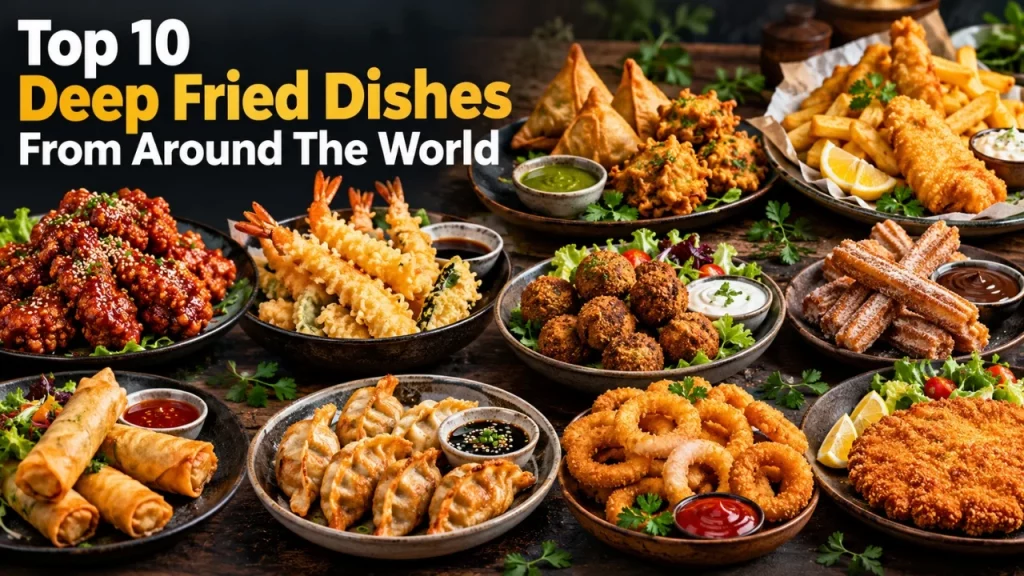
Ten famous fried dishes get lumped together in most roundups as equally indulgent, equally crispy, equally fine in moderation. They are not. Whether a dish gets fried once or twice, what oil it sits in, and what the batter is made of changes how much fat ends up in the food and what kind of compounds form in that fat. Those three variables, almost never quantified in food writing, decide which of these ten is comparatively the safer indulgence and which deserves real caution.
1. Why Double-Frying Isn’t Just a Trick
Double-frying works because of two separate physical problems that single-frying can’t solve at once: cooking the inside fully and building a crust that stays rigid. A first fry at a lower temperature cooks the interior and lets much of the surface moisture escape as steam, leaving a porous, still-soft shell. Resting the food allows that trapped steam to finish migrating outward evenly. A second, hotter fry then dehydrates the surface fast, collapsing those pores into a tighter, glassier structure that resists soaking up oil and holds its crunch far longer after it leaves the fryer.
Korean fried chicken and tostones already use this two-step method, which is why both stay crisp on a plate for longer than most fried foods. Samosas, pakoras and falafel, by contrast, are almost always fried once, straight through at a single temperature. That single long fry gives the oil more time in contact with a still-moist interior, which generally means more oil absorbed into the final piece, not less.
2. Reused Oil Has a Shelf Life, Even If the Fryer Doesn’t
Frying doesn’t just change food, it changes the oil. Repeated heating drives oxidation, polymerization and some hydrogenation of the frying medium, as researchers note when explaining why fried-food habits are hard to separate from the oil itself in a prospective cohort study of US nurses and health professionals. In practice, that means oil used for batch after batch at a street stall accumulates breakdown products with every reheating cycle, well before it looks or smells obviously “off.”
There is no single universally agreed number in the research for exactly how many fry cycles is safe, because it depends on oil type, temperature, and what’s being fried in it. The practical signals worth watching are darkening color, persistent foaming, a drop in smoke point, and a heavier, sluggish texture. Oil showing two or more of those signs has already undergone significant chemical change, regardless of how many hours it has technically been in the pot.
3. Batter Chemistry Decides How Much Oil Lands on Your Plate
Rice flour, used in Japanese tempura batter, forms a weaker gluten network than wheat flour, which creates a lighter, less continuous crust with fewer deep channels for oil to settle into. Wheat-based batters, used for fish and chips, churros, and samosa pastry, build a denser, more absorbent structure. Chickpea flour, the base of both pakora batter and much falafel binding, is protein-dense and tends to fry into a more porous crumb, which generally pulls in more oil during a single long fry than a thin rice-flour coating does.
This matters because two dishes that look similarly “crispy” can carry very different amounts of absorbed fat purely because of what the batter is made from, not because one chef fried longer than another. A tempura shrimp and a pakora of similar size are not nutritionally equivalent just because both are described as fried and crunchy.
4. The Acrylamide Question Nobody Breaks Down by Dish
Acrylamide forms when starchy, carbohydrate-rich foods are cooked at high temperatures, through a reaction between natural sugars and the amino acid asparagine. A review of dietary acrylamide intake across 101 studies found estimated median intake ranging from 0.02 to 1.53 micrograms per kilogram of body weight per day worldwide, with children’s body-weight-adjusted intake running up to three times higher than adults’, a gap the review attributes partly to children eating more starchy fried and baked snacks relative to their size.
Of the ten dishes in question, the carbohydrate-heavy ones, samosa pastry, pakora batter, falafel, and churros, sit in the higher-risk category for acrylamide formation because they’re starch-forward and often fried hot and long enough to brown deeply. Fried chicken, Korean fried chicken, tempura shrimp, and arancini’s rice-and-cheese core are comparatively lower acrylamide risk, since their bulk is protein, fat, or already-cooked starch rather than raw flour exposed directly to high heat.
5. Oil Choice Changes the Cardiovascular Math
Palm oil, widely used in commercial and street frying because it’s cheap and stable at high heat, is high in saturated fatty acids. A systematic review of palm oil and cardiovascular disease risk found so few usable studies that the authors could only narrate the findings rather than statistically pool them, leaving the evidence on palm oil specifically inconclusive rather than reassuring. That gap means a fried dish’s health profile can shift meaningfully depending on whether a vendor uses palm oil, a reused blend, or a fresh neutral oil, even when the dish itself and frying time are identical.
6. What the Large Cohort and Pattern Studies Actually Found
A review summarizing current evidence on fried food and cardiovascular health concluded there is strong evidence of higher chronic disease risk specifically when fried foods are eaten four or more times per week, while acknowledging that other studies have failed to confirm an association at lower frequencies, a genuine disagreement in the literature rather than settled fact. The nurses’ and health professionals’ cohort study linked more frequent fried-food consumption with higher incidence of type 2 diabetes and coronary artery disease over decades of follow-up, though as an observational study it cannot prove the frying itself, rather than the overall dietary pattern, caused the outcomes.
A cross-sectional study of nearly 20,000 Dutch adults identified a “refined-foods” consumption pattern, higher in french fries, sugary drinks, and white bread, as distinct from patterns built around fried vegetables, fish, and wine, and linked to worse cardiovascular risk factor profiles in the general population. Because it’s cross-sectional, it shows association at one point in time, not cause and effect.
7. Who Should Avoid the Fryer Basket Altogether
None of the listicles note that deep-fried food isn’t neutral for everyone. People with gastroesophageal reflux often find fried food triggers symptoms because high fat content slows stomach emptying and can relax the valve that keeps acid down. People with gallbladder disease or a history of gallstones are frequently advised to limit fried and high-fat meals because fat intake stimulates gallbladder contraction and can provoke pain. And given the cardiovascular associations above, anyone already managing elevated cardiovascular risk or type 2 diabetes has a clearer reason than “everyone loves it” to treat these dishes as occasional rather than routine.
8. A Practical Ranking of the Ten
| Relative concern | Dishes | Main driver |
|---|---|---|
| Comparatively lower | Tempura, arancini, Korean fried chicken | Light rice-flour or double-fried crust limits oil uptake and starch exposure |
| Middle | Fried chicken, tostones, fish and chips | Wheat batter or single coating, moderate oil absorption |
| Comparatively higher | Samosa, pakora, falafel, churros | Starch-heavy batter, single long fry, higher acrylamide and oil-absorption potential |
This ranking is a guide to frying mechanics, not a verdict on any one dish or cuisine. The same samosa fried twice at controlled temperatures in fresh oil behaves very differently from one fried once in oil reused all week.
Crispy isn’t the problem. How it got crispy, and in what oil, for how many rounds, is where the real difference sits.
<h2

James Carter
The EverBBQ editorial desk — covering BBQ news, features and everything off the grill.