Chia Seeds vs. Flaxseeds vs. Pumpkin Seeds: Which Is Best for Your Health?
The exact chia-flax-pumpkin ratio backed by trial data, plus who should skip which seed for thyroid, clotting, or hormone reasons.
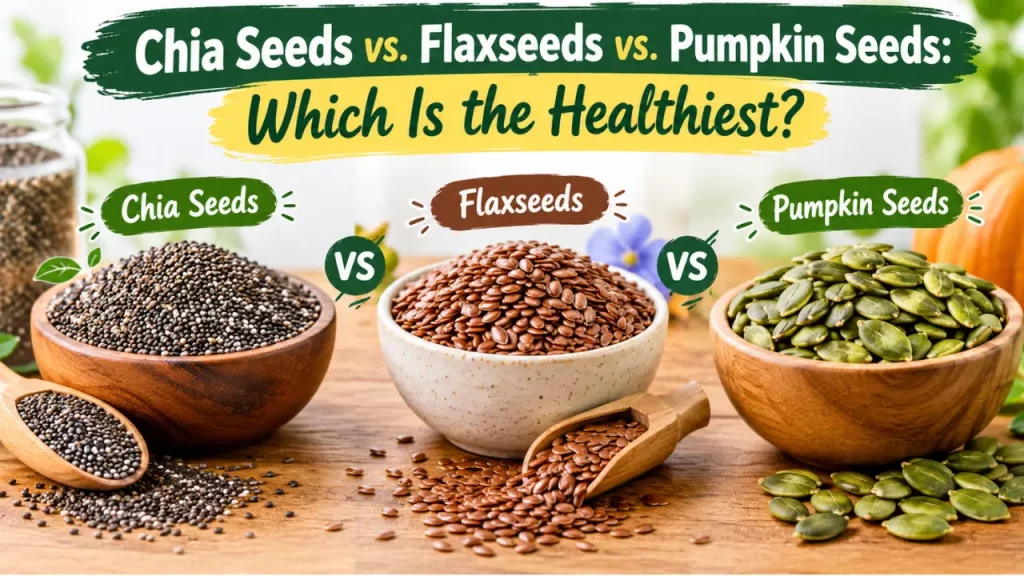
You’re standing at the counter at 6 a.m., three jars open — dark chia, golden flax, pale green pumpkin seeds — and a single tablespoon in your hand, trying to decide how much of each to tip into your oatmeal before the coffee finishes brewing. Nobody ever tells you the ratio. They just tell you all three are “good for you” and leave you guessing.
Here’s the direct answer: there isn’t one perfect seed, but there is a workable combined ratio, and it isn’t equal parts of everything. Based on the dosing actually used in human trials and the safety ceilings for each seed’s problem nutrient, a sensible daily mix leans heavier on chia, moderate on flax, and lighter on pumpkin — roughly two parts chia to one part ground flax to one part pumpkin seed, capped at a modest total rather than piled on freely.
The one-spoon answer, and why it isn’t equal parts
Chia gets the largest share because it’s the only one of the three with a real randomized trial behind a specific dose. In a six-month, double-blind trial of overweight adults with type 2 diabetes, people given chia at 30 grams per 1,000 calories of diet per day lost 1.9 ± 0.5 kg over six months, compared with 0.3 ± 0.4 kg in a control group eating an oat-bran product at 36 grams per 1,000 calories. That’s roughly six times more weight lost on chia than on the comparison fiber source, inside a calorie-restricted diet, not as a free-standing miracle food. Flax gets a smaller share because its active compounds — lignans and alpha-linolenic acid — are powerful in animal and cell studies at concentrated doses, and nobody has defined a precise everyday ceiling for a person also eating chia and pumpkin seeds on the same spoon. Pumpkin seed gets the smallest share purely because of its mineral density; stacking it at the same volume as the other two pushes zinc and calories up fast without much added fiber benefit.
What the lab evidence on flax and hormones actually shows
This is the part people get wrong in both directions. The common warning is “avoid flax if you’ve had a hormone-sensitive cancer,” but the actual research tells a more interesting story. In cell studies, alpha-linolenic acid reduced growth in both estrogen-receptor-positive and estrogen-receptor-negative breast cancer cell lines, cutting growth by 55-80% at a 75 micromolar dose and increasing programmed cell death regardless of estrogen exposure. In mice with estrogen-receptor-negative tumors, flaxseed, its lignan, and its oil component each slowed tumor growth, and a separate mouse study found 10% dietary flaxseed cut lung metastasis from 55.6% to 22.2% and lymph node metastasis from 88.9% to 33.3%. A review of the broader evidence base concluded that flaxseed lignans do not interfere with tamoxifen and may instead improve its effectiveness, with observational data linking higher lignan intake to 33-70% lower breast cancer mortality and 40-53% lower all-cause mortality, mostly in postmenopausal women.
None of that is a green light to self-treat, and most of it comes from animal or lab-dish studies rather than trials in people — that distinction matters. But if your real concern is “will a spoonful of ground flax undo my cancer treatment,” the honest answer from the data reviewed here leans toward reassurance, not alarm. The conversation to have with your oncologist is about dose and timing around specific drugs, not blanket avoidance.
The real risk with seeds isn’t any single nutrient hiding in one of them — it’s stacking three good-for-you seeds on the same spoon and never noticing that their totals, especially fiber, oxalate, and minerals, add up faster than any one seed’s serving size suggests.
Interactions that deserve an actual conversation with your doctor
| Situation | Seed to watch | What to do |
|---|---|---|
| Warfarin or other blood thinners | Flax and chia (omega-3 content) | Theoretical bleeding-risk interaction; ask your prescriber before adding daily ground flax |
| Diabetes or blood pressure medication | Chia | The trial above showed real glycemic and weight effects — monitor glucose closely, dose adjustments may follow |
| Antibiotics (tetracyclines, quinolones) | Pumpkin seed (zinc) | Space seed intake at least two hours from the dose |
| IBS, diverticulitis, or swallowing difficulty | Chia | Never eat it dry; the gelling that makes pudding also swells against a narrowed gut or throat |
| History of calcium-oxalate kidney stones | All three, cumulatively | Keep total seed intake modest and pair with calcium-containing foods at the same meal |
Raw flax and cyanide: kitchen myth or real number
Flaxseed does contain cyanogenic compounds, and that fact gets repeated often enough to scare people off a spoonful entirely. None of the trials reviewed here measured toxicity thresholds in people eating ordinary amounts, so it would be dishonest to hand you a precise “safe” gram figure. What the evidence does support is that the serious effects researchers study — tumor growth suppression, lignan absorption, cholesterol changes — all come from the same modest everyday amounts people already use in cooking, not from raw, unprocessed, large-batch consumption. Grinding your flax, which you need to do anyway to absorb its nutrients, also reduces the raw-seed exposure that the myth is built around.
When to actually eat the spoonful
The chia trial didn’t test seeds eaten at a specific clock time against seeds eaten at another; it tested a daily dose inside a calorie-controlled diet over six months and measured satiety hormones as a secondary outcome, alongside the larger weight loss. That’s a meaningful signal that chia’s fiber and gel-forming bulk plausibly blunt appetite when it’s part of your eating pattern, but there’s no trial evidence here proving that eating it fifteen minutes before lunch beats eating it with breakfast. The practical, evidence-aligned move is consistency — the same daily mix, folded into a meal you’ll actually eat every day — rather than chasing a precise pre-meal window the research hasn’t tested.
One mixed spoonful, built in roughly two parts chia to one part ground flax to one part pumpkin seed, sized to your own calorie needs and checked against your medications, beats any single seed eaten alone — but only if you treat the mix as a daily total to manage, not a free pass to add more of everything.
Sources
