Tofu vs Eggs: Which Is Healthier for Your Plate?
Two eggs aren't matched by 100 grams of tofu — here's the real gram equivalence, and who should skip the swap entirely.
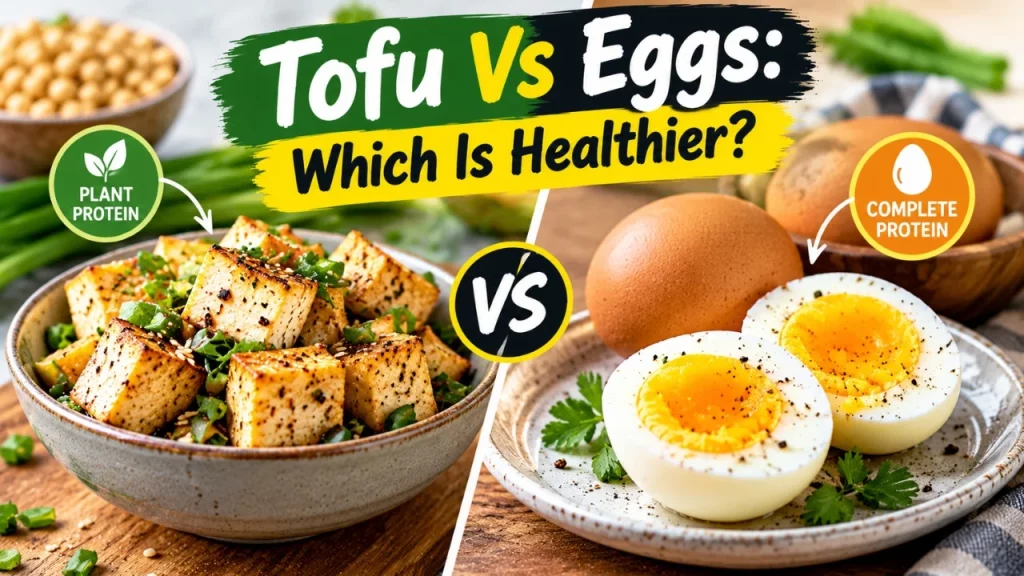
If you had to rebuild a breakfast around just one protein, would two eggs or a block of tofu actually leave your body with more usable material to work with? Most comparisons stop at grams of protein on a label, which is a little like comparing two paychecks without checking the tax rate. The real answer depends on protein quality, not just protein quantity, and on who is eating it.
The short version: you need roughly 170 to 180 grams of firm tofu — not 100 — to match the usable protein in two large eggs, and for people with thyroid disease, gout, advanced kidney disease, or young children relying on tofu as a main protein source, that swap deserves a second look.
The Case for Eggs
Eggs are the reference protein against which almost everything else is measured. Their amino acid pattern lines up so closely with what the human body needs that nutrition scientists have historically treated egg protein as close to 100 percent usable, or “biological value” 100. Two large eggs deliver about 12 grams of that near-complete protein, plus the nutrients already well covered elsewhere — B12, vitamin D, choline, selenium, and zero fiber or carbohydrate to speak of. None of that is in dispute.
What gets left out of most comparisons is why egg protein scores so highly: it isn’t just the amount of each amino acid, it’s the balance. Methionine, lysine, and the other essential amino acids arrive in roughly the proportions your muscles and enzymes actually need, so very little goes to waste.
There’s a practical reason this matters beyond a lab metric. When a protein is well balanced, your body doesn’t need to break down additional muscle tissue to supply the one or two amino acids that are running short. Picture it like a recipe that calls for four ingredients in specific proportions: if you’re missing most of the flour, having plenty of sugar, butter, and eggs doesn’t let you finish the cake. Egg protein hands your body all four “ingredients” in roughly the right ratio already, so almost nothing is left over unused and almost nothing has to be borrowed from elsewhere. That’s also part of why eggs show up so often in post-exercise meals — not because the calorie count is special, but because the amino acid delivery requires so little further work from the body.
None of this makes eggs mandatory, and it doesn’t mean someone who doesn’t eat eggs is shortchanging themselves — it just means that when eggs are on the table as an option, their protein tends to go further per gram than most alternatives, tofu included.
The Case for Tofu
Tofu is not a raw food that happens to need cooking — it’s a processed soy product, curdled with a coagulant and pressed to remove water, which already changes its digestibility before it ever hits a pan. A review of soy protein’s nutritional profile found that soy is naturally short on methionine, an essential amino acid, and contains trypsin inhibitors that interfere with digestion; heat treatment destroys most of these, but commercial processing still leaves up to 20 percent of one key inhibitor, the Bowman-Birk inhibitor, intact in finished soy foods, according to a review of soy protein quality and processing. That’s the technical reason tofu’s protein, gram for gram, does less than egg protein does.
Soy also contains isoflavones, plant compounds that loosely mimic estrogen, which is where most of the internet anxiety about tofu originates. More on that below — but it’s worth saying now that the fiber, calcium, iron, and magnesium content of tofu, already well documented elsewhere, are real and not cancelled out by the protein-quality gap.
It’s worth adding what tofu brings to the table that eggs simply can’t: it’s a complete plant protein in a food that also carries dietary fiber, something no animal protein source offers. For someone managing cholesterol intake, avoiding animal products entirely, or simply trying to get more plant foods into a day that’s otherwise light on them, tofu’s lower protein efficiency is a reasonable trade for everything else it delivers. The gram-for-gram shortfall described above is a real cost, but it’s a cost that comes with other benefits attached, not a flaw that makes tofu a poor food.
| Factor | Two large eggs | 100 g firm tofu |
|---|---|---|
| Protein, approximate | 12 g | 10–12 g |
| Protein usability (biological value) | Reference standard, ~100% | Lower, commonly cited around 68% of egg’s value |
| Limiting amino acid | None significant | Methionine |
| Cholesterol | Present | None |
| Isoflavones | None | Present, variable by product |
| Processing before eating | Minimal | Curdled, pressed, enzyme inhibitors partly reduced by heat |
The Real Gram-for-Gram Swap
Here’s the arithmetic that almost never gets published. Two eggs give you about 12 grams of nearly 100 percent usable protein. If tofu’s usable protein runs around 68 percent of egg quality, you need about 170 to 180 grams of firm tofu — roughly two-thirds of a standard block — to end up with the same amount of protein your body can actually put to work. That’s a meaningfully bigger portion than the 100-gram serving most nutrition labels and recipe cards use as their reference point, and it’s also more calories and more soy isoflavones than people typically assume they’re getting when they “swap” tofu for eggs on a one-to-one basis.
This isn’t a reason to avoid tofu. It’s a reason to stop treating the swap as even. If a recipe calls for two eggs and you’re replacing them for protein reasons rather than taste or texture reasons, doubling or tripling the tofu portion gets you closer to parity than a straight gram-for-gram substitution would.
Who Should Think Twice
The isoflavones in soy are where most of the caution flags genuinely belong, and they’re worth separating from the protein-quality discussion above because they affect a narrower group of people. A review of isoflavone research found that soy’s plant estrogens can interfere with thyroid hormone synthesis in people who already have compromised thyroid function or low iodine intake, and the effect is dose-related rather than universal, according to a review of soy isoflavones and thyroid function. For someone with healthy thyroid function and adequate iodine intake, occasional tofu is not the same exposure as large daily amounts eaten by someone already managing hypothyroidism.
Soy is also moderately high in purines, compounds that break down into uric acid, which matters specifically for people managing gout. Research on soy protein intake found a measurable association between higher soy protein consumption and increased uric acid levels in some populations, according to a study of soy protein and uric acid, though the relationship is smaller than that seen with organ meats or certain seafood. For someone without a history of gout, this is background noise. For someone actively managing flare-ups, it’s a factor worth discussing with a clinician rather than guessing about.
People with advanced kidney disease are often told to watch protein load generally, regardless of source, since both egg and soy protein ultimately place demand on the kidneys to process nitrogen waste — in that situation the swap question becomes less about eggs versus tofu and more about total daily protein, a conversation that belongs with a doctor or dietitian rather than a food comparison article. And because tofu’s protein efficiency is lower than egg’s, a young child relying on tofu as a primary protein source may need meaningfully larger servings than a parent would assume from a label, simply to hit the same usable protein a couple of eggs would provide.
What the Research Actually Supports
Large-scale dietary pattern research offers a useful reality check against treating either food as uniquely dangerous. A long-running cohort analysis of egg consumption found no clear, consistent association between moderate egg intake and increased cardiovascular risk in the general population, according to a cohort study on egg consumption and cardiovascular outcomes, which undercuts the older assumption that dietary cholesterol from eggs translates directly into blood cholesterol problems for most people. Separately, a review of soy food consumption found no consistent evidence that typical dietary levels of soy isoflavones affect reproductive hormones in men or women within normal dietary ranges, according to a review of soy isoflavone intake and hormonal effects, which is worth knowing given how much of the anti-tofu sentiment online rests on hormone disruption claims that don’t hold up at ordinary intake levels.
Put together, the honest picture is narrower than either food’s advocates usually admit: eggs are not a cardiovascular risk for most people at normal intake, and tofu is not a hormonal hazard at normal intake either. The real, defensible difference between them is the protein-quality gap described above, plus the narrower list of conditions — thyroid disease, gout, advanced kidney disease, and pediatric nutrition — where the details actually change the advice.
Sources
