Wild-Caught vs. Farm-Raised Shrimp: Which Is Healthier?
Not all farmed shrimp carries the same risk — here's how to read a bag's country of origin like a safety label.
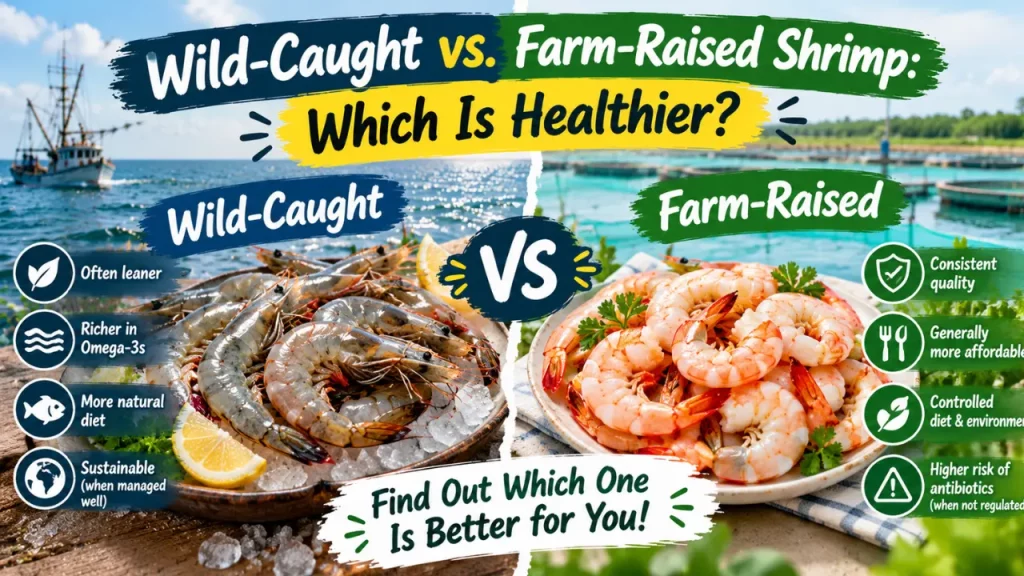
You’re standing at the seafood counter holding two bags of frozen shrimp. One says “wild-caught, Gulf of Mexico” and costs twice as much. The other says “farm-raised, product of Indonesia” or “product of India” and is on sale. You’ve heard that farmed shrimp can carry antibiotics, so you hesitate, flip the bag over, find no real answer, and buy whichever one is cheaper anyway because the label doesn’t actually tell you anything useful.
- The measurable risk from farmed shrimp isn’t drug residue sitting in the flesh — it’s antibiotic-resistant bacteria that survive cooking’s heat but not necessarily your kitchen hygiene.
- Peer-reviewed testing has found resistance genes in nearly all farmed vannamei shrimp sampled across multiple coastal production regions, not an occasional bad batch.
- The risk is not evenly distributed across buyers: it concentrates in people with weakened immunity, pregnancy, or existing antibiotic treatment, and is close to negligible for everyone else.
- U.S. regulators keep a running list of countries and banned drugs tied to shrimp imports — nitrofurans and chloramphenicol are the two names worth recognizing.
The quick answer
Wild-caught shrimp is the lower-risk choice specifically because it was never raised in a pond that required disease control with antibiotics. Farmed shrimp is not automatically dangerous, but its risk profile depends heavily on where it was grown, and that risk is about bacteria, not nutrition. Basic nutrition between the two is essentially identical, so if your only question is calories or protein, buy whichever is fresher and cheaper. If your question is contamination risk, country of origin and your own health status both matter more than the words “wild” or “farmed” printed on the bag.
What regulators are actually flagging
The U.S. Food and Drug Administration maintains an import screening system that automatically detains shrimp shipments when lab testing turns up drugs that are not approved for use in food animals in the United States. Two names show up repeatedly in that screening history: nitrofurans and chloramphenicol. Both are broad-spectrum antibiotics that were used for decades in shrimp ponds to control bacterial disease outbreaks before global food-safety agencies restricted or banned them, because residues of nitrofuran metabolites and chloramphenicol have been linked to serious health effects in the people who eat enough of them over time. Shrimp exported from India, Vietnam, Indonesia, and Ecuador have all, at different points, triggered automatic detention under this system because test results from a shipment or a facility came back positive for one of these compounds. That detention history is exactly why “check the certification” is not a complete answer — a bag can carry an eco-label and still have come from a region with an active drug-detention pattern, because certifications generally verify sourcing and farming practice, not laboratory drug-residue results on that specific shipment.
Why the real danger is bacteria, not the drug itself
Cooking shrimp to a safe internal temperature kills the bacteria living on and in it. That part works the way you’d expect. What heat does not reliably undo is the resistance training those bacteria populations have already undergone in the pond. A foundational study of ready-to-eat shrimp as a vehicle for resistant bacteria tested thirteen retail shrimp brands from four countries of origin and recovered 1,564 bacterial isolates representing 162 species. Of those isolates, 657 — 42 percent — had acquired resistance to at least one of ten common antibiotics tested, and 131 of the 162 species, or 81 percent, included resistant members. The pathogens identified were not exotic: E. coli, Salmonella, Shigella flexneri, Enterococcus, and Staphylococcus, organisms that cause ordinary foodborne illness but that, in their resistant form, don’t respond to first-line antibiotic treatment if they make someone sick.
That pattern holds up in farm-level research, too. A review of antibiotic use in aquaculture and resistance gene transfer explains the mechanism: antibiotics are typically dosed into pond water at low, subtherapeutic levels, which doesn’t kill bacteria outright but does apply exactly the kind of mild, sustained pressure that favors resistant strains surviving and multiplying. A study of antibiotics and resistance genes in farmed shrimp guts across 12 Chinese coastal regions found sulfadiazine, ciprofloxacin, and norfloxacin present in the gut of every single sampling site tested, along with four resistance-related genetic markers detected everywhere as well. A separate analysis of resistance genes in commercial vannamei shrimp bought from markets and supermarkets identified 62 distinct resistance genes across 21 gene types in shrimp that had already reached retail, with resistance tied mainly to Vibrio and Aeromonas bacteria — common shrimp pathogens, not rare lab curiosities. Follow-up work tracking resistance genes over time in shrimp tissue versus pond water found the concentration was consistently higher inside the shrimp’s own digestive organ than in the water surrounding it, meaning the bacteria aren’t just passing through — they’re established residents.
The thing worth fearing on a farmed-shrimp label isn’t a dose of banned drug sitting in the meat — it’s bacteria that already survived that drug once, which means your body’s own antibiotics may not work against them if they ever cause an infection.
So does cooking solve it or not?
Partially. Heat destroys live bacteria, including resistant ones, which is why properly cooked shrimp carries far less live bacterial load than raw or undercooked shrimp. What cooking does not reliably destroy is chloramphenicol and nitrofuran metabolites, which are chemically stable enough to survive normal kitchen heat — this is precisely why FDA screens for them at the border rather than relying on consumers cooking them away. The resistance risk, meanwhile, mostly happens before cooking: through cross-contamination on cutting boards, through raw shrimp juices touching other foods, or through shrimp eaten undercooked or added raw to things like sushi or ceviche. Properly cooked shrimp, handled with ordinary kitchen hygiene, closes off most of the resistant-bacteria exposure pathway even if the shrimp came from a region with documented antibiotic use.
Why vannamei specifically
Pacific white shrimp, Litopenaeus vannamei, makes up the overwhelming majority of global farmed shrimp production because it grows fast and tolerates crowded ponds well. That same crowding is what makes disease control, and therefore antibiotic use, routine in vannamei farming in a way it simply isn’t for wild-caught species living at natural densities in open water. Every resistance-gene study cited above was conducted specifically on vannamei, not because researchers ignored other species, but because vannamei’s production scale and farming intensity are what generate the pressure that produces resistant bacteria in the first place.
Who should actually change their shopping habits
For a healthy adult with no antibiotic allergies or current prescriptions, the measured risk here is small: resistant bacteria on properly cooked shrimp, handled hygienically, rarely translates into illness. The calculation changes for three specific groups. People who are immunocompromised — through chemotherapy, organ transplant medication, HIV, or similar conditions — face a much higher chance that an ordinary foodborne infection becomes serious, and a resistant strain removes the fallback options doctors would normally reach for. Pregnant women face a related but distinct concern from mercury guidance: mercury is about the fish’s neurotoxin load, while resistant bacteria are an infection risk that pregnancy’s altered immune state makes harder to fight off and treat. Anyone currently on an antibiotic course, or who has a documented history of multidrug-resistant infection, is effectively testing their own luck against the exact mechanism these studies describe. For those three groups, choosing wild-caught shrimp, or farmed shrimp from countries without an active FDA drug-detention pattern, is a reasonable and specific precaution rather than general caution.
What to actually do with this at the store
Read the country of origin before the certification logo. Favor wild-caught or farmed shrimp from countries without a recent nitrofuran or chloramphenicol detention history when buying for someone in a higher-risk group. Cook shrimp fully rather than serving it raw or lightly seared for anyone immunocompromised, pregnant, or on antibiotics. Treat raw shrimp packaging and liquid the way you’d treat raw chicken — separate cutting board, immediate handwashing, no reusing the thawing dish for anything else. None of this requires giving up farmed shrimp entirely; it requires matching the precaution to the actual person eating it.
Sources
- Ready-to-eat shrimp as an international vehicle of antibiotic-resistant bacteria (2005)
- Antibiotics, antibiotic-resistant bacteria, and resistance genes in aquaculture (2022)
- Occurrence and distribution of antibiotics and resistance genes in shrimp guts across Chinese coastal regions (2022)
- Diversity of antibiotic resistance genes in intestinal bacteria of commercial Penaeus vannamei (2019)
- Temporal variation of antibiotic resistance genes in shrimp hepatopancreas and pond water (2020)

James Carter
The EverBBQ editorial desk — covering BBQ news, features and everything off the grill.