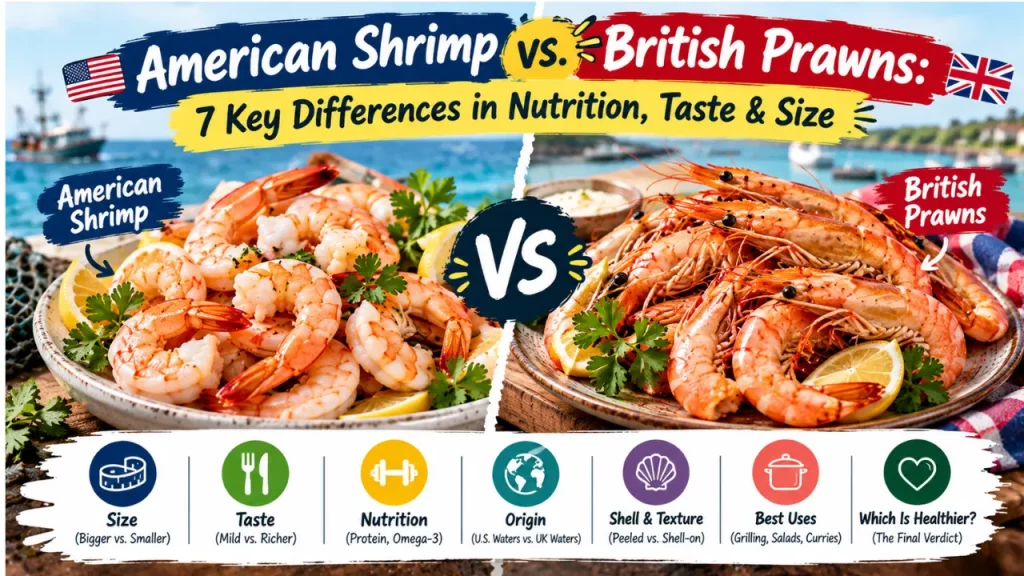
American Shrimp vs. British Prawns: 7 Key Differences in Nutrition, Taste & Size
Real USDA and UK label numbers settle which shellfish is actually healthier, cheaper, and safer for allergy sufferers — no vague tables, just figures.
You’re adapting a prawn cocktail recipe from a British food blog, and it calls for “250g cooked and peeled king prawns.” Your American grocery store doesn’t sell anything called a prawn — just bags labeled “16/20 count shrimp” or “cooked shrimp, tail-off.” You grab a bag, cook it, and notice the nutrition label looks nothing like the one on the imported frozen prawns your neighbor buys. Which one is actually better for you, and which one is actually cheaper to keep buying every week? The answer isn’t naming or texture — it’s what’s in the numbers.
Myth: American shrimp and British prawns are nutritionally interchangeable
Biologically and in the kitchen, shrimp and prawns behave almost identically, which is why people assume the nutrition label does too. It doesn’t, mostly because of how each is typically sold rather than what species it came from. Raw American shrimp, the kind sold fresh or frozen-raw at a US seafood counter, runs about 85 calories, 20.1 grams of protein, 161 milligrams of cholesterol, and 119 milligrams of sodium per 100 grams, based on standard USDA composition data for raw shrimp. Omega-3 fats (EPA plus DHA combined) sit around 0.26 grams per 100 grams — present, but far below oily fish like salmon. Once that same shrimp is boiled, the numbers shift slightly: roughly 99 calories, 24 grams of protein, and cholesterol rising to about 189 milligrams per 100 grams, simply because cooking concentrates the edible portion as water cooks off. British prawns sold fresh or frozen-raw track very close to those same figures, because they are the same crustacean family with a similar muscle composition. The real divide opens up with processing, which is covered below.
Myth: Shrimp’s cholesterol number means you should limit it like bacon
A cholesterol figure above 160 milligrams per 100 grams looks alarming next to a steak, and for decades dietary advice told people to cap shrimp intake for exactly that reason. That advice has been loosening. Major dietary guidance in the US dropped its hard daily cap on dietary cholesterol years ago, reflecting a broader shift in nutrition science: for most healthy people, saturated fat and overall dietary pattern influence blood cholesterol more than cholesterol eaten directly from food like shrimp or eggs. Shrimp is also very low in saturated fat, which is the nutrient most consistently linked to raised LDL cholesterol in the blood. That doesn’t make shrimp risk-free for everyone — people with diabetes or existing lipid disorders are still sometimes advised to watch shellfish intake, and that’s a conversation for a doctor who knows an individual’s bloodwork, not a blanket rule for every shopper. For most people without those conditions, the sodium and preparation method attached to shrimp or prawns is a more immediate, measurable concern than the cholesterol number sitting on the label.
Myth: Sodium content is basically the same once you cook either one
This is where American shrimp and British prawns actually diverge the most, and it rarely makes it into comparison charts. Fresh or plain frozen-raw shrimp cooked at home without added salt stays close to its natural sodium level — around 111 to 119 milligrams per 100 grams. But a large share of British prawns sold in supermarkets arrive already cooked, peeled, and packed in brine for shelf life and food safety, since pre-cooked seafood needs that extra step to stay stable in the chiller cabinet. Typical UK supermarket labels for cooked and peeled prawns list salt content in the range of roughly 1.5 to 2 grams per 100 grams, which converts to somewhere around 600 to 700 milligrams of sodium per 100 grams — five to six times higher than a portion of plain raw American shrimp cooked without salt. Canned shrimp sold in the US has a similar brining problem, so the fair comparison isn’t “shrimp vs. prawns” but “plain, fresh-cooked vs. pre-brined.” If sodium is a concern, the fix is simple and doesn’t require switching countries: rinse pre-cooked, brined prawns or canned shrimp under cold water before eating, which measurably cuts the surface sodium before it hits your plate.
Myth: “Jumbo shrimp” and “king prawns” are the same size, so recipes convert directly
US shrimp are sold by a count-per-pound system, while UK prawns are sold by name, and the two don’t line up as neatly as cooks assume. For substituting one for the other in a recipe, this rough conversion holds up in practice:
| US count per pound | US market label | Closest UK prawn name |
|---|---|---|
| U-15 or fewer | Colossal/Extra Jumbo | Extra-large king prawns |
| 16-20 | Jumbo | King prawns |
| 21-25 | Extra Large | King prawns (smaller grade) |
| 26-30 | Large | Tiger prawns |
| 31-40 | Medium | Standard/cocktail prawns |
| 41-50 | Small | Small cocktail prawns |
| 51-60+ | Extra Small/Salad | Brown or cold-water shrimp |
If a British recipe calls for “king prawns,” reaching for a US bag labeled 16/20 or 21/25 count will give you the closest match in both bite size and cooking time. Going smaller won’t ruin the dish, but it will shorten the cooking time needed, since smaller pieces cook through faster and can turn rubbery if treated like a jumbo shrimp on the stove.
Myth: An allergy to shrimp doesn’t apply to prawns, because they have different names
This is the one myth worth taking seriously, because getting it wrong has real consequences. Shrimp and prawns share the same dominant allergen, a muscle protein called tropomyosin, and research on shellfish allergy consistently finds extensive cross-reactivity across crustacean species despite their different common names, as summarized in a 2019 review on shellfish allergy. A broader review of shellfish allergens found that beyond tropomyosin, proteins like arginine kinase and myosin light chain are also shared across shrimp, prawns, crab, and lobster, and that cross-reactivity between even distantly related species is common, according to a comprehensive review of shellfish allergy. A laboratory study testing blood serum from allergic patients found that tropomyosin from tiger prawn cross-reacted strongly with crab tropomyosin, and that cooking actually increased IgE reactivity rather than reducing it, per a 2013 study on prawn and crab tropomyosin. A separate study trying to identify which specific allergens best predict a real clinical reaction in shrimp-allergic patients confirmed tropomyosin’s central role in triggering genuine allergic responses, not just lab-test sensitization, according to research on molecular diagnosis of shrimp allergy. In plain terms: a US shrimp allergy and a reaction to UK prawns are, in the overwhelming majority of cases, the same allergy wearing two different labels. Renaming the food does not change the protein inside it. The same research also notes a documented cross-reactivity between crustacean tropomyosin and house-dust-mite tropomyosin, so people with a strong dust-mite allergy who have never knowingly eaten shellfish are occasionally found to react to shrimp or prawns the first time they try them. Anyone with a diagnosed shellfish allergy, a severe dust-mite allergy, or a history of anaphylaxis after eating any crustacean should avoid both American shrimp and British prawns rather than assuming one is safer because of its name, and should discuss any shellfish introduction with an allergist rather than self-testing at home.
Sources

Mick Hudson
Low-and-slow recipes, rubs, sauces and fire management from our pitmaster team.