Pork vs. Beef: Which Has More Iron and Vitamin B12?
Beef wins on iron and B12, but the real question is how much pork closes the gap — and who should never try.
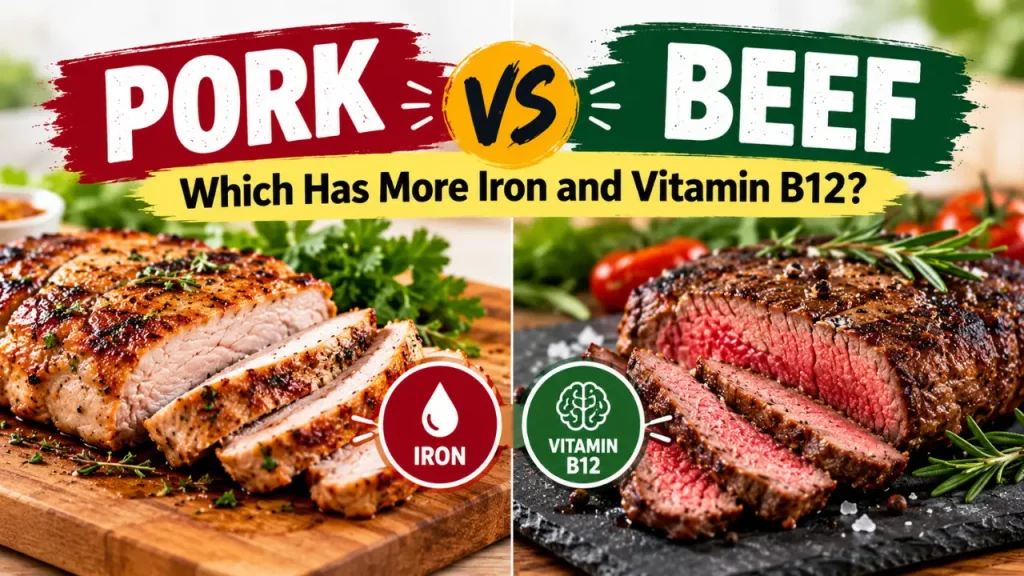
Your doctor’s note says “eat more iron-rich foods,” and standing in the meat aisle you’re doing mental math between a pork shoulder and a beef chuck roast, because the pork was on sale and the beef wasn’t. You’ve heard beef has more iron. But how much more, and does it actually matter if you just eat a bigger pork chop instead?
Which has more iron and B12, pork or beef?
Beef comes out ahead on both, and not by a little. A typical cooked serving of lean ground beef runs around 2.7 mg of iron and 2.4 µg of vitamin B12 per 100 g, while a comparable cooked pork loin serving provides roughly 0.9 mg of iron and 0.7 µg of B12 per 100 g. That means beef has about three times the iron and more than three times the B12, gram for gram. This gap holds even though both are red meats with well-absorbed heme iron, and even though cut and cooking method shift the exact numbers somewhat.
How much pork would you need to eat to match beef’s iron?
About three times as much, by weight. If a 100 g portion of beef gives you 2.7 mg of iron, you would need close to 300 g of pork loin, roughly 10.5 ounces, to reach that same iron number. Put another way: swapping a standard 3.5-ounce beef serving for pork and wanting equal iron means eating an extra 7 ounces of pork on top of what would have been a normal portion. That’s not a side dish adjustment, it’s nearly doubling your plate.
How much pork would you need to eat to match beef’s B12?
Even more. Because pork’s B12 advantage gap is wider than its iron gap, matching a 100 g beef serving’s 2.4 µg of B12 takes around 340 g of pork, about 12 ounces, which is close to three-quarters of a pound of meat in a single sitting. For reference, the adequate intake for vitamin B12 in adults is about 4.0 µg a day, with higher needs in pregnancy and lactation, according to a review of B12 intake from animal foods. Hitting that target from pork alone, without any other B12 source in the day, would require well over a pound of pork.
| Nutrient | Beef, 100 g cooked | Pork, 100 g cooked | Pork needed to match beef |
|---|---|---|---|
| Iron | ~2.7 mg | ~0.9 mg | ~300 g (10.5 oz) |
| Vitamin B12 | ~2.4 µg | ~0.7 µg | ~340 g (12 oz) |
| Zinc | ~5.3 mg | ~2.0 mg | ~265 g (9.3 oz) |
Does eating pork actually help with anemia?
It can help, but less efficiently than beef, and the body only absorbs a fraction of what’s on the plate either way. Heme iron, the kind found in both pork and beef, is absorbed at roughly 15–35% depending on overall iron status and what else is eaten in the meal. So of pork’s 0.9 mg iron per 100 g, the amount that actually reaches your bloodstream might be somewhere between 0.13 and 0.3 mg, compared with roughly 0.4 to 0.95 mg absorbed from the same weight of beef. For someone managing diagnosed anemia, that difference compounds meal after meal, which is why clinicians usually care less about which red meat you pick and more about total heme iron intake across the week.
What about zinc, does pork fall short there too?
Yes, and this is the mineral most comparisons skip. Beef provides around 5.3 mg of zinc per 100 g against pork’s roughly 2.0 mg, meaning pork again needs close to triple the portion size to match it. This matters beyond muscle meat trivia: a secondary analysis of the UK National Diet and Nutrition Survey found that British women eating less than 40 g of total red meat daily were more likely to fall below recommended intake levels for zinc, iron, B12 and potassium than women eating 40–69 g daily, and after adjusting for overall energy intake, the zinc shortfall remained statistically significant. In other words, low red meat intake overall, not just low beef intake, is where zinc problems start.
Who should not try to out-eat beef’s advantage with pork?
Several groups should be cautious about treating “eat more pork” as a fix for low iron or B12. People with hereditary hemochromatosis, a condition causing iron overload, are generally advised to limit heme iron intake altogether, so increasing any red meat portion, pork included, works against their treatment rather than for it. People managing chronic kidney disease often need to watch total protein and potassium together, which makes piling on extra ounces of any meat to chase a single nutrient number a poor trade. Pregnant and lactating people have higher B12 requirements, as noted in the review on vitamin B12 intake from animal foods, which makes beef’s density an advantage worth keeping rather than diluting with larger, less B12-rich pork portions. And current cardiovascular guidance, discussed in an analysis of meat intake and greenhouse gas policy, points toward keeping red and processed meat intake near 70 g a day rather than expanding it, a ceiling that a plenary review on meat, dairy and nutritional status ties to colorectal cancer risk reduction, not iron optimization. Older adults deserve a separate mention: the Newcastle 85+ Study found that total B12 intake from meat and meat products was only weakly linked to blood B12 status in people around age 85, likely because absorption itself declines with age, so simply eating more of any meat may not move the needle the way it does in younger adults.
Why do athletes avoid pork, and should they?
Many don’t, and the idea that athletes should skip pork isn’t backed by nutrition evidence at all. It’s more likely a confusion between older food-safety caution around undercooked pork and trichinosis risk, which modern farming and proper cooking have made largely moot, and vague claims about pork being harder to digest or more “inflammatory,” which no cited research here supports or refutes directly. Nothing in the available evidence suggests pork is nutritionally worse for performance than beef; it simply delivers less iron, B12 and zinc per ounce, which matters more for endurance athletes tracking those specific nutrients than any digestion myth.
How can pork lovers still hit their targets?
Pair pork with foods that cover its gaps instead of only eating more of it. Shellfish such as clams and mussels are exceptionally dense in both iron and B12 and can fill the difference without adding another half-pound of meat to a plate. Fortified breakfast cereals and nutritional yeast add B12 cheaply for anyone cutting back on meat volume generally. Liver from either animal dramatically outperforms muscle meat for both nutrients, so a small weekly serving alongside regular pork meals closes most of the gap in one move. A modeling study of meat and dairy replacement scenarios in the Netherlands found that even a “half meat” substitution pattern could still meet protein targets while reducing environmental impact, suggesting there’s room to mix pork, other animal foods and fortified plant foods without needing to double portion sizes to protect iron and B12 status.
Sources
- Associations between Red Meat Intakes and the Micronutrient Intake and Status of UK Females (2017)
- Intakes of Folate and Vitamin B12 and Biomarkers of Status in the Very Old: The Newcastle 85+ Study (2016)
- Vitamin B12 Intake From Animal Foods, Biomarkers, and Health Aspects (2019)
- Food and the planet: nutritional dilemmas of greenhouse gas emission reductions through reduced intakes of meat and dairy foods (2010)
- Replacing meat and dairy with plant-based alternatives in the Netherlands: trade-offs in environmental impacts and critical nutrient intake (2026)

Tom Fletcher
The latest from the Australian and global BBQ scene — comps, cooks and culture.