Pancakes vs. Oatmeal vs. Whole-Grain Cereal: Which Breakfast Is Healthiest?
The "healthiest breakfast" changes depending on whether you're managing blood sugar, losing weight, or have a sensitive gut — here's the data for each.
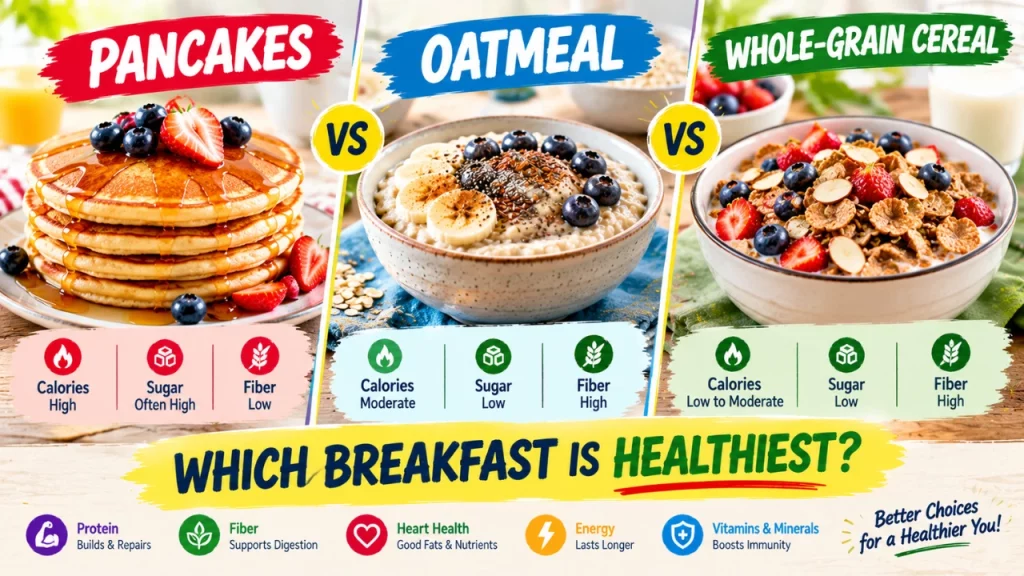
Here’s the number that should be on every cereal box but isn’t: in a six-month trial of adults with type 2 diabetes, swapping a high-glycemic-index breakfast cereal for a low-glycemic-index one made no measurable difference to long-term blood sugar control. Glycated hemoglobin, the marker doctors use to track diabetes management over months, came out statistically the same in both groups, according to a long-term cereal comparison in people with type 2 diabetes. If you’ve ever stood in the cereal aisle agonizing over which box has the “better” glycemic index, that finding is a little deflating.
So which breakfast actually is healthiest? The honest answer is that it depends on what you’re trying to protect — your blood sugar in the next three hours, your weight over the next three months, or your gut on an ordinary Tuesday. Pancakes, oatmeal, and whole-grain cereal perform differently in each of those situations, and the gap between them is sometimes bigger, and sometimes smaller, than people assume.
For blood sugar control, the spike matters more than the label
The clearest head-to-head numbers come from a small study of six women who ate either a high-glycemic-index cereal breakfast or a moderate-glycemic-index version — cereal blended with slower-digesting carbohydrates — then went for a brisk walk three hours later. The high-GI breakfast scored 77 on the glycemic index; the moderate one scored 51, according to research on breakfast glycemic index and exercise metabolism. That 26-point gap translated into a real hormonal difference: right before exercise, insulin levels in the high-GI group were more than double those in the moderate-GI group — 31.5 microU/L versus 15.2 microU/L. Pancakes made with white flour and syrup sit at the high end of that spectrum, similar to or above the 77 mark; plain oatmeal and fiber-dense cereal land closer to the 51.
But the diabetes trial above is the reality check: a smaller post-meal spike doesn’t automatically mean better long-term control. Over six months, people eating the high-GI cereal and the low-GI cereal ended up with similar glycated hemoglobin, similar body weight, and similar fasting cholesterol and triglycerides. The one number that did move was HDL cholesterol, which rose about 10% in a third group that replaced cereal carbohydrate with monounsaturated fat instead. That’s a meaningful clue: for some people managing diabetes, the bigger lever isn’t which cereal box you pick, it’s how much of breakfast is carbohydrate at all.
| Breakfast factor | Value | Source |
|---|---|---|
| High-GI cereal breakfast | GI 77 | Loughborough exercise study |
| Moderate-GI cereal + slow carbs | GI 51 | Loughborough exercise study |
| Pre-exercise insulin, high-GI | 31.5 microU/L | Loughborough exercise study |
| Pre-exercise insulin, moderate-GI | 15.2 microU/L | Loughborough exercise study |
| 6-month HbA1c difference, high- vs low-GI cereal | no significant difference | type 2 diabetes cereal trial |
| HDL change, MUFA swap vs cereal | about +10% | type 2 diabetes cereal trial |
Why some doctors are wary of defaulting to oatmeal
Oatmeal gets treated as the automatic safe choice, but it isn’t neutral for everyone. Oats contain phytic acid and oxalate compounds that can bind minerals like iron and calcium during digestion, which is one reason some clinicians caution against relying on a large oatmeal bowl as your only source of those nutrients, especially if the rest of your diet is already low in them. There’s also a practical timing issue that doctors flag more often than nutrition articles do: a heavy, fiber-thick breakfast eaten too close to a thyroid medication dose can blunt how much of the drug gets absorbed, which is why many endocrinologists recommend waiting 30 to 60 minutes after thyroid medication before eating anything fiber-dense, oatmeal included. None of this makes oatmeal unhealthy — it just means “oatmeal is good for you” is a generalization, not a rule that applies the same way to someone on levothyroxine as it does to someone who isn’t.
Who shouldn’t reach for oatmeal by default
Oats are a moderate source of fermentable carbohydrates, and for people with IBS or broader FODMAP sensitivity, a large bowl can trigger bloating that a smaller portion wouldn’t. Pancakes and most boxed cereals made from wheat carry a separate risk for anyone with gluten sensitivity or celiac disease, including cross-contamination in oat products processed on shared equipment. And for pure weight-loss goals, oatmeal’s calorie density becomes relevant in a way label-reading rarely captures: a large bowl of plain oats can quietly carry more calories than a protein-forward alternative, even though it “feels” lighter.
That’s where satiety research gets interesting. In a study of low-income preschoolers, breakfasts built around 19 to 20 grams of protein and separately around 10 to 11 grams of fiber produced equal feelings of fullness and better overall diet quality than the children’s usual breakfast, according to research on high-protein and high-fiber breakfasts in young children. Protein and fiber got to the same fullness finish line by different roads — useful if your cereal box is light on one but not the other. In adults with excess weight, a breakfast pattern higher in fiber and unsaturated fat produced better satiety readings over a 10-week crossover trial than a typical lower-fiber breakfast, per a study comparing breakfast patterns in people with weight excess, though that trial was small and the results were self-reported fullness scores rather than hard metabolic outcomes.
Fiber type matters, too, not just fiber amount. In a trial with overweight women, cereal with 15 grams of fiber from wheat arabinoxylan or flax didn’t make people report feeling fuller on a simple rating scale than cereal with just 4 grams of fiber — but it did raise blood levels of GLP-1 and PYY, the gut hormones that signal fullness to the brain, according to a study of fiber-enriched cereal and appetite hormones. That’s the honest caveat behind every “healthiest cereal brand” claim: no single peer-reviewed study has crowned one supermarket box as objectively best. The closest thing to a real-world shortcut is still checking whether the fiber is intact and substantial — closer to that 15-gram mark than the 4-gram one — rather than trusting a front-of-box health claim.
Back in the cereal aisle
So the two boxes in your hands, and the pancake batter waiting at home, aren’t competing for one trophy. If you’re managing diabetes, the data says a smaller glycemic spike helps in the next few hours but may not move your long-term numbers the way cutting total carbohydrate does. If you’re trying to stay full until lunch, protein and genuinely high fiber both get you there, just by different mechanisms. And if your gut, your thyroid prescription, or your gluten tolerance complicates the “obvious” healthy choice, that complication is real, not pickiness.
Which situation sounds most like yours — the blood sugar numbers, the weight-loss satiety math, or the gut sensitivity caveat — and did it change which box you’d actually buy?
Sources
- Comparison of high- and low-glycemic-index breakfast cereals with monounsaturated fat in the long-term dietary management of type 2 diabetes (2000)
- High-Protein and High-Dietary Fiber Breakfasts Result in Equal Feelings of Fullness and Better Diet Quality in Low-Income Preschoolers (2017)
- Distinct breakfast patterns on satiety perception in individuals with weight excess (2016)
- Effects of two dietary fibers as part of ready-to-eat cereal breakfasts on perceived appetite and gut hormones in overweight women (2015)
- Effects of the glycemic index of breakfast on metabolic responses to brisk walking in females (2007)
