Egg vs Mushrooms: Which Is Healthier for You?
Exact purine, potassium, vitamin D and LDL numbers that tell gout, kidney, and cholesterol patients which food to actually pick.
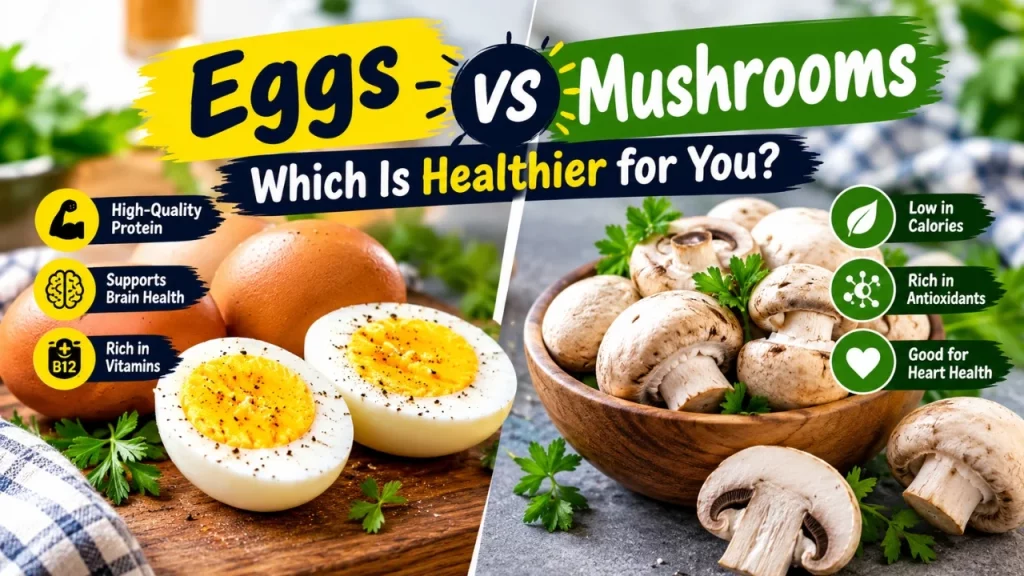
Two friends are standing at the same stove. One just got a gout flare diagnosis and is eyeing a carton of eggs with relief because she thinks mushrooms are the “safe vegetable” option. The other has stage 3 kidney disease and is piling sliced portobello into the pan because he assumes anything plant-based must be gentler on his body than eggs. Both are guessing. Neither has looked at a single number. By the end of this article, both would make the opposite choice.
The short answer to “which is healthier” is that it depends entirely on who is asking, and the people who need a real answer are usually managing gout, kidney disease, a cholesterol number, or a vitamin D deficiency. Here are the thresholds that actually apply to each of them.
Step 1: If you have gout, treat mushrooms as a moderate-purine food, not a free pass
Gout management is built around purine intake, because purines break down into uric acid. Red meat and organ meat get all the attention, but mushrooms sit in the moderate-purine category of most clinical purine-content tables, broadly similar to legumes and some fish, not negligible like most vegetables. Eggs, by contrast, are one of the lowest-purine protein sources available, which is why egg-based meals are a standard recommendation for gout patients who still need protein without raising uric acid load.
Tip: if you’re mid-flare or have a uric acid level your doctor is actively trying to bring down, swapping a mushroom side dish for two eggs is a concrete, low-effort way to cut purine intake at that meal without losing protein.
Step 2: If you have kidney disease or are on certain blood pressure medications, check the potassium column first
Mushrooms are a notably potassium-dense food for their calorie count. Raw white mushrooms carry roughly 318 mg of potassium per 100 g, and that number climbs higher in cooked portobello and shiitake varieties because water loss concentrates the mineral. For someone with normal kidney function this is a benefit. For someone with chronic kidney disease, or anyone on potassium-sparing diuretics or ACE inhibitors where potassium can build up in the blood, 100 g of mushrooms can represent a meaningful chunk of a daily potassium allowance that’s sometimes restricted to 1,500 to 2,000 mg. Eggs contain only around 55 mg of potassium per large egg, making them one of the few high-protein foods that doesn’t compete for that budget.
Tip: if your renal dietitian has given you a daily potassium ceiling, weigh your mushroom portion rather than estimating it by eye — the difference between a half-cup and a full cup can move you 150 to 200 mg.
Step 3: Compare the vitamin D numbers honestly before buying either food for that reason
This is where labeling gets misleading. Ordinary mushrooms grown in the dark carry only trace vitamin D, often cited around 7 IU per 100 g — not a meaningful source. Mushrooms deliberately exposed to UV light, now sold labeled as such in many stores, can jump to several hundred IU per 100 g, in some products reported near 400 IU or more, which genuinely rivals a supplement dose. A single egg yolk, for comparison, supplies roughly 37 IU of vitamin D — real, but modest next to a UV-treated mushroom serving.
Tip: if vitamin D is your actual goal, the label matters more than the food category — a regular mushroom and a UV-exposed mushroom are nutritionally different products, even though they look identical in the produce bin.
Step 4: Decide if two eggs a day is actually a cholesterol risk for you
This is the question readers with high LDL get told to “ask their doctor” about, so here are the numbers instead. In a randomized crossover trial of 49 healthy adults averaging 56 years old, six weeks of two eggs a day left total cholesterol essentially flat — 203.8 mg/dL at baseline versus 205.3 mg/dL after — and had no significant effect on flow-mediated dilation, a direct marker of artery function. A larger randomized trial of 105 healthy men and women, the Eggant study, found that two eggs daily for eight weeks did not raise cardiovascular risk markers compared with egg whites, even with added carotenoids.
For people who already have high cholesterol, not just healthy adults, a crossover trial of 45 adults with hyperlipidemia tested two whole eggs daily for eight weeks inside a DASH-style heart-healthy diet and compared it against the same diet with eggs excluded, specifically to see whether cardio-metabolic risk factors moved. That is the closest real-world test of “should someone with bad cholesterol numbers still eat eggs daily,” and it’s a far more relevant comparison than any study done only on healthy volunteers.
There are limits worth knowing. A controlled trial of 153 adults with mildly elevated triglycerides found that DHA-enriched eggs specifically raised LDL cholesterol significantly more than ordinary eggs (p = 0.047) — a reminder that not all “enhanced” eggs behave like regular ones. And a small crossover trial of 20 overweight, postmenopausal women found that whole eggs, compared with yolk-free egg substitute, actually improved HDL’s cholesterol removal capacity, suggesting the yolk isn’t the villain it’s often treated as.
Tip: if your LDL is already elevated, the honest reading of this evidence is that two whole eggs a day, inside an otherwise heart-healthy diet, has not been shown to worsen risk markers in people who actually have hyperlipidemia — but egg products engineered with added DHA are a separate case and shouldn’t be assumed to behave the same way.
Step 5: Know the one mushroom downside nobody puts on the nutrition label
Common white and button mushrooms (Agaricus bisporus) naturally contain a compound called agaritine. Animal studies have raised theoretical concerns about agaritine at high doses, though this research is early, done in animals, and has not been shown to translate into human cancer risk at normal dietary intakes. Agaritine is also heat-sensitive and breaks down substantially with cooking, which is one more reason raw mushroom snacking isn’t obviously superior to cooked. This isn’t a reason to avoid mushrooms — it’s a reason to stop treating them as a food with zero downside while eggs get all the scrutiny.
- Gout: mushrooms are moderate-purine, eggs are low-purine — choose eggs during flares
- Kidney disease or potassium-restricted diets: mushrooms carry roughly 318 mg potassium per 100 g versus about 55 mg in one egg — eggs are the safer default
- Vitamin D goals: regular mushrooms (~7 IU/100 g) are negligible, UV-exposed mushrooms can reach several hundred IU/100 g, one egg yolk supplies about 37 IU
- High LDL or hyperlipidemia: trial data in both healthy and hyperlipidemic adults shows two whole eggs daily did not worsen key risk markers, though DHA-enriched eggs raised LDL more than ordinary ones
- Agaritine in common mushrooms: a theoretical, animal-study-based concern, reduced by cooking, not established as a human risk
Common mistakes
The biggest one is treating “healthier” as a single, universal label instead of a condition-specific question. The second is assuming all mushroom products are nutritionally identical — a UV-exposed mushroom and a regular one can differ by a factor of fifty or more in vitamin D content. The third is applying DHA-enriched egg data to ordinary eggs, when the trial evidence shows they don’t behave the same way for LDL. The fourth is skipping the potassium label on mushrooms entirely because they’re perceived as a “diet food,” when for a kidney patient that’s exactly the number that matters most.
Which one of these numbers changes what’s in your fridge this week — the purine table, the potassium count, or the LDL data?
Sources
- Egg consumption and cardiovascular risk in healthy adults, Eggant study (2023)
- Egg consumption and endothelial function, randomized crossover trial (2005)
- Daily eggs in a heart-healthy diet for adults with hyperlipidemia, randomized crossover trial (2026)
- Lipid responses to DHA-enriched eggs in hypertriglyceridemic adults (2003)
- Whole egg versus yolk-free egg and HDL cholesterol efflux capacity in postmenopausal women (2019)
