Hoagie vs Sub: How the Two Sandwiches Really Differ (and What to Order)
The real border lines between hoagie, sub, grinder and hero territory, and the structural rules that separate them even in the same deli.
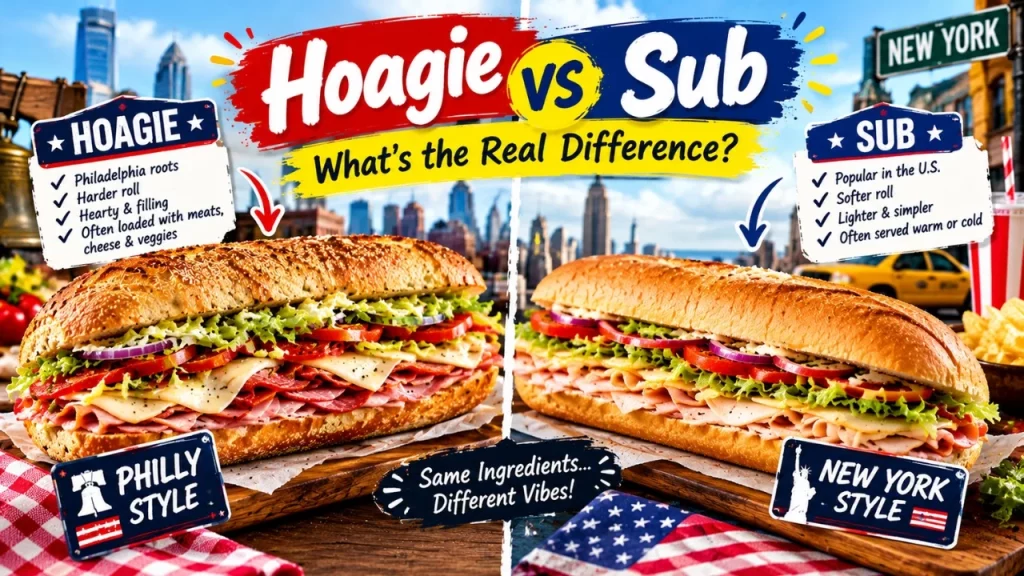
If you crossed the Delaware River right now and ordered a “hoagie” on one side and a “sub” on the other, would anyone actually blink? The honest answer is more complicated than most food writing lets on, and it depends less on which state you’re standing in than on which town, which deli counter, and whether the sandwich is about to go in an oven.
What word will actually get you understood in Philadelphia versus New York?
In Philadelphia and the surrounding counties, “hoagie” is the default word, and asking for a “sub” will get you served without comment but marks you as an outsider. In New York City, “hero” is still the working word at old-school delis, though “sub” has become so common in chain shops and bodegas that younger New Yorkers use it without thinking. Cross into New England, especially Massachusetts, Connecticut, and Rhode Island, and “grinder” takes over almost completely at independent sandwich shops, even though chain menus nationwide have trained everyone to accept “sub” as a safe, neutral fallback. That’s the real map: four regional words that all point at a similar category of sandwich, but none of them are interchangeable without consequence in their home territory.
Where exactly is the hoagie-sub border, and does New Jersey really split the difference?
Yes, and the split runs roughly along the state’s own internal divide rather than along the Delaware River. South Jersey, which shares a media market, commuting patterns, and a lot of family history with Philadelphia, uses “hoagie” as the default word, especially in Camden, Gloucester, and Burlington counties. North Jersey, oriented toward New York City, leans toward “sub” and occasionally “hero,” particularly in Bergen, Hudson, and Essex counties. Central Jersey, the perpetually disputed middle ground, is genuinely mixed, and you’ll find delis within a few miles of each other defaulting to different words depending on who owns the shop and where their supplier or family roots trace back to. There isn’t a legal boundary or a documented line on a map; it’s a dialect border that moves with population and ownership, similar to how soda and pop divide the Midwest. The practical rule for a traveler: in South Jersey, lead with “hoagie.” In North Jersey, lead with “sub,” and don’t be surprised if “hero” also works at an old Italian deli.
In a Philly or South Jersey deli, what actually separates a hoagie from a sub when both words are on the menu?
When a single shop in this region offers both terms, the difference is structural, not just verbal, and it centers on three things: the roll, the temperature, and the dressing. A true hoagie uses a specific style of Italian roll, usually a touch denser and chewier than a standard sub roll, is served cold, and is dressed with oil, vinegar, and oregano rather than mayonnaise-based sauces. A sandwich on the same menu labeled “sub” is more likely to be built to order with whatever the customer wants, including melted cheese, toasting, or hot fillings like meatballs or chicken cutlet. In other words, inside the same shop, “hoagie” often functions as a specific cold, dressed, Italian-style sandwich, while “sub” is used as the catch-all term for anything else long and roll-based, including hot versions. This is the detail most comparisons skip: the two words aren’t just synonyms sitting side by side, they’re doing different jobs on the same menu.
Does toasting a sandwich disqualify it from being called a hoagie?
In the strict, traditional sense, yes, a heated or toasted long sandwich is not considered a true hoagie by people who grew up with the word. The classic hoagie is a cold sandwich, assembled and dressed at room temperature, and the ingredients, particularly the lettuce, tomato, and raw onion, are chosen specifically because they hold up cold rather than wilting under heat. Shops that toast a long sandwich with melted cheese will usually call it something else on the menu, often just describing it by its filling, or defaulting to “sub,” precisely because regular customers would otherwise correct them. That said, language is loosening over time, and some newer shops do advertise “toasted hoagies,” which old-school customers in Philadelphia will tell you is a contradiction in terms. If you want to signal you know what you’re doing in a Philly deli, ask for your hoagie cold and your meatball sandwich separately.
Is a grinder specifically a hot sandwich, or just a regional synonym?
A grinder genuinely is associated with heat in a way that hoagie is not, and this is one of the clearer structural claims you can make among these four words. In much of New England, “grinder” is reserved for a sandwich that’s toasted or baked, often with melted cheese, and the name is widely believed to reference the crusty roll that requires some “grinding” with your teeth, or alternatively the grinding motion of eating something substantial and dense. Cold versions do exist and are sometimes still called grinders in casual speech, but at delis that distinguish their menu carefully, a cold Italian cold-cut sandwich is more likely to be called a sub or an Italian, while “grinder” gets attached to the hot, cheese-melted version. This is a real, if imperfect, structural rule, and it’s the opposite convention from the hoagie, where heat is the disqualifying factor rather than the defining one.
Does a hero have any real structural difference, or is it only a naming quirk?
A hero is structurally almost identical to a sub and the difference is overwhelmingly about naming tradition rather than ingredients or preparation. In New York City’s older Italian-American delis, “hero” is the word tied to the neighborhood’s own sandwich history, in the same way “hoagie” is tied to Philadelphia’s, and asking for a “sub” in one of these shops won’t confuse anyone, but it marks you as not local the way ordering a “hoagie” would in that same shop. Philadelphia delis essentially never use “hero,” and New York delis that lean on tradition will rarely volunteer the word “hoagie” unprompted. So the hero-sub relationship is the cleanest example in this whole comparison of two words for the same sandwich, with no meaningful structural line between them, unlike the hoagie-sub split that exists even within a single Philly-area shop.
If you order a hoagie in Chicago, Los Angeles, or somewhere outside these regions, what will you actually get?
Outside the Northeast corridor, “hoagie” is understood but not native, and the most common outcome is a brief pause followed by a sandwich that’s functionally a sub, built however the shop normally builds subs, cold or toasted, with no particular attention to the Philadelphia conventions of a dense Italian roll or oil-and-vinegar dressing. National chains have flattened a lot of this variation, since their menus train staff in every city to recognize “hoagie” as just another word customers sometimes use for their standard long sandwich, so you won’t be laughed at, but you also won’t get the specific cold, dressed, Italian-style sandwich a Philadelphia local would expect. In Chicago, “sub” is the dominant word and “hoagie” will usually be met with simple compliance rather than confusion. In Los Angeles, where sandwich culture skews toward delis, Mexican tortas, and chain shops, “hoagie” is the least recognized of the four regional words, and you’re more likely to get a slightly puzzled clarifying question than an actual regional-style sandwich. The safest cross-country strategy is to order by description, cold Italian cold cuts with oil and vinegar on a roll, rather than relying on any single regional word to do the work for you.
