USA vs UK vs AUS Milk: Which Is More Healthy and Protein-Rich?
Protein counts are nearly identical — the real USA/UK/AUS milk differences are hormones, heat treatment, and iodine, and they matter most to specific people.
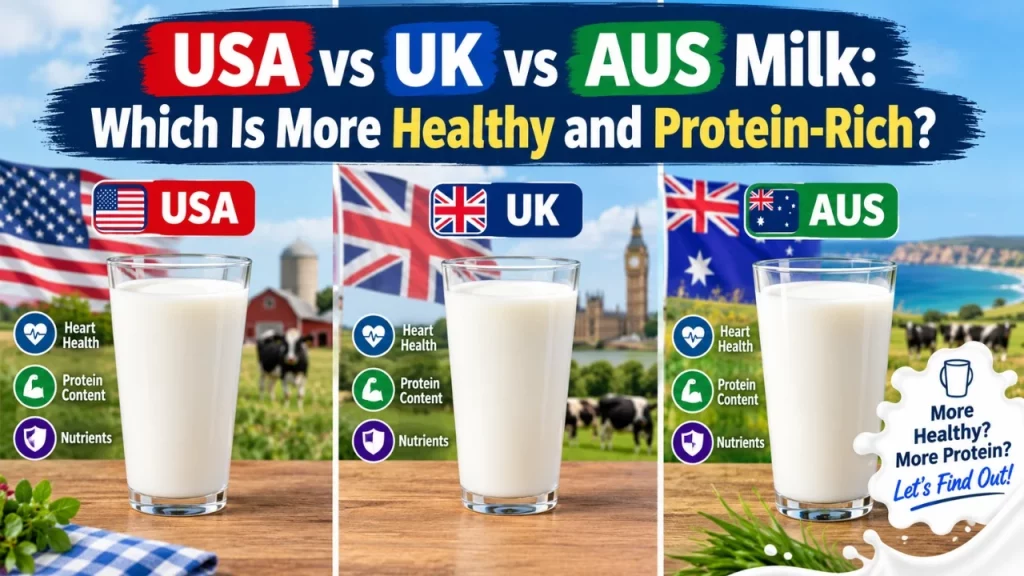
You’re standing in a relative’s kitchen in another country, pouring milk into your child’s cereal, and something nags at you. Maybe your kid has a dairy allergy and you’ve read that “whey-sensitive” reactions can vary by brand. Maybe you’re on thyroid medication and your doctor has told you to watch your iodine. Maybe you just noticed the carton says “UHT” instead of “pasteurized” and you’re not sure if that’s a downgrade. The label looks the same as home. The milk is not.
Protein content won’t settle this — a serving of American, British or Australian milk all land in roughly the same 7 to 9 gram range, fat percentage wobbles by a few tenths of a point, and no single country’s carton wins a blanket “healthiest” title. That part is already settled territory. What actually separates these milks are regulatory choices and farming practices that change what’s in the carton beyond protein grams — and for a handful of specific people, those differences are not trivial.
Side One: USA Milk — Hormones Allowed, Standard Pasteurization
US dairy regulation permits the use of recombinant bovine somatotropin (rBST, also called rbGH) to boost milk yield in cows — a practice banned in the UK, the rest of the EU, and Australia. This is a real and verifiable regulatory gap, not a marketing myth. Where the conversation gets murkier is health outcomes: concerns about rBST center on whether it raises insulin-like growth factor 1 (IGF-1) levels in milk and, in turn, in people who drink it. That question is scientifically contested and the evidence available here doesn’t settle it either way — so it’s fair to flag the regulatory difference plainly while being honest that robust, direct human-outcome data on rBST-milk consumption is thin and disputed, not a slam-dunk health risk.
On processing, most US retail milk is HTST-pasteurized (high-temperature, short-time) rather than UHT (ultra-high temperature). This matters more than it sounds like it should, which brings us to the UK side.
Side Two: UK and AUS Milk — Hormone-Free but UHT and Iodine Make Their Own Mark
UK supermarket milk is frequently UHT-treated, heated to around 135°C for a few seconds versus the gentler 72°C of HTST pasteurization. A chemistry-focused study comparing thermally-induced lactosylation of whey proteins in UHT versus pasteurized milk found that the harsher UHT heat drives lactose onto lysine residues inside known whey protein epitopes — including a site on beta-lactoglobulin, one of the proteins most commonly implicated in milk allergy. This is a laboratory and structural study, not a clinical allergy trial, so it doesn’t prove UHT milk triggers more reactions in real patients. But it does show, at the molecular level, that UHT heat changes the very protein structures the immune system recognizes — which is exactly the mechanism allergists worry about when discussing whey sensitivity and processed dairy.
Then there’s iodine, and this is where UK milk stands genuinely apart. A UK study measuring iodine in retail milk found organic milk was 42.1% lower in iodine than conventional milk — a median of 144.5 ng/g in organic versus 249.5 ng/g in conventional. Converted to a per-100-gram basis, that’s roughly 14.5 micrograms in organic UK milk against roughly 25 micrograms in conventional UK milk. The reason traces back to farming practice: UK dairy herds are commonly treated with iodine-based (iodophor) teat disinfectants and iodine-supplemented feed, both of which raise iodine concentration in the milk itself. That’s a concrete, practice-driven swing of nearly double, within one country’s own milk supply, before you even compare it to another nation’s dairy industry.
Why would anyone care about 10 extra micrograms of iodine in a glass of milk? Because iodine intake margins are tighter than most people assume. A review calculating iodine in plant-based diets found that a fully plant-based EAT-Lancet style diet provides only about 128 micrograms of iodine a day — 85% of the standard adult recommendation of 150 micrograms, and just 51–64% of what’s recommended during pregnancy. Dairy is one of the main iodine sources propping up intake in many diets, so a milk that happens to run low in iodine (organic UK milk, for instance) can matter for someone already running close to the margin.
The flip side matters too. Iodine from food and milk ends up concentrated in breast milk. A study of 57 lactating women in the Boston area found median breast milk iodine of 155 micrograms per liter, ranging widely from 2.7 to as high as 1968 micrograms per liter, tracking with the mother’s own iodine intake. And a separate small clinical study of 50 postpartum women found that 58% had moderate to severe iodine deficiency, with median breast milk iodine of just 84 micrograms per liter, and 6% of their newborns showing elevated thyroid-stimulating hormone. None of this says one country’s cow’s milk directly fixes or causes thyroid problems in infants — it’s evidence about breastfeeding women’s iodine status generally — but it illustrates exactly why a milk supply that runs iodine-rich (like conventional UK dairy) or iodine-poor (like organic UK dairy, or milk from cows never exposed to iodophor disinfectants) isn’t a neutral detail for anyone pregnant, breastfeeding, or managing thyroid disease.
| Factor | USA | UK | Australia |
|---|---|---|---|
| rBST/rbGH use | Legally permitted | Banned | Banned |
| Typical processing | HTST pasteurization | Often UHT | Mostly HTST pasteurization |
| Iodine (conventional, per 100g) | Not measured here | ~25 mcg (UK study) | Not measured here |
| Iodine (organic, per 100g) | Not measured here | ~14.5 mcg (UK study) | Not measured here |
| Whey protein structure | Less heat-altered | More lactosylated under UHT | Less heat-altered |
Who Should Not Treat These Milks as Interchangeable
- Infants and formula-dependent households — maternal and infant iodine status is sensitive to small shifts in dietary iodine, as the postpartum and Boston studies both show.
- People with diagnosed whey allergy — UHT’s structural changes to beta-lactoglobulin are a plausible reason to discuss pasteurized versus UHT options with an allergist, even without a clinical trial proving one causes more reactions.
- Anyone on an iodine-restricted diet, such as before certain thyroid scans or radioactive iodine treatment — conventional UK milk’s higher iodine content is not a minor rounding difference.
- Hormone-sensitive individuals who prefer to avoid rBST exposure altogether, even while acknowledging the human health evidence on it remains unsettled rather than proven dangerous.
Grass-fed versus grain-fed feeding regimes also differ by country and are known to shift the balance of fats like omega-3 and CLA in milk, even when the protein number on the label stays put — worth asking about on the farm label, separate from the hormone and processing questions above.
The Verdict
There is no overall winner here, and anyone promising one is skipping the fine print. For a healthy adult with no allergy, thyroid condition, or pregnancy to manage, the USA/UK/AUS protein differences are too small to act on. But for the specific groups above, the carton’s country of origin carries real, measurable consequences — a near-doubling of iodine between UK organic and conventional milk, structural whey changes under UHT heat, and a hormone-use policy gap that regulators themselves treat as significant enough to ban on one side of the Atlantic and allow on the other. Read the carton for processing method and organic status, not just the protein line, and let your specific health situation — not your passport — decide which milk belongs in your fridge.
Sources
- Iodine and plant-based diets: a narrative review and calculation of iodine content (2024)
- Iodine concentration of organic and conventional milk: implications for iodine intake (2012)
- Breast milk iodine and perchlorate concentrations in lactating Boston-area women (2007)
- Postpartum maternal iodine status and the relationship to neonatal thyroid function (2003)
- Thermally-Induced Lactosylation of Whey Proteins: Identification and Synthesis of Lactosylated beta-lactoglobulin Epitope (2020)

Mick Hudson
Low-and-slow recipes, rubs, sauces and fire management from our pitmaster team.