Sardines vs. Anchovies vs. Herring: Which Small Fish Packs the Biggest Nutritional Punch?
The right small fish depends less on nutrient charts and more on whether you have gout, hypertension, are pregnant, or react to histamine.
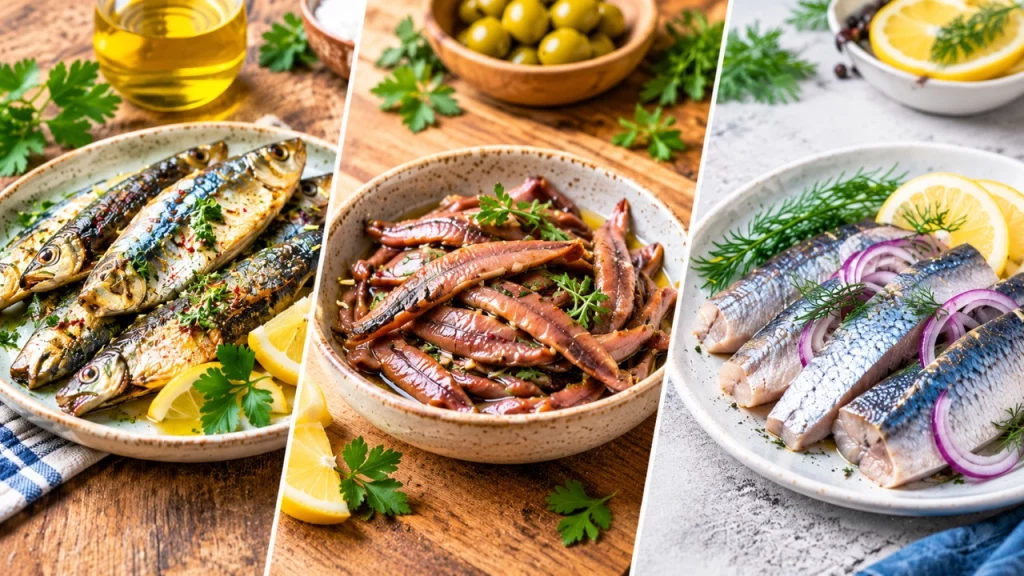
Ask around and most people will tell you sardines win, hands down — they top the charts for calcium and omega-3s, so case closed. That ranking falls apart the moment you ask “healthiest for whom.” A fish that’s a smart pick for a pregnant reader can be a genuine problem for someone managing gout, and a can that’s perfectly fine for blood pressure can trigger a migraine in someone sensitive to histamine. The real answer depends on the person, not the label.
- There’s no single winner — the right choice among sardines, anchovies, and herring depends on whether your concern is gout, blood pressure, pregnancy, or histamine reactions.
- All three are classified as purine-rich “fish meats,” the same category as organ meats, which matters far more for gout than most comparisons let on.
- “Low mercury” is a reassuring label, but the data behind it can be thinner than it sounds — a retail mercury study flagged outdated, small-sample national figures as a real limitation.
- Histamine, not sodium, is the overlooked trigger for migraine-prone or histamine-intolerant readers, and it depends more on handling and curing than on species.
The quick verdict, by condition
| Condition | Best approach | Why |
|---|---|---|
| Gout | Small, infrequent portions of any of the three | All three sit in the purine-rich “fish meat” category — species doesn’t change the category |
| High blood pressure | Fresh or no-salt-added canned versions | Sodium load depends on preparation, not which fish it is |
| Pregnancy | Any of the three, 2-3 servings weekly | All test in the lowest mercury tier, though “low” deserves a closer look (below) |
| Histamine sensitivity | Fresh or flash-frozen fillets over canned, cured, or pickled | Histamine builds with handling time and salt-curing, not with the species itself |
Worth noting: this table is a starting point, not a prescription. Someone managing both gout and high blood pressure at once needs to weigh both columns together, and a person who’s pregnant and also histamine-sensitive should lean toward fresh, quickly-chilled fillets rather than anything shelf-stable. The conditions don’t cancel each other out — they stack.
Gout: the purine problem nobody puts on the comparison chart
Every “sardines vs. anchovies vs. herring” ranking you’ve seen talks about omega-3s and calcium. Almost none mention purines, the compounds your body converts into uric acid — the substance that crystallizes in joints during a gout flare. A detailed analysis of purine content across 270 foodstuffs, using HPLC testing, found that purine-rich foods cluster into a predictable group: animal meats, fish meats, organ meats such as liver, and yeast. Fish meats as a category sit alongside organ meats — not alongside, say, chicken breast or tofu. Japan’s national guidance, cited in that same review, recommends keeping total daily purine intake under 400 milligrams to prevent gout and hyperuricemia. A few ounces of any small fish, especially when it’s the main protein at a meal, can take up a meaningful slice of that daily allowance before you’ve added anything else.
A systematic review of cohort studies on seafood intake and gout risk, looking across multiple populations found a consistent association between higher seafood consumption and elevated uric acid or gout incidence, reinforcing that this isn’t a quirk of one food-composition table — it shows up in real-world intake data too. That matters for how you read portion advice. It’s not that sardines are “bad” and herring is “better,” or vice versa; it’s that anyone with a history of gout flares is working with a tighter daily purine budget regardless of which of the three ends up on the cracker. A practical way to apply this: treat any of the three as a flavor component or occasional protein rather than a nightly staple, and pay attention to what else is on the plate. A dinner that pairs sardines with a beer and a plate of mussels is stacking purine sources from three directions at once, even though each item alone might look moderate.
This category guidance also explains why gout advice and general “heart-healthy” advice sometimes talk past each other. A cardiologist recommending oily fish for omega-3 intake isn’t wrong, and a rheumatologist advising caution around purine-rich fish isn’t wrong either — they’re optimizing for different outcomes. Someone with both a cardiovascular history and a gout history has to split the difference, which usually means smaller portions eaten less often rather than cutting these fish out entirely.
Blood pressure: it’s the can, not the fish
Sodium content in sardines, anchovies, and herring swings wildly depending on how the fish was processed, and that swing has almost nothing to do with the species itself. A fillet packed in oil with no added salt and a fillet cured in brine can carry very different sodium loads even though both are labeled the same fish. This is why blanket statements like “anchovies are high-sodium, herring is lower” don’t hold up well — an anchovy fillet rinsed of its curing salt and a herring fillet pickled in a salty brine can flip that comparison entirely.
For someone managing blood pressure, the practical move is to check the label for “no salt added” or “packed in water/oil” rather than picking a species based on reputation. Rinsing canned fish under water before eating it can also meaningfully cut the surface sodium, since a lot of it sits in the liquid and clings to the fillet rather than being absorbed deep into the flesh. This is a small habit, but it’s the kind of detail that actually moves the needle more than choosing sardines over herring or vice versa.
Pregnancy and mercury: why “low mercury” deserves a second look
All three of these fish routinely land in the lowest mercury tier of seafood advisories, which is genuinely reassuring and is part of why they show up so often on pregnancy-safe fish lists. But “low mercury” as a category label is built on sampling data, and sampling data has limits worth understanding rather than just trusting at face value. A study examining mercury levels in retail fish specifically flagged that some of the national reference figures used to classify fish as low-risk were based on older, smaller sample sets than you’d want for a recommendation that pregnant people lean on. That doesn’t mean the low-mercury classification is wrong — it almost certainly still holds directionally — but it’s a reminder that “low” is a statistical average across catches, seasons, and regions, not a guarantee for any individual can or fillet.
The practical takeaway for a pregnant reader isn’t to avoid these fish; it’s to treat the 2-3 servings a week guidance as a ceiling built with some margin already baked in, rather than a floor to hit every week without variation. Rotating between the three, and between these small fish and other low-mercury options entirely, spreads any uncertainty in the underlying sampling across a wider base rather than concentrating it in one weekly habit.
Histamine sensitivity: the variable most comparisons skip entirely
Histamine intolerance and migraine sensitivity are driven by how much histamine has built up in the flesh by the time it reaches your plate, and that’s primarily a function of time, temperature, and curing — not which of the three fish you picked. Fish in this family are naturally higher in free histidine, an amino acid that bacteria convert into histamine as the fish ages or sits at the wrong temperature. A fillet that’s filleted and frozen within hours of catch carries far less histamine than one that sat on ice for a day before processing, even if both end up in the same type of can. Research specifically examining histamine formation in fish products found that handling conditions and fermentation or curing steps were the dominant drivers of histamine accumulation, well above any baseline difference attributable to species.
That’s why the practical advice above favors fresh or flash-frozen fillets over canned, cured, or pickled versions for anyone prone to migraines or histamine reactions — it’s not about dodging a particular fish, it’s about dodging the processing steps most likely to let histamine accumulate. Someone who reacts badly to pickled herring might tolerate a fresh herring fillet cooked the same day without any issue at all, which is a distinction a simple species-based ranking can never capture.
Omega-3 content: close enough that it shouldn’t be the deciding factor
It’s worth saying plainly: differences in omega-3 content between sardines, anchovies, and herring are real but rarely large enough to be the thing that should drive your choice, especially once the condition-specific factors above are on the table. A broader look at fatty fish nutrient profiles found that small, oily fish in this category deliver comparably strong omega-3 and micronutrient profiles across species, with variation driven more by diet, season, and fat content at catch than by any inherent species advantage. In other words, the “sardines win on omega-3s” claim that opened this article is true in isolated lab comparisons, but it’s rarely true by a margin wide enough to override what actually matters for your specific health situation.
Putting it together
None of this is an argument for avoiding sardines, anchovies, or herring — all three are genuinely good, inexpensive sources of protein, calcium, and omega-3 fats, and dismissing them over any single concern would be overcorrecting. The point is narrower: the question “which of these three is healthiest” doesn’t have a stable answer independent of who’s asking. Swap in your own condition, check the table, and read the section that applies to you rather than trusting a generic ranking that was never built with your situation in mind.
Sources
- https://doi.org/10.1186/s42358-019-0067-7
- https://doi.org/10.1248/bpb.b13-00967
- https://doi.org/10.1016/j.scitotenv.2006.04.018
- https://doi.org/10.3390/foods15152590
- https://doi.org/10.1002/fsn3.71151
