Pumpkin Spice vs. Caramel Apple Coffee: Which Fall Drink Is Winning Over Americans?
Caramel apple is growing faster, but pumpkin spice still fills more cups — here's what that gap actually means for drinkers and chains.
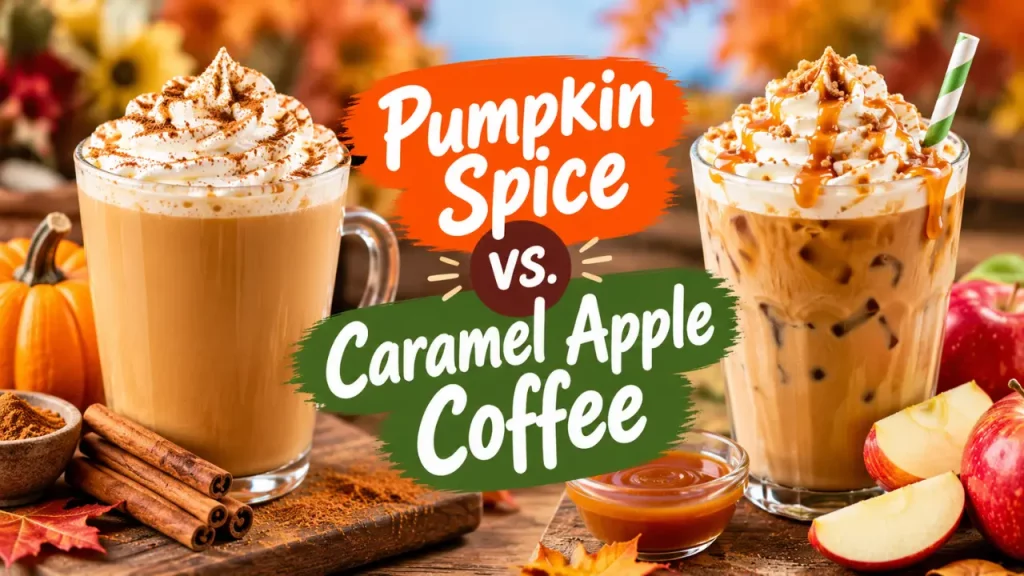
The espresso machine hisses twice, a cup gets marked with a sharpie, and the barista calls out “pumpkin” without even looking up. Behind her, a hand-written insert taped to the register reads “NEW: Caramel Apple Latte — Ask Me!” Nobody has asked yet this morning. It is the second week of September, the drive-thru line is already wrapped around the building, and almost every cup going out the window has the same orange sleeve. The new flavor is sitting on the counter looking a little lonely, waiting for its headline moment to turn into an actual order.
That gap — between what gets announced and what gets ordered — is the whole story of this fall’s coffee season.
Buzz is not the same as a sold cup
Pumpkin spice has been the default autumn drink in American coffee shops for so long that it barely needs marketing anymore; people walk in already knowing what they want. Caramel apple, by contrast, has been the thing people talk about this year — it is showing up in more new menu listings, getting more delivery-app orders relative to where it started, and drawing attention precisely because it is new. But talk and orders are two different currencies, and nothing available publicly actually puts a dollar figure or a cup count next to either drink at a chain level. No coffee company publishes “we sold X cups of pumpkin spice versus Y cups of caramel apple this fall,” so every comparison floating around right now is really a comparison of proxies — search interest, menu appearances, social posts — standing in for sales nobody has disclosed.
That matters because proxies can point in opposite directions from revenue. A flavor can dominate conversation and still ring up fewer transactions than a decades-old favorite that nobody bothers to post about because it is simply what they order every year without thinking.
The math problem hiding inside “growth”
When a new item posts a large growth percentage, that number is almost always measured against a small starting point. A drink that existed on a handful of menus last year and triples its presence this year can report a huge percentage gain while still being available, and ordered, far less often than an item already on thousands of menus nationwide. Pumpkin spice’s position is the reverse: it is so established that its year-over-year growth number will always look modest, because it is already close to saturating the market of people who want it. A flavor cannot grow 99 percent of something that was already everywhere.
This is why “fastest growing” and “most sold” can both be true at once without contradicting each other. Caramel apple can genuinely be the fastest-growing fall flavor in percentage terms while pumpkin spice still accounts for the overwhelming majority of actual fall-flavored cups sold industry-wide. Growth rate tells you about momentum and trend direction. It tells you nothing about volume, and volume is what pays a barista’s wages.
Who actually orders which
The clearest way to make sense of the split is to stop asking “which drink is winning” as if there were one answer, and start asking who each drink is winning. Pumpkin spice behaves like a tradition — it draws people who treat the first pumpkin latte of the season as a small ritual marking the change in weather, and that ritual habit tends to be strongest among longtime regulars who have ordered the same thing every September for years. Caramel apple behaves more like a novelty purchase — it draws people curious to try something new, often triggered by seeing it mentioned online or recommended on a delivery app, which is exactly why it shows up disproportionately in impulse and delivery orders rather than habitual counter orders. Neither pattern is universal, and plenty of individual drinkers break the mold in both directions, but the underlying mechanism — ritual versus curiosity — explains why the two flavors can both be “winning” without actually competing for the same customer on the same morning.
Why McDonald’s moved and Starbucks didn’t
McDonald’s dropping its pumpkin spice latte in favor of a caramel apple pie drink looks, from a distance, like a signal that the industry is turning away from pumpkin spice. It is more accurately read as a company-specific bet. McDonald’s does not need its fall drink to outsell Starbucks’ pumpkin spice latte; it needs its fall drink to feel distinct from Starbucks’ pumpkin spice latte, because going head to head on the same flavor against the chain most associated with it is a losing comparison before the first cup is poured. A caramel apple pie drink also ties neatly into McDonald’s existing dessert menu in a way pumpkin spice never did. Starbucks, meanwhile, has no incentive to abandon the flavor it effectively made into a cultural institution — it would be leaving its own signature on the table. Read that way, one chain’s menu swap is a positioning decision, not evidence of a wider industry retreat from pumpkin spice.
What this actually means at the counter
For a drinker trying to decide what to order, the practical takeaway is simple: if you want the flavor most likely to be consistent, available everywhere, and made correctly by a barista who has pulled that exact recipe a thousand times this month, pumpkin spice remains the safer bet. If you want to try something while it is still being refined and promoted, and you don’t mind some variation in how different shops execute it, caramel apple is the more interesting order right now, particularly through delivery apps where it is overrepresented relative to in-store counter sales.
For a coffee shop or chain deciding what to stock, the honest answer is to carry both but budget for them differently. Pumpkin spice is the volume play — the drink you prep for in bulk because the demand is proven and repeat-purchase habits are already built in. Caramel apple is the trial play — worth menuing to capture curious customers and delivery traffic, but not yet something to bet the season’s syrup budget on until a full year of sales, not search trends, says otherwise.
Back at the counter, the barista finally gets her first caramel apple order around eleven, right between a run of six pumpkin spice lattes. She makes it carefully, slower than the others, still learning the steps. The orange sleeves keep piling up by the register anyway, cup after cup, the quiet math of an old favorite still outselling the drink everyone’s been talking about.

James Carter
The EverBBQ editorial desk — covering BBQ news, features and everything off the grill.