Cheddar vs. Mozzarella: Which Has More Protein and Calories?
A standardized protein-per-calorie and protein-per-sodium ranking across every cheddar and mozzarella variant, with the sat-fat evidence left unfinished elsewhere.
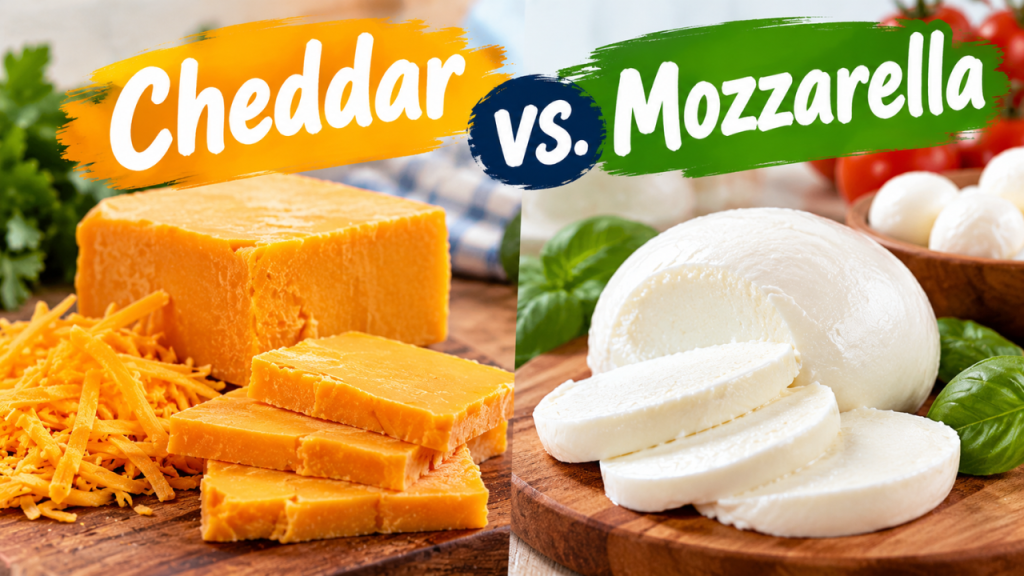
An ounce of fresh mozzarella can carry as little as 18 milligrams of sodium. The same ounce of regular cheddar carries roughly ten times that. Nobody puts those two numbers side by side, because most comparisons stop at “cheddar has more sodium” without ever finishing the sentence. Once you do finish it — and once you run protein against calories, saturated fat, and sodium for every common variant of both cheeses — the “healthier cheese” answer changes depending on what you’re actually trying to protect: your waistline, your blood pressure, or your arteries.
1. The direct answer: protein and calories, variant by variant
Per 1 ounce (28 g), standard USDA-style values look like this:
| Cheese | Calories | Protein (g) | Sat fat (g) | Sodium (mg) |
|---|---|---|---|---|
| Cheddar, regular | 115 | 7 | 6.0 | 176 |
| Cheddar, sharp | 113 | 7 | 5.9 | 180 |
| Cheddar, reduced-fat/2% | 70 | 8 | 2.0 | 220 |
| Mozzarella, whole milk | 85 | 6 | 3.7 | 178 |
| Mozzarella, part-skim | 72 | 7 | 2.8 | 175 |
| Mozzarella, fresh (in water) | 75 | 5.5 | 3.4 | 18 |
So regular cheddar and part-skim mozzarella deliver almost identical protein, but cheddar costs 43 more calories to get it. Reduced-fat cheddar flips the whole comparison, which is the piece most side-by-side articles never run.
2. The protein-per-calorie ranking nobody finishes
Dividing grams of protein by calories (expressed per 100 kcal) gives a single, comparable number:
- Reduced-fat cheddar: 11.4 g protein per 100 kcal
- Part-skim mozzarella: 9.7 g per 100 kcal
- Fresh mozzarella: 7.3 g per 100 kcal
- Whole milk mozzarella: 7.1 g per 100 kcal
- Regular or sharp cheddar: 6.1 g per 100 kcal
For someone counting calories, reduced-fat cheddar is the actual winner, not part-skim mozzarella — it edges out mozzarella by roughly 17% more protein per calorie, almost double what full-fat cheddar delivers. Sharp cheddar does not meaningfully change the ranking; its “stronger flavor, smaller portion” advantage is real, but gram for gram its nutrient profile matches plain cheddar almost exactly.
3. The sodium comparison, finished
Protein per 100 mg of sodium tells a different story than protein per calorie:
- Fresh mozzarella: about 30.6 g protein per 100 mg sodium
- Part-skim mozzarella: 4.0 g per 100 mg sodium
- Regular cheddar: 4.0 g per 100 mg sodium
- Reduced-fat cheddar: 3.6 g per 100 mg sodium
- Whole milk mozzarella: 3.4 g per 100 mg sodium
Fresh mozzarella isn’t a close winner here, it’s a different category entirely — roughly seven to eight times more protein per milligram of sodium than any aged cheese, cheddar included. That’s because fresh mozzarella is barely salted and sold packed in water rather than brined and aged like cheddar or low-moisture mozzarella. Reduced-fat cheddar, meanwhile, is the one variant where cutting fat actually raises sodium, since manufacturers often add salt back for flavor once fat is removed.
4. Why reduced-fat cheddar changes the entire conversation
Most comparisons of cheddar and mozzarella leave out 2% or reduced-fat cheddar entirely, which skews the “cheddar is worse” framing. At 70 calories and 2 g of saturated fat per ounce, reduced-fat cheddar has less than a third the saturated fat of regular cheddar and comes in lighter than even part-skim mozzarella. The tradeoff is sodium (220 mg per ounce, the highest of any variant listed here) and, for many people, a noticeably blander, rubberier texture that makes it harder to use in small amounts the way sharp cheddar is used.
5. What the saturated fat research actually says
The instinctive “cheddar has more saturated fat, so it’s worse for your heart” line skips past a decade of research that complicates it. A systematic review of saturated fatty acid chain length found that long-chain saturated fats, including palmitic and stearic acid from meat and cheese, were linked to higher cardiovascular disease risk, while short- and medium-chain saturated fats showed a neutral or even potentially beneficial association — and replacing saturated fat with refined carbohydrates raised cardiovascular risk rather than lowering it.
A separate review of saturated fat replacement strategies reported that dairy fat from milk and cheese carries a slightly lower cardiovascular risk than fat from meat, though still a higher risk than unsaturated fats when directly substituted. A small observational study of cheese consumption in elderly women found no association at all between cheese intake and carotid artery thickness, a marker of early atherosclerosis, even though yogurt intake was linked to thinner arteries in the same group — worth noting as early and observational, not proof of safety or harm.
More broadly, a comprehensive review of randomized controlled trials on dairy fat concluded there was no apparent harmful effect of dairy consumption on cardiometabolic risk factors regardless of fat content, and a meta-analysis of saturated fat food sources and mortality found that high intakes of milk, cheese, yogurt, and butter were not significantly associated with higher mortality, unlike processed meat. None of this means cheddar’s extra saturated fat is irrelevant — it means the blanket “more sat fat equals worse” framing oversimplifies evidence that is genuinely mixed and food-source specific.
6. Who should actually avoid each one
People managing hypertension or on a sodium-restricted diet should treat both aged cheddar and low-moisture mozzarella as sodium-dense foods at 175 to 220 mg per ounce; fresh mozzarella, at roughly a tenth of that sodium load, is the far safer everyday choice for this group, not a minor variation.
People with lactose intolerance generally tolerate both cheeses reasonably well, since aging reduces lactose content, but very fresh mozzarella retains more moisture and slightly more lactose than aged cheddar, so those with more severe intolerance may notice a difference between the two. Anyone tracking saturated fat intake specifically — rather than sodium or lactose — gets the biggest single change from switching to reduced-fat cheddar or part-skim mozzarella, both of which cut saturated fat by more than half compared with their full-fat versions without sacrificing protein.
There isn’t one correct cheese here, only a correct cheese for the number you’re trying to control. Reduced-fat cheddar wins on protein per calorie. Fresh mozzarella wins on protein per milligram of sodium, by a wide margin. Regular cheddar and part-skim mozzarella land close enough on most measures that the deciding factor should probably be sodium sensitivity or simply which one you’ll actually eat in a sensible portion.
Sources
- Saturated Fatty Acid Chain Length and Risk of Cardiovascular Disease: A Systematic Review (2022)
- Saturated Fatty Acids and Cardiovascular Disease: Replacements for Saturated Fat to Reduce Cardiovascular Risk (2017)
- Association between yogurt, milk, and cheese consumption and carotid artery intima-media thickness (2011)
- Comprehensive Review of the Impact of Dairy Foods and Dairy Fat on Cardiometabolic Risk (2016)
- Food sources of saturated fat and the association with mortality: a meta-analysis (2013)
