Roasted Makhana vs Potato Chips vs Popcorn: Which Is Healthiest?
Real USDA gram-for-gram numbers for makhana, popcorn and chips — plus who should skip the "healthy" snacks entirely.
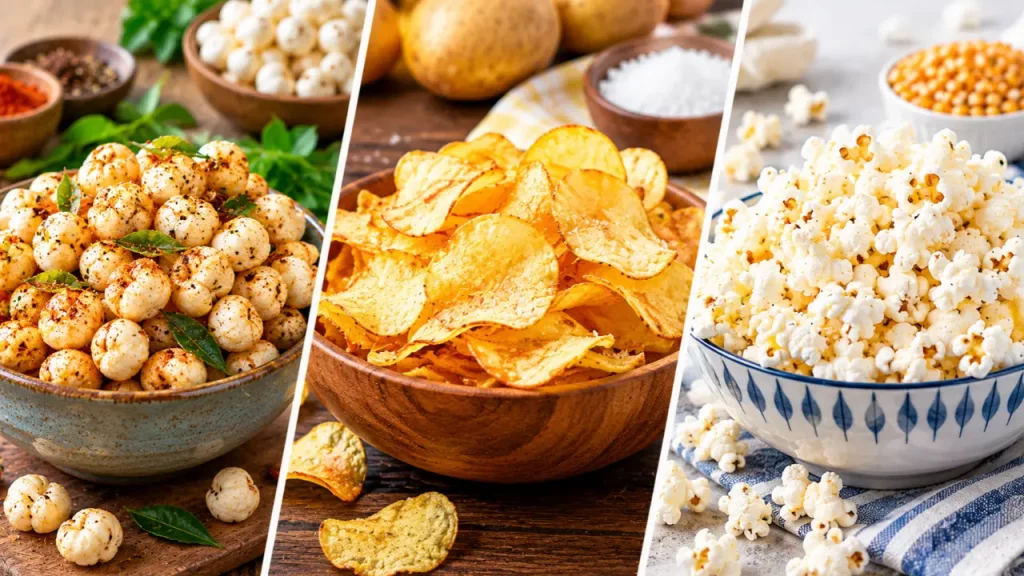
Gram for gram, roasted makhana and air-popped popcorn land almost on top of each other on a nutrition label — which means the real decision isn’t about calories at all, it’s about which one your body specifically tolerates.
Most comparisons stop at “chips bad, popcorn and makhana good.” That’s true as far as it goes. But nobody puts the actual numbers side by side, and nobody mentions that makhana and popcorn each carry their own specific risk for certain people — not hypothetical risk, documented physiological reasons. Here’s the version with the numbers attached.
Myth: You can’t really compare these snacks without vague “approximate” numbers
You can, because the USDA already measured them. Here is what a realistic 28 g (1 oz) serving — roughly a small handful — actually contains, according to USDA data on raw lotus seeds (makhana) and USDA data on air-popped popcorn:
| Per 28 g serving | Makhana (raw) | Air-popped popcorn |
|---|---|---|
| Energy | 25.2 kcal | 110 kcal |
| Total fat | 0.15 g | 1.29 g |
| Sodium | 0.28 mg | 2.27 mg |
| Fiber | not listed separately | 4.11 g |
| Protein | 1.17 g | 3.66 g |
| Carbohydrate | 4.9 g | 22.1 g |
Notice the gap: raw makhana is almost calorie-free by snack standards, while unbuttered popcorn is more than four times the energy per equal weight — not “a bit higher,” genuinely four-fold. But popcorn also packs 4.11 g of fiber per 28 g, which makhana doesn’t come close to, so the calories buy you satiety. Both are near-zero on sodium in their raw/unsalted form — the sodium number people worry about almost entirely comes from what’s added in the pan, not the food itself.
Potato chips don’t have an equivalent clean USDA line in this comparison because their composition swings wildly by brand, oil, and frying time — which is exactly the point of the next section.
Myth: Chips are only a problem because of fat and sodium
Fat and salt are the least of it. A 2024 analysis of 120 potato chip samples across 40 brands in Kermanshah, Iran found that the acrylamide content of potato chips and the resulting health risk stayed under the safety threshold for adults in every brand tested, but for children, 31 of the 40 brands (77.5%) exceeded the safe non-carcinogenic risk threshold, and every single brand exceeded the cancer-risk benchmark for children specifically. Separately, research measuring acrylamide and heavy metals in potato and corn chips found acrylamide levels roughly 3,500 times higher than the permissible limit set for drinking water, with daily intake estimated at 7 to 40 times the WHO’s carcinogenic risk-intake benchmark. A 2014 review raised concern specifically about fried potato chip consumption in children, given how frequently kids eat them relative to body weight.
That said, two large prospective cohort studies push back on how alarming this is in practice. A Health Professionals Follow-Up Study tracking 47,896 US men found no meaningful link between dietary acrylamide and prostate cancer over 20 years. A Nurses’ Health Study II cohort of 90,628 women similarly found no significant association between acrylamide intake and premenopausal breast cancer (relative risk 0.92, confidence interval crossing 1). So: the chemical is there, the lab risk models flag it, but the long-term human cohort data hasn’t confirmed a cancer signal at typical consumption levels. Treat chips as the clear last-place snack on calories and processing — not because they’re a proven carcinogen source in adults, but because the acrylamide risk is real for children and the fat/calorie load is the highest of the three by a wide margin.
Myth: Makhana has no downside — it’s just protein and minerals
For most people, that’s close to true — low fat, low sodium, a reasonable 4.13 mg of iron and 56 mg of magnesium per 100 g. But makhana, like other lotus-seed and water-chestnut-family foods, carries calcium oxalate compounds. For anyone with a history of calcium-oxalate kidney stones, regular high-volume intake of oxalate-containing foods is a recognized dietary risk factor doctors already screen for — it’s not a popular detail, but it’s not a secret from nephrology either. If you’ve had a kidney stone before, this is the snack to moderate, not the chips.
Myth: Popcorn is the universal safe choice
It’s safe for most digestive systems, but not all. The hard, fibrous hulls that give popcorn its 4.11 g of fiber per 28 g are the same hulls that can lodge in dental work, aggravate existing gum issues, or get physically trapped at the site of small colon pouches in people prone to diverticulitis. The same roughage that’s a fiber win for most adults is a specific, named caution for anyone with active GERD (the hull fragments and oil residue can trigger reflux) or a diverticulitis history. None of this shows up in the typical “popcorn is healthy” write-up, but it’s a standard caution given to people in those groups.
Myth: All three snacks hit blood sugar the same way
They don’t, and the fiber numbers explain why. Popcorn’s 4.11 g of fiber per 28 g slows glucose absorption more than makhana’s mostly-starch 4.9 g of carbohydrate per 28 g, which has comparatively little fiber to buffer it. Neither snack has a clinical glycemic-index trial in the evidence here, so treat this as a reasoned inference from USDA composition data rather than a tested blood-sugar study — but the direction is consistent: more fiber per gram of carbohydrate generally means a gentler rise. For diabetics choosing between the two, popcorn’s fiber cushion is the more defensible pick, with the caveat that butter and sugar toppings erase that advantage instantly.
Myth: There’s no real answer to “can I eat 10 makhana a day?”
A typical roasted makhana piece weighs roughly 1 gram, so 10 pieces is roughly 10 g — about a third of the 28 g serving in the table above. Scaling the USDA numbers down, that’s approximately 9 kcal, under 0.1 g of fat, and essentially no sodium in its plain roasted form. For almost anyone without an oxalate-related kidney stone history, 10 makhana a day is nutritionally trivial — the real calorie load comes from how much ghee or oil they’re roasted in, not the seed itself.
So which is “healthiest”? On raw numbers, makhana and popcorn are both far ahead of chips — but the honest answer depends on what your body already struggles with. Which of these three would you actually have to give up first?
Sources
- USDA FoodData Central: Seeds, lotus seeds, raw (nutrient data)
- USDA FoodData Central: Snacks, popcorn, air-popped (nutrient data)
- Acrylamide in potato chips in Iran, health risk assessment and mitigation (2024)
- Carcinogenic and neurotoxic risks of acrylamide and heavy metals from potato and corn chips (2015)
- Potato chips and childhood: what does the science say? (2014)
- Dietary acrylamide and risk of prostate cancer (2012)
- Dietary acrylamide intake and risk of premenopausal breast cancer (2009)

James Carter
The EverBBQ editorial desk — covering BBQ news, features and everything off the grill.