Matcha vs Green Tea vs Chai: Caffeine, Nutrition, and Flavor Compared
Real mg-per-cup caffeine ranges, the cortisol question answered with evidence, and who should actually skip matcha, chai, or green tea.
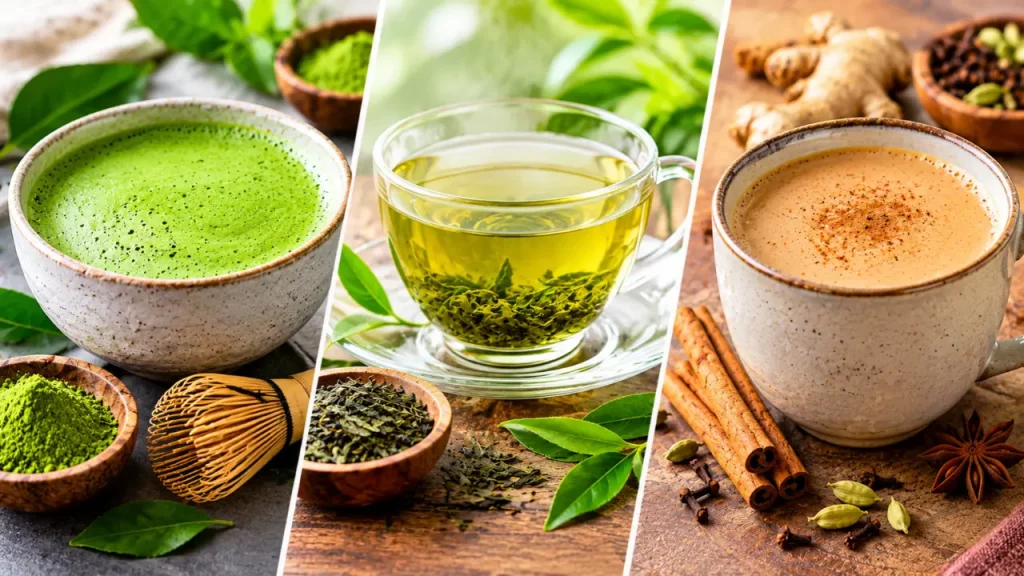
It’s 2:47 in the afternoon. You’ve got a headache creeping in behind your eyes, a meeting in ten minutes, and three tins on the counter: matcha, loose green tea, chai concentrate. You grab the one that sounds the least likely to keep you staring at the ceiling at midnight — but you’re guessing, because nobody ever tells you the actual numbers.
The caffeine math nobody shows you
Here’s the part every comparison skips: real milligrams, per real cup, not vague words like “more” or “less.” An 8-ounce brewed coffee typically runs around 95 mg of caffeine. An 8-ounce cup of black tea — the base of most chai — lands around 47 mg, though a spiced chai made with a strong concentrate or extra tea bags can push higher. Steeped green tea, where you drink the infused water and toss the leaves, usually comes in lower, around 28 mg. Matcha sits above both of those, often around 70 mg per cup, because you’re drinking the whole ground leaf instead of a diluted extract of it.
Those are typical ranges, not fixed numbers — brew time, leaf quality, and how much powder you scoop will swing them. But the order matters more than the exact digit: matcha usually beats green tea by roughly double, and chai usually lands in the middle, closer to black tea’s number, especially once milk dilutes the cup further.
If you want to check the raw data yourself instead of taking a tea company’s marketing copy at face value, the USDA’s own nutrient entries for brewed coffee, brewed green tea, and matcha are worth bookmarking, especially if you’re also watching something else in the cup — sodium in a store-bought chai concentrate, for instance, or the carbohydrate count in a sweetened matcha latte — since the caffeine line is only one row in a much longer nutrient panel.
Here’s a concrete version of the 2:47 problem: if that headache is actually mild caffeine withdrawal rather than low blood sugar, switching cold from your usual coffee to steeped green tea cuts your intake by roughly two-thirds in a single move — enough to make the headache worse for an hour before it gets better. A gentler way to taper is chai, then black tea, then green tea, then decaf, spread across a week, rather than jumping straight to matcha, which despite being marketed as “just tea” delivers almost as much caffeine as the coffee you’re trying to cut back on. None of this matters much, though, if you’re already drinking three coffees a day — at that level of tolerance, the gap between 47 mg and 95 mg in one afternoon cup is noise your body won’t register.
Does matcha actually spike cortisol?
This gets searched constantly and almost never answered. A systematic review mapping matcha and green tea compounds against stress hormones looked specifically at cortisol, testosterone, and the testosterone-to-cortisol ratio across studies using matcha, brewed green tea, isolated L-theanine, and concentrated EGCG. Its conclusion wasn’t a clean yes or no — it found the existing evidence fragmented, because these preparations aren’t chemically interchangeable, and it proposed ranking drinks by their ratio of caffeine-plus-EGCG to calming compounds like L-theanine as a better way to predict stress response than treating “tea” as one thing.
A separate randomized placebo-controlled trial in middle-aged and older adults compared matcha directly against plain caffeine under mild induced stress. A single dose of caffeine improved attention during and after the stress task. The reaction-time improvement seen after a single dose of matcha was judged to likely come from its caffeine content, not some separate matcha-specific effect. The twist: after continuous daily intake, the matcha group showed gains in sustained work output that the caffeine-only group didn’t match. So the honest answer is — matcha’s caffeine behaves like caffeine in the short term, but regular use over time may do something caffeine alone doesn’t, at least for attention and output. That’s not proof it blunts a cortisol spike; it’s proof the short-term hormone panic isn’t backed by strong direct evidence either way yet.
The physiological reason this question even gets asked is straightforward: caffeine on its own does prompt a short rise in circulating cortisol in most people, which is why the “matcha causes a cortisol spike” claim spreads so easily online — it’s half-right about the caffeine and silent about the L-theanine riding along with it in the same cup. Where this genuinely matters is narrow: if you’re having morning cortisol checked for a medical workup, or doing a saliva cortisol awakening test, drink your matcha after the sample, not before, since caffeine timing can shift the reading regardless of what the longer-term research eventually settles on.
The iron and zinc absorption problem
This is the part that matters if you’re anemic, pregnant, or eating a plant-based diet and leaning on supplements. Catechins — the compounds matcha delivers in far larger doses than steeped green tea — bind metals. A lab study on human liver cells found that the green tea catechin EGCG binds zinc even more strongly than a dedicated zinc-chelating agent, and it reduced how much zinc the cells actually absorbed. That’s cell-level evidence, not a human feeding trial, but it confirms the mechanism is real.
Whether that mechanism actually moves the needle on iron status in real people is less settled. A small pilot trial in 17 women with obesity gave 400 mg of EGCG daily for eight weeks and tracked ferritin, hepcidin, and iron saturation. After correcting for multiple comparisons, none of the iron markers moved significantly. So: the chelation mechanism is proven in cells, but an eight-week human trial at a concentrated dose didn’t confirm it translates into a measurable drop in iron status in this group, over this length of time, at this dose.
What that leaves you with is a mechanism that’s real but a real-world effect that’s still unproven at typical intake levels. The practical, low-cost response is timing rather than avoidance: if you take an iron or zinc supplement, or eat an iron-heavy meal like red meat or lentils, leave an hour or two before or after your matcha or strong green tea, since catechin binding happens in the gut at the point of absorption, not after the mineral is already in your bloodstream. This is a caveat worth taking seriously if your ferritin is already low, you’re pregnant, or you’re vegetarian and iron is already a tight margin for you. It’s far less relevant if your iron panel is normal and you eat meat regularly, since the binding effect would have to be large and constant to meaningfully dent mineral stores that are already well-stocked — and the eight-week trial above suggests, at least at that dose, it isn’t.
The weight-loss claims on the tin
Matcha and green tea extract are routinely marketed with “boosts metabolism” language, usually leaning on the same catechins discussed above. A recent review examining tea catechins in relation to body weight pooled the available human research rather than relying on the cell-and-rodent studies that packaging copy tends to cite. The pattern that emerges across that body of work is modest and inconsistent effect sizes — nowhere close to the kind of reliable, sizeable change that would justify treating a daily matcha habit as a weight-management strategy on its own. That doesn’t make the drink pointless; it just means the caffeine-for-alertness case is on firmer ground than the catechins-for-fat-loss case, and the two shouldn’t be sold as the same benefit.
Who actually needs to think about any of this
Most of what’s above is irrelevant noise for someone who drinks one cup of whichever tea they like and eats a varied diet with no diagnosed deficiencies. The people who should actually adjust behavior are narrower: those managing anemia or low ferritin, pregnant people whose iron needs are already elevated, anyone with a medical cortisol test scheduled, and people who are unusually caffeine-sensitive and currently guessing at doses instead of checking them. Everyone else can treat the 2:47 tin choice as a matter of taste and timing — chai or black tea for a gentler afternoon lift, green tea for the lowest-caffeine option that still counts as “tea,” matcha when you actually want something closer to coffee in a different format.
Sources
- https://fdc.nal.usda.gov/food-details/173230/nutrients
- https://fdc.nal.usda.gov/food-details/171910/nutrients
- https://fdc.nal.usda.gov/food-details/174155/nutrients
- https://doi.org/10.1002/mnfr.70575
- https://doi.org/10.1111/obr.70173
- https://doi.org/10.3390/nu13051700
- https://doi.org/10.1016/j.jnutbio.2009.12.009
- https://doi.org/10.3389/fnut.2026.1925871

Mick Hudson
Low-and-slow recipes, rubs, sauces and fire management from our pitmaster team.